


In short ⚡
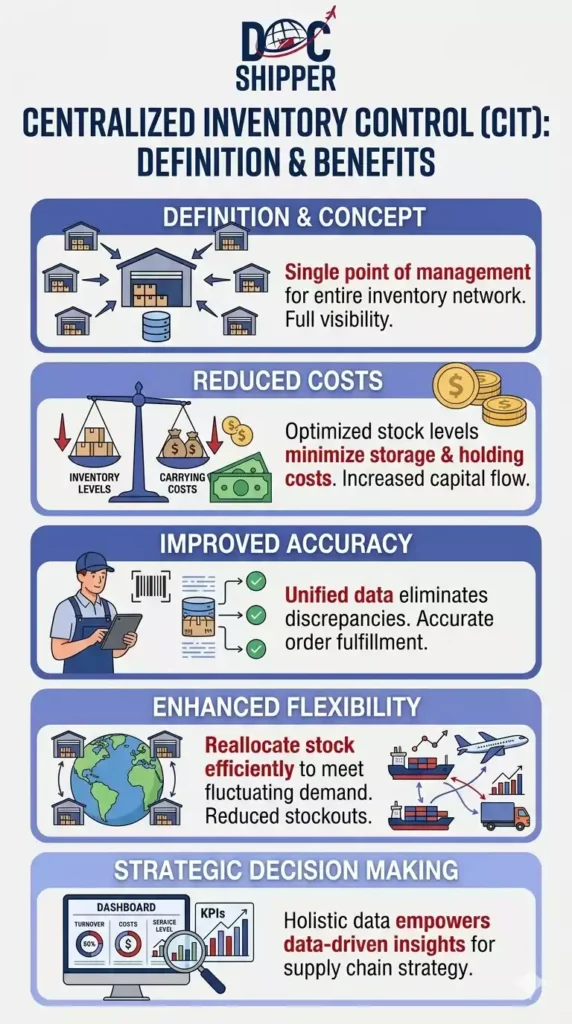
Centralized Inventory Control (CIT) is a supply chain management strategy where inventory monitoring, ordering, and distribution decisions are managed from a single, central location. This approach consolidates stock visibility across multiple warehouses, stores, or distribution centers, enabling unified decision-making and optimized resource allocation throughout the entire logistics network.
Introduction
Many international businesses struggle with inventory fragmentation—excess stock in one location while facing shortages in another. This disconnect creates unnecessary costs, delays customer fulfillment, and complicates compliance tracking across borders.
Centralized Inventory Control addresses these challenges by establishing a single command center for inventory decisions. This approach becomes essential when managing import/export operations across multiple countries, customs jurisdictions, and distribution points.
Key characteristics of effective CIT systems include:
- Real-time visibility across all storage locations and transit inventory
- Unified forecasting that accounts for regional demand patterns and lead times
- Centralized purchasing to leverage economies of scale and supplier negotiations
- Coordinated replenishment that optimizes transportation costs and customs clearance
- Standardized processes for inventory valuation, tracking, and compliance reporting
Strategic Mechanisms & Implementation Framework
Centralized Inventory Control operates through integrated technology platforms that connect warehouse management systems, transportation management, and enterprise resource planning. The central control unit receives continuous data feeds from all nodes in the distribution network.
The decision hierarchy typically follows a three-tier structure. Strategic decisions (supplier selection, network design) occur at corporate headquarters. Tactical decisions (monthly replenishment, allocation rules) happen at regional hubs. Operational execution (picking, packing, shipping) remains at local facilities, but follows centrally-defined protocols.
From a compliance perspective, CIT simplifies customs documentation and duty management. A centralized system maintains master records of harmonized system codes, certificates of origin, and preferential trade agreements. This reduces classification errors that trigger customs penalties. According to EU Customs regulations, consistent documentation across shipments accelerates clearance and reduces inspection rates.
The financial benefits stem from reduced safety stock requirements. When inventory is managed locally, each location maintains buffer stock to handle demand uncertainty. Centralized control applies statistical pooling—aggregate demand variance is lower than the sum of individual variances. This mathematical principle allows companies to maintain the same service level with 15-30% less total inventory.
Technology integration requires connecting disparate systems through APIs or middleware platforms. Modern CIT solutions use cloud-based architectures that provide role-based access to stakeholders across the supply chain. At DocShipper, we help clients implement inventory visibility platforms that integrate with their existing ERP systems, ensuring seamless data flow from overseas suppliers through to final delivery points.
The organizational structure must support centralized decision-making while maintaining local operational flexibility. This typically involves establishing a supply chain control tower staffed by demand planners, inventory analysts, and logistics coordinators who monitor network performance and make allocation decisions based on real-time data.
Real-World Applications & Performance Data
Consider a consumer electronics company importing products from Asia to serve European markets. Under decentralized control, each country subsidiary managed its own inventory, resulting in frequent stock imbalances and expedited air freight costs.
| Metric | Decentralized Model | Centralized CIT Model | Improvement |
|---|---|---|---|
| Total Inventory Value | €12.5M | €9.2M | 26% reduction |
| Stock-out Rate | 8.3% | 3.1% | 63% reduction |
| Expedited Freight Costs | €420K/year | €145K/year | 65% reduction |
| Inventory Turns | 4.2x | 6.8x | 62% increase |
| Order Fulfillment Time | 5.2 days | 3.8 days | 27% faster |
Another practical scenario involves a fashion retailer with seasonal collections. The centralized system analyzes sell-through rates across all stores and redistributes inventory from slow-moving to high-demand locations. This dynamic allocation reduced end-of-season markdowns by 18% while improving in-stock rates during peak selling periods.
For companies engaged in cross-border e-commerce, CIT enables sophisticated fulfillment strategies. A single order management system determines the optimal fulfillment location based on inventory availability, shipping costs, and estimated delivery times. This approach reduces split shipments and improves customer experience.
In the pharmaceutical sector, where regulatory compliance and expiration date management are critical, centralized control ensures first-expired-first-out (FEFO) logic across the entire network. A major distributor reduced product write-offs by €2.3M annually after implementing centralized batch tracking and automated expiration alerts.
DocShipper recently assisted a manufacturing client in transitioning from regional inventory management to a centralized European hub model. By consolidating safety stock and implementing demand-driven replenishment, the client achieved a 22% reduction in working capital while improving service levels across all markets.
Conclusion
Centralized Inventory Control transforms fragmented stock management into a coordinated, data-driven system that reduces costs, improves service levels, and simplifies compliance in international logistics. The strategic benefits extend beyond inventory reduction to encompass better cash flow, faster response to market changes, and enhanced visibility across the supply chain.
Need expert guidance on implementing centralized inventory strategies for your international operations? Contact DocShipper for tailored logistics solutions.
📚 Quiz
Test Your Knowledge: Centralized Inventory Control (CIT)
1. What best defines Centralized Inventory Control (CIT)?
2. A common misconception about CIT is that centralizing inventory decisions eliminates the need for local warehouse staff. What does CIT actually centralize?
3. A consumer electronics company imports goods from Asia to serve five European countries. Each country subsidiary manages its own stock, leading to frequent shortages in Germany while France holds excess inventory. Which approach best resolves this?
🎯 Your Result
📞 Free Quote in 24hFAQ | CIT (Centralized Inventory Control): Definition, Benefits & Practical Examples
Centralized control consolidates decision-making authority and inventory visibility at a single point, while decentralized systems allow each location to manage its own stock independently. Centralized approaches optimize across the entire network rather than individual sites.
Through statistical pooling effects—aggregate demand variance is lower than individual variances. This allows maintaining the same service level with less total safety stock. Centralized visibility also eliminates redundant buffer stock at multiple locations.
A cloud-based inventory management platform integrated with warehouse management systems, ERP, and transportation management software. Real-time data synchronization and analytics capabilities are essential for effective centralized decision-making.
Yes, even businesses with 2-3 locations can benefit from unified visibility and coordinated replenishment. Modern SaaS solutions offer scalable CIT capabilities without requiring large IT investments.
Centralized systems maintain standardized product classifications, origin certificates, and trade agreement documentation. This consistency reduces customs clearance delays and minimizes the risk of classification errors that trigger penalties.
Organizational resistance from local managers losing autonomy, integration complexity with legacy systems, data quality issues, and the need for process standardization across locations. Change management is as critical as technology implementation.
Implementation timelines range from 6-18 months depending on network complexity, system integration requirements, and organizational readiness. Phased rollouts starting with pilot locations often yield better results than big-bang approaches.
No, local operations teams remain essential for receiving, storage, picking, and shipping activities. Centralization affects planning and allocation decisions, not physical warehouse operations. Local staff execute centrally-defined strategies.
Advanced forecasting algorithms account for regional patterns, seasonality, and local market characteristics. The central system optimizes global inventory positioning while respecting regional demand profiles and lead time differences.
Key performance indicators include inventory turnover rate, stock-out frequency, fill rate, working capital invested in inventory, expedited freight costs, and forecast accuracy. Regular comparison against pre-implementation baselines demonstrates value.
Absolutely. Many companies implement CIT while outsourcing warehousing to 3PLs. The central control system integrates with 3PL warehouse management systems to maintain visibility and coordinate replenishment across outsourced facilities.
Properly implemented centralized control improves service levels by reducing stock-outs, enabling faster replenishment, and allowing inventory transfers between locations to meet demand. Network-wide visibility prevents localized shortages while other locations hold excess stock.
Need Help with
Logistics or Sourcing ?
First, we secure the right products from the right suppliers at the right price by managing the sourcing process from start to finish. Then, we simplify your shipping experience - from pickup to final delivery - ensuring any product, anywhere, is delivered at highly competitive prices.


Fill the Form
Prefer email? Send us your inquiry, and we’ll get back to you as soon as possible.
Contact us




:%20Definition,%20Benefits%20&%20Practical%20Examples)