


In short ⚡
Direct Store Delivery (DSD) is a distribution model where manufacturers or suppliers deliver products directly to retail stores, bypassing traditional distribution centers. This streamlined approach reduces handling time, ensures product freshness, and allows suppliers to maintain greater control over merchandising and inventory management at the point of sale.Introduction
Many businesses struggle with supply chain inefficiencies, delayed deliveries, and loss of product quality during multi-step distribution. Direct Store Delivery addresses these challenges by eliminating intermediary warehouses and establishing a direct link between manufacturers and retailers.
In international trade and logistics, DSD has become crucial for time-sensitive products, particularly in food, beverage, and pharmaceutical sectors. This model transforms traditional distribution by prioritizing speed, freshness, and supplier control over retail presentation.
- Reduced transit time: Products reach shelves faster without warehouse delays
- Enhanced product quality: Fewer touchpoints minimize handling damage and spoilage
- Supplier merchandising control: Manufacturers manage shelf placement and promotional displays
- Real-time inventory visibility: Direct contact enables immediate stock level assessment
- Cost structure variation: Eliminates warehousing fees but increases delivery frequency costs
DSD Mechanisms & Strategic Implications
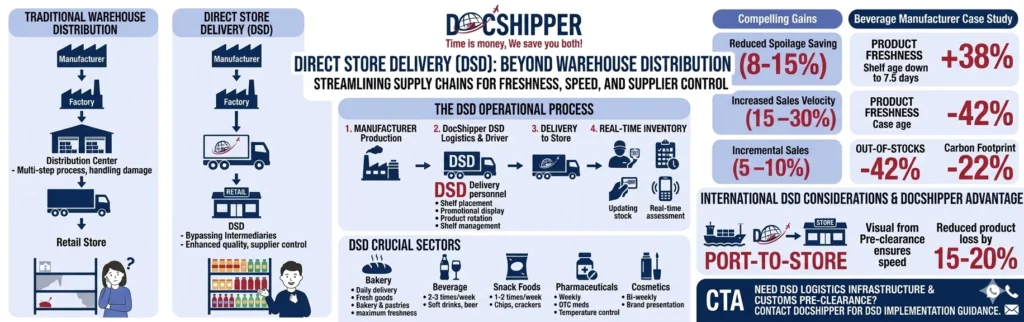
The operational framework of Direct Store Delivery requires manufacturers to maintain their own fleet or contract specialized logistics providers. Delivery personnel not only transport goods but also perform merchandising tasks, including shelf stocking, product rotation, and display setup.
From a regulatory perspective, DSD operations must comply with food safety standards (FDA regulations in the US, EU food law in Europe) and temperature control requirements for perishables. The supplier assumes responsibility for maintaining cold chain integrity from production facility to retail shelf. According to the FDA Food Safety Modernization Act, suppliers using DSD must implement preventive controls throughout the distribution process.
The contractual relationship between supplier and retailer differs significantly from traditional wholesale models. Retailers typically negotiate consignment terms or pay-on-scan arrangements, where payment occurs only when products sell. This shifts inventory risk to the supplier but provides retailers with zero-stock investment.
Technology integration plays a critical role in DSD efficiency. Route optimization software, handheld scanning devices, and real-time inventory management systems enable drivers to process orders, track deliveries, and update stock levels instantly. At DocShipper, we integrate DSD tracking systems with customs documentation platforms to ensure seamless international product flow and compliance verification.
The quality assurance dimension of DSD requires suppliers to implement rigorous product inspection protocols. Each delivery batch undergoes freshness checks, expiration date verification, and damage assessment before shelf placement. This direct oversight reduces the 15-20% product loss typically associated with warehouse-based distribution systems.
Concrete Examples & Industry Data
DSD models vary significantly across industries and product categories. Understanding these variations helps businesses determine whether this distribution strategy aligns with their operational capabilities and market positioning.
| Industry Sector | Typical Products | Delivery Frequency | Key Advantage | Primary Challenge |
|---|---|---|---|---|
| Bakery & Fresh Goods | Bread, pastries, tortillas | Daily (5-7 times/week) | Maximum freshness (24-48h shelf life) | High fuel and labor costs |
| Beverages | Soft drinks, beer, energy drinks | 2-3 times/week | Promotional display control | Heavy product weight logistics |
| Snack Foods | Chips, crackers, nuts | 1-2 times/week | Product rotation and shelf management | Seasonal demand fluctuations |
| Pharmaceuticals | OTC medications, vitamins | Weekly | Temperature control compliance | Regulatory documentation complexity |
| Cosmetics | Premium beauty products | Bi-weekly | Brand presentation consistency | Theft prevention and security |
Case Study: Beverage Manufacturer Efficiency Gains
A European soft drink producer implemented DSD across 2,400 retail locations. Results after 12 months:
- Product freshness improved by 38% (reduced average shelf age from 12 to 7.5 days)
- Out-of-stock incidents decreased by 42% through real-time inventory monitoring
- Promotional compliance increased to 94% (vs. 67% under warehouse distribution)
- Overall distribution costs rose by 18%, offset by 31% sales volume increase
- Carbon footprint reduced by 22% through optimized delivery routes
International DSD Considerations: When implementing DSD for imported products, customs clearance timing becomes critical. DocShipper coordinates pre-clearance procedures to ensure imported goods move directly from port to retail stores without warehouse detention, maintaining the speed advantage inherent to DSD models.
Cost-Benefit Analysis: Industry data shows DSD typically costs 12-25% more than warehouse distribution per unit delivered. However, this premium is offset by reduced spoilage (saving 8-15%), improved sales velocity (increasing 15-30% for perishables), and enhanced brand visibility (contributing 5-10% incremental sales).
Conclusion
Direct Store Delivery represents a strategic distribution choice that prioritizes product quality, supplier control, and retail responsiveness over pure cost efficiency. Success requires robust logistics infrastructure, technology integration, and strong retailer partnerships.
Need assistance implementing DSD strategies for your international shipments or optimizing customs procedures for direct retail delivery? Contact DocShipper for expert guidance tailored to your supply chain requirements.
📚 Quiz
Test Your Knowledge: Direct Store Delivery (DSD)
Q1. What is the core definition of Direct Store Delivery (DSD)?
Q2. Under a DSD arrangement, who typically bears the inventory risk at the retail location?
Q3. A bakery producing artisan bread with a 24–48 hour shelf life is evaluating distribution options. Which approach best fits their needs?
🎯 Your Result
📞 Free Quote in 24hFAQ | Direct Store Delivery (DSD): Definition, Process & Concrete Examples
Perishable goods with short shelf lives (bakery, dairy, fresh produce), high-turnover beverages, and products requiring specialized merchandising (cosmetics, premium snacks) benefit most from DSD distribution models.
DSD eliminates distribution centers, with suppliers delivering directly to retail locations. This reduces handling steps but requires suppliers to manage delivery logistics, merchandising, and inventory tracking at each store.
Primary costs include delivery fleet maintenance, fuel expenses, driver labor, route optimization technology, and merchandising personnel. These typically exceed warehouse distribution costs by 12-25% per unit.
Small producers can use DSD for local or regional markets by starting with high-density store clusters. Third-party logistics providers specializing in DSD services offer scalable alternatives to building proprietary delivery fleets.
Retailers shift inventory ownership to suppliers under consignment or vendor-managed inventory arrangements. This reduces capital tied up in stock but requires trust in supplier reliability and product quality.
Route optimization software, mobile inventory scanning devices, real-time communication systems, and integrated order management platforms are critical. Cloud-based systems enable instant data sharing between suppliers and retailers.
Imported products require pre-clearance customs procedures to maintain DSD speed advantages. Temperature-controlled imports must demonstrate unbroken cold chain documentation from origin to retail delivery point.
DSD increases delivery frequency, potentially raising carbon emissions. However, optimized routing, full truck loads per route, and elimination of warehouse energy consumption can result in net environmental benefits of 15-25%.
Retailers gain fresher products, reduced inventory carrying costs, professional merchandising support, and improved shelf availability. Premium shelf space allocation to DSD suppliers generates additional revenue through slotting fees.
Key performance indicators include on-time delivery rate, product freshness scores, out-of-stock frequency, merchandising compliance percentage, cost per delivery, and sales velocity compared to warehouse-distributed competitors.
Hybrid models use DSD infrastructure for retail deliveries while leveraging the same regional distribution points for direct-to-consumer shipments, maximizing asset utilization and reducing overall logistics costs.
Essential terms include minimum order guarantees, shelf space commitments, payment timing (typically 30-45 days), product return policies, promotional support obligations, and termination notice periods of 60-90 days.
Need Help with
Logistics or Sourcing ?
First, we secure the right products from the right suppliers at the right price by managing the sourcing process from start to finish. Then, we simplify your shipping experience - from pickup to final delivery - ensuring any product, anywhere, is delivered at highly competitive prices.


Fill the Form
Prefer email? Send us your inquiry, and we’ll get back to you as soon as possible.
Contact us




:%20Definition%20&%20Guide%20for%202026)