


In short ⚡
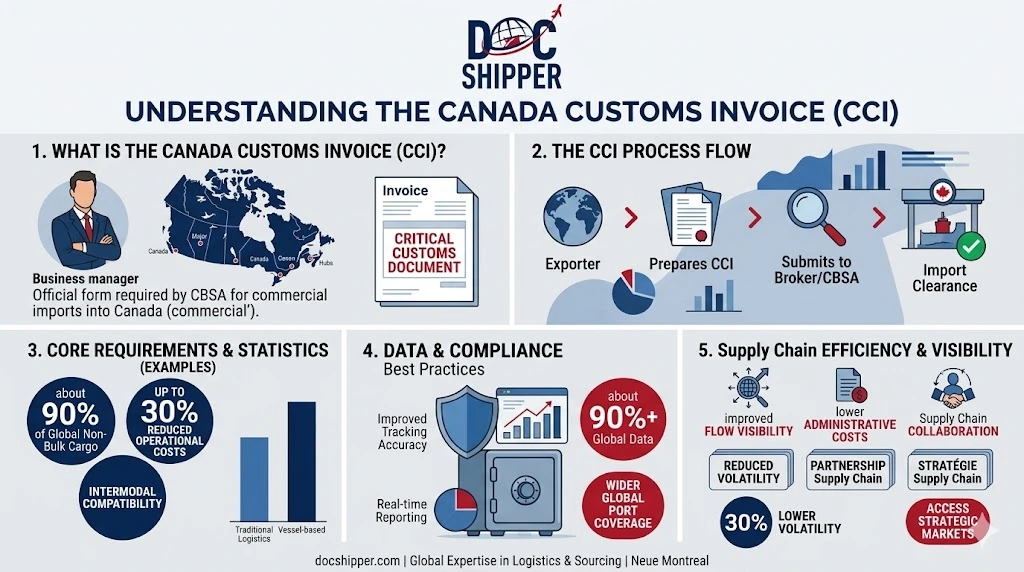
The Canada Customs Invoice is a mandatory commercial document required by the Canada Border Services Agency (CBSA) for all commercial shipments valued over CAD $2,500 entering Canada. This standardized form provides detailed transaction information including seller/buyer identities, goods description, valuation data, and country of origin, enabling customs authorities to assess duties, verify trade compliance, and facilitate clearance procedures efficiently.
Introduction
Exporters shipping goods to Canada frequently encounter delays, fines, or shipment rejections due to incomplete or incorrect customs documentation. The Canada Customs Invoice stands as one of the most critical yet commonly misunderstood documents in cross-border trade with Canada.
Unlike standard commercial invoices used in other jurisdictions, this document follows a prescribed format mandated by Canadian customs regulations. Its purpose extends beyond simple transaction recording—it serves as the primary tool for customs valuation, duty assessment, and regulatory compliance verification.
Key characteristics of the Canada Customs Invoice include:
- Mandatory threshold: Required for all commercial shipments exceeding CAD $2,500 in value
- Standardized format: Must contain 19 specific data fields as defined by CBSA Form B3-3
- Legal authority: Governed by the Customs Act and Customs Invoice Regulations
- Valuation basis: Determines the transaction value for customs duty calculation
- Trade compliance tool: Verifies origin, classification, and regulatory requirements
Understanding this document’s requirements prevents costly clearance delays and ensures smooth import operations into the Canadian market.
Legal Requirements & Technical Details
The Canada Customs Invoice operates under strict regulatory framework established by the Canada Border Services Agency (CBSA). The document must be completed by the vendor or exporter and submitted at the time of importation, either electronically through the Integrated Import Declaration system or in paper form.
Mandatory data fields include vendor and purchaser complete addresses, detailed goods description with HS codes, quantities in both units of measure and weight, unit prices, total invoice value, currency of settlement, terms of sale (Incoterms), and country of origin. Each field serves a specific regulatory purpose in the customs clearance process.
The valuation methodology follows the WTO Valuation Agreement principles, with the Canada Customs Invoice providing the foundation for transaction value determination. This includes the price actually paid or payable, adjusted for elements such as assists, royalties, subsequent proceeds, and transportation costs depending on the agreed Incoterms.
Special provisions apply for specific scenarios: related-party transactions require additional declarations regarding price influence, goods subject to anti-dumping or countervailing duties need supplementary documentation, and temporary imports under specific programs may require modified invoice formats.
The legal implications of inaccurate or incomplete Canada Customs Invoices extend beyond simple delays. Penalties under Section 109.1 of the Customs Act can reach $25,000 for false statements, while repeated non-compliance may trigger enhanced examination protocols or importer verification audits. At DocShipper, we systematically review all Canada Customs Invoices before shipment to ensure full regulatory compliance and prevent border issues.
For authoritative guidance, consult the official CBSA Form B3-3 guidelines which provide detailed instructions for each required field and acceptable documentation formats.
Practical Examples & Compliance Data
Understanding theoretical requirements differs significantly from practical application. The following scenarios demonstrate real-world Canada Customs Invoice usage across common trade situations.
Comparative Scenario Analysis
| Scenario Type | Invoice Value | Document Required | Key Considerations |
|---|---|---|---|
| Low-value shipment | CAD $1,800 | Commercial invoice | Canada Customs Invoice not mandatory |
| Standard commercial | CAD $15,000 | Canada Customs Invoice | All 19 fields mandatory, HS codes required |
| Related-party transaction | CAD $45,000 | Canada Customs Invoice + Declaration | Must declare relationship and confirm arm’s length pricing |
| USMCA preferential | CAD $8,500 | Canada Customs Invoice + Certificate of Origin | Origin declaration must align with invoice data |
| Temporary import | CAD $125,000 | Canada Customs Invoice + Carnet ATA | Invoice must note temporary status and return date |
Use Case: Electronics Manufacturer Export
Situation: A German electronics manufacturer ships 500 industrial sensors valued at EUR 35,000 (CAD $52,500) to a Canadian distributor in Toronto.
Canada Customs Invoice requirements:
- Vendor details: Complete German company name, street address, city, postal code, country, VAT number
- Purchaser details: Canadian distributor full legal name, complete Toronto address with postal code
- Goods description: “Industrial proximity sensors, capacitive type, detection range 8mm, Model PS-C8-NPN” with HS Code 8536.50.00
- Quantity specification: 500 pieces, total net weight 125 kg, gross weight 185 kg including packaging
- Valuation data: Unit price EUR 70.00, total value EUR 35,000, currency EUR, exchange rate applied at customs
- Terms of sale: CIF Toronto (Incoterms 2020), indicating freight and insurance included in invoice value
- Origin declaration: Country of origin Germany, manufactured in Nuremberg facility
Outcome: With a properly completed Canada Customs Invoice, customs clearance occurred within 4 hours of arrival. The importer claimed preferential duty rates under CETA (Canada-EU Trade Agreement), reducing duty from 6.5% to 0%, saving CAD $3,412.50.
Common compliance data points:
- 87% of Canada Customs Invoice rejections stem from incomplete HS code classification
- Average clearance delay for incorrect invoices: 3-7 business days
- Penalty assessments for false declarations average CAD $5,000-$15,000 per occurrence
- CBSA processes over 18 million commercial shipments annually requiring customs invoices
- Electronic submission through EDI reduces processing time by 65% compared to paper documents
At DocShipper, we prepare Canada Customs Invoices for over 2,000 shipments monthly, maintaining a 99.7% first-time acceptance rate through rigorous pre-clearance verification and HS code validation.
Conclusion
The Canada Customs Invoice represents far more than bureaucratic formality—it functions as the cornerstone document for compliant, efficient trade with Canada. Mastering its requirements prevents costly delays and regulatory complications.
Need expert assistance with Canada customs documentation or end-to-end import logistics? Contact DocShipper today for comprehensive support tailored to your cross-border shipping needs.
📚 Quiz
Test Your Knowledge: Canada Customs Invoice
Q1 — What is the minimum shipment value that triggers the mandatory use of a Canada Customs Invoice for commercial goods entering Canada?
Q2 — A common misconception is that a standard commercial invoice always replaces the Canada Customs Invoice. Which statement is correct?
Q3 — A U.S. exporter ships CAD $8,500 worth of auto parts to a Canadian buyer and wants to claim preferential USMCA duty rates. Which document combination is required?
🎯 Your Result
📞 Free Quote in 24hFAQ | Canada Customs Invoice: Definition, Requirements & Practical Examples
No, it is mandatory only for commercial shipments valued over CAD $2,500. Shipments below this threshold can use standard commercial invoices, though they must still contain essential customs information including description, value, origin, and HS codes.
Your commercial invoice can serve as a Canada Customs Invoice if it contains all 19 mandatory data fields specified in CBSA Form B3-3. Many exporters create hybrid documents combining both formats to satisfy both accounting and customs requirements simultaneously.
Incomplete invoices trigger customs holds, requiring document resubmission before clearance proceeds. This typically delays shipment release by 3-7 business days, incurs demurrage charges, and may result in administrative penalties ranging from CAD $250 to $1,000 for repeated violations.
No, you may submit the document in either English or French, both official languages of Canada. CBSA officers are bilingual and accept documentation in either language. However, goods descriptions should be clear and unambiguous regardless of language chosen.
State the actual transaction currency and amount on the invoice. CBSA will apply the official exchange rate in effect on the date of importation to convert values to Canadian dollars for duty calculation purposes. Do not pre-convert amounts yourself.
FOB (Free On Board) includes only the goods value at the point of export, while CIF (Cost, Insurance, Freight) includes transportation and insurance to the Canadian destination. The Incoterm declared determines which costs are included in the customs value for duty assessment.
Yes, electronic invoices submitted through EDI (Electronic Data Interchange) or the Single Window Initiative are fully accepted and preferred. Digital submission accelerates processing, reduces errors, and provides automated validation of required data fields before customs arrival.
Canadian regulations require importers and exporters to retain all customs documentation, including Canada Customs Invoices, for a minimum of six years from the date of importation. This supports potential audits, verification requests, or dispute resolution processes.
Freight forwarders can assist with preparation, but the legal responsibility for accuracy rests with the vendor/exporter named on the invoice. The document must be signed by an authorized representative of the selling entity, confirming the information's accuracy and completeness.
Immediately notify your customs broker or CBSA before goods are released. Minor corrections can often be handled through supplementary documentation. Significant errors may require formal amendment procedures under Section 32.2 of the Customs Act, potentially with penalty implications.
If the declared value exceeds CAD $2,500, yes. However, bona fide samples of negligible value may qualify for simplified documentation. Clearly mark such shipments as "Commercial samples—no commercial value" and provide detailed descriptions to support the no-value declaration.
The Canada Customs Invoice provides the transaction and product data that must align with your USMCA certification. Inconsistencies between the invoice description, HS codes, origin declaration, and certificate will trigger verification requests and potentially deny preferential treatment, resulting in higher duty assessments.
Need Help with
Logistics or Sourcing ?
First, we secure the right products from the right suppliers at the right price by managing the sourcing process from start to finish. Then, we simplify your shipping experience - from pickup to final delivery - ensuring any product, anywhere, is delivered at highly competitive prices.


Fill the Form
Prefer email? Send us your inquiry, and we’ll get back to you as soon as possible.
Contact us




