


In short ⚡
Demand Chain Management is a strategic approach that focuses on customer demand as the starting point for planning production, inventory, and distribution. Unlike traditional supply chain models, it reverses the flow by pulling products through the system based on actual market signals rather than forecasts, optimizing responsiveness and reducing waste.Introduction
Most businesses still operate on supply-driven models, pushing products based on forecasts that frequently miss actual demand. This disconnect creates excess inventory, stockouts, and lost revenue. In global trade, where lead times span weeks and customer expectations demand immediate fulfillment, this gap becomes critical.
Demand Chain Management addresses this challenge by inverting the traditional approach. It synchronizes operations with real customer behavior, creating a pull-based system that starts with the end consumer and works backward through manufacturing and sourcing.
Core characteristics include:
- Customer-centric planning driven by actual purchase signals
- Real-time visibility across all network nodes
- Collaborative forecasting with suppliers and distributors
- Agile production systems responsive to demand fluctuations
- Integrated technology platforms connecting demand signals to fulfillment
For international logistics operators, this model transforms how inventory flows across borders, reducing capital tied up in slow-moving stock while improving service levels.
Strategic Framework & Operational Mechanisms
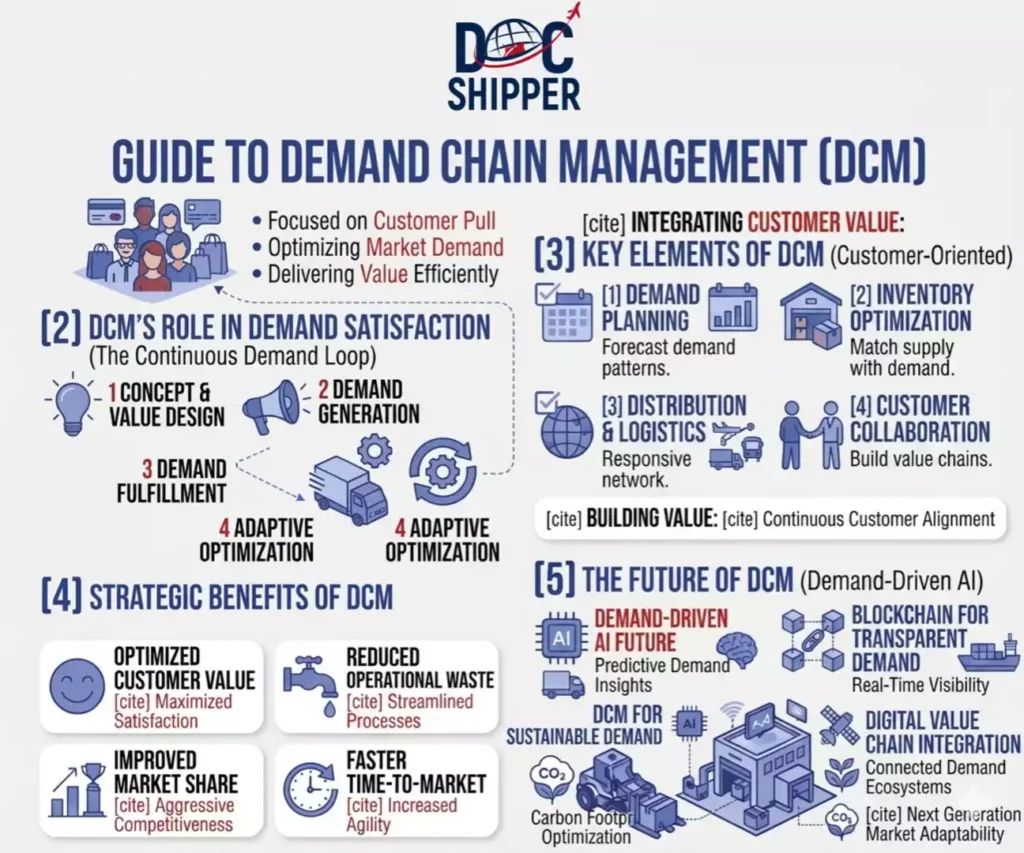
Demand Chain Management operates through three fundamental mechanisms that distinguish it from conventional supply chain models.
Demand sensing and shaping forms the foundation. Advanced analytics capture point-of-sale data, web traffic patterns, social media trends, and promotional impacts. This intelligence feeds directly into production schedules, bypassing traditional monthly forecast cycles. Companies can detect demand shifts within 24-48 hours rather than waiting for monthly reports.
Synchronized planning processes connect every stakeholder in real time. Sales teams, procurement specialists, production planners, and logistics providers access the same demand signals simultaneously. This eliminates the sequential planning that creates delays and distortions as information passes through organizational silos.
Postponement strategies delay final product configuration until actual orders arrive. Generic components move through the supply chain, with customization occurring close to the customer. This approach dramatically reduces forecast dependency while maintaining quick response times.
From a regulatory perspective, demand-driven models must still comply with customs documentation requirements. The European Union Customs Code mandates proper classification and valuation regardless of fulfillment speed. At DocShipper, we integrate demand chain visibility tools with customs compliance systems, ensuring rapid fulfillment never compromises regulatory adherence.
Technology infrastructure enables the entire model. Cloud-based platforms integrate ERP systems, warehouse management software, transportation management systems, and customer relationship tools. APIs connect these platforms, allowing demand signals to trigger automated responses across the network.
Performance metrics shift from efficiency to responsiveness. Traditional supply chains measure cost per unit and capacity utilization. Demand chains prioritize perfect order rate, demand forecast accuracy, cash-to-cash cycle time, and customer satisfaction scores. This reorientation drives different operational decisions throughout the network.
Implementation Models & Performance Data
Real-world applications demonstrate how demand chain principles transform logistics performance across industries.
Comparative Performance: Traditional vs. Demand-Driven Models
| Metric | Supply Chain Model | Demand Chain Model | Improvement |
|---|---|---|---|
| Forecast Accuracy | 65-70% | 85-92% | +25% |
| Inventory Turnover | 4-6 times/year | 8-12 times/year | +100% |
| Order Fulfillment Time | 7-14 days | 2-5 days | -64% |
| Stockout Rate | 8-12% | 2-4% | -75% |
| Working Capital Reduction | Baseline | -20 to -35% | Significant |
Use Case: Electronics Manufacturer
A European electronics company importing components from Asia faced chronic forecast errors. Their traditional model ordered components based on 90-day projections, resulting in 18% excess inventory and 11% stockouts simultaneously.
After implementing demand chain principles, they established direct data feeds from retailers. Component orders now trigger within 72 hours of retail sales spikes. Results after 12 months:
- Inventory holding costs decreased 28%
- Stockout incidents dropped to 3.2%
- Customer satisfaction scores improved 34 points
- Air freight expenses reduced 19% despite faster response times
- Total logistics costs as percentage of revenue fell from 12.4% to 9.1%
Fashion Retail Implementation
A multinational apparel brand operates 400 stores across 15 countries. Their demand chain system captures daily sales by SKU, size, and location. This granular data feeds directly to manufacturing partners in Bangladesh and Vietnam.
Production runs shifted from quarterly batches to weekly micro-batches. Lead times compressed from 120 days to 35 days. End-of-season markdowns decreased from 32% to 14% of inventory value. The company now introduces new styles 6 times per season instead of 2, responding to emerging trends while competitors react to outdated forecasts.
At DocShipper, we support this agility through flexible customs clearance arrangements and multi-modal transport options that adapt to changing demand patterns without compromising compliance or cost efficiency.
Conclusion
Demand Chain Management represents a fundamental shift from forecast-driven operations to customer-driven networks. Companies adopting this model achieve superior inventory performance, faster fulfillment, and stronger customer relationships while reducing working capital requirements.
Need guidance implementing demand-responsive logistics for your international operations? Contact DocShipper for expert support tailored to your supply chain challenges.
📚 Quizz
Test Your Knowledge: Demand Chain Management
Q1 — What best defines Demand Chain Management?
Q2 — A common misconception about Demand Chain Management is that it completely eliminates forecasting. What is the correct interpretation?
Q3 — A European electronics importer switches from 90-day forecast-based ordering to a demand chain model with direct retail data feeds. Which outcome best reflects the expected result?
🎯 Your Result
📞 Free Quote in 24hFAQ | Demand Chain Management: Definition, Implementation & Real-World Examples
Supply chain management pushes products based on forecasts, while demand chain management pulls products based on actual customer signals. The demand chain starts with the consumer and works backward, creating a responsive rather than predictive system.
Core technologies include real-time data integration platforms, advanced analytics tools, cloud-based collaboration systems, and API connections between ERP, WMS, TMS, and CRM systems. Mobile applications and IoT sensors enhance visibility.
Absolutely. Even basic point-of-sale integration with suppliers creates pull-based ordering. Small retailers using e-commerce platforms already have demand visibility that can drive inventory decisions without expensive enterprise systems.
Fashion, consumer electronics, automotive aftermarket, pharmaceuticals, and fast-moving consumer goods see the greatest impact. Any industry with demand volatility, short product lifecycles, or high inventory costs benefits significantly.
Pilot implementations require 3-6 months. Full organizational transformation spans 18-36 months, including technology deployment, process redesign, supplier integration, and cultural change management across the enterprise.
Data quality and integration issues top the list. Organizational resistance to process changes, supplier collaboration difficulties, technology investment requirements, and performance metric realignment also present significant hurdles.
It typically increases shipment frequency while reducing shipment sizes. Companies shift from monthly container loads to weekly or bi-weekly shipments, requiring flexible logistics partnerships and streamlined customs processes.
Forecasting still exists but serves strategic planning rather than operational execution. Long-term capacity planning and supplier relationship management require forecasts, but day-to-day operations respond to actual demand signals.
Key metrics include demand forecast accuracy, perfect order rate, cash-to-cash cycle time, inventory days of supply, customer order cycle time, and supply chain responsiveness index. Financial measures track working capital efficiency.
Yes, but it requires strong digital connectivity and collaborative relationships. Suppliers need visibility to demand signals and capacity to respond quickly. Some companies establish regional postponement centers to balance global sourcing with local responsiveness.
Most companies report 15-25% reduction in inventory carrying costs, 20-40% improvement in forecast accuracy, and 10-20% increase in customer satisfaction within the first year. Full financial benefits typically materialize over 2-3 years.
It requires deeper collaboration and information sharing. Suppliers gain better visibility to actual demand, enabling more efficient production planning. Relationships shift from transactional to strategic partnerships with shared performance incentives.
Need Help with
Logistics or Sourcing ?
First, we secure the right products from the right suppliers at the right price by managing the sourcing process from start to finish. Then, we simplify your shipping experience - from pickup to final delivery - ensuring any product, anywhere, is delivered at highly competitive prices.


Fill the Form
Prefer email? Send us your inquiry, and we’ll get back to you as soon as possible.
Contact us




