


In short ⚡
CFR (Cost and Freight) is an Incoterm where the seller pays for transportation costs to the destination port, but risk transfers to the buyer once goods are loaded on the vessel. The buyer assumes responsibility for insurance, unloading, and import clearance.Introduction
Many importers confuse CFR with CIF, assuming freight coverage automatically includes insurance. This misunderstanding creates significant financial exposure during international shipments. Understanding CFR precisely prevents costly disputes and unexpected expenses.
CFR applies exclusively to sea and inland waterway transport. It defines clear boundaries between seller and buyer obligations in the logistics chain. This Incoterm remains popular for bulk commodities and containerized cargo where buyers prefer controlling insurance policies.
- Seller pays freight costs to the named destination port
- Risk transfers at the ship’s rail at the port of shipment
- Buyer arranges and pays for marine insurance
- Buyer handles all destination charges and customs clearance
- Only applicable for maritime and inland waterway transport
CFR Mechanics & Responsibilities
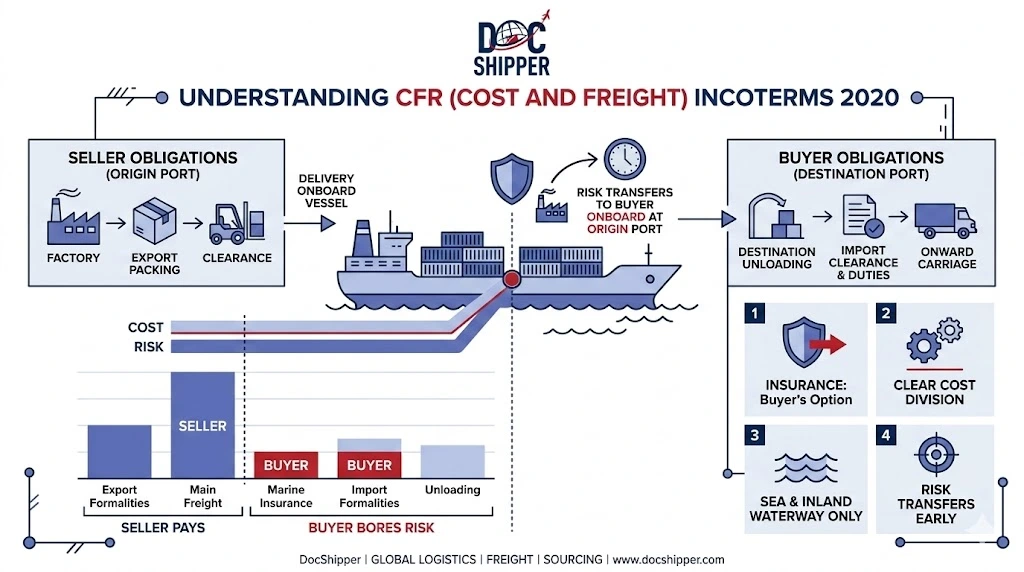
Under CFR terms, the seller’s obligation includes delivering goods on board the vessel and paying freight charges to the agreed destination port. However, risk transfers much earlier—at the moment goods cross the ship’s rail at the loading port. This creates a critical gap between cost responsibility and risk assumption.
The point of risk transfer represents the most misunderstood aspect of CFR. Once goods are loaded, any damage, loss, or delay during transit becomes the buyer’s responsibility. The seller has already fulfilled delivery obligations even if the cargo never reaches its destination. This differs fundamentally from CIF, where sellers must provide minimum insurance coverage.
Export documentation and clearance remains entirely the seller’s responsibility. This includes export licenses, customs declarations, and any pre-shipment inspections required by the origin country. The seller must provide the buyer with proof of delivery and shipping documents enabling cargo collection at destination.
The buyer assumes significant responsibilities under CFR. These include arranging adequate marine insurance, paying for unloading at the destination port, handling import customs clearance, and covering all duties and taxes. Terminal handling charges (THC) and documentation fees at destination also fall to the buyer.
At DocShipper, we systematically advise clients on appropriate insurance coverage when purchasing under CFR terms. Our risk assessment ensures buyers don’t face unprotected exposure during ocean transit, particularly for high-value shipments or volatile routes.
According to the International Chamber of Commerce, CFR explicitly requires sellers to contract carriage but not insurance. This distinction makes CFR suitable when buyers have preferential insurance rates or specific coverage requirements that standard seller-arranged policies cannot meet.
Cost Breakdown & Practical Scenarios
Understanding the financial allocation under CFR prevents budget overruns and clarifies total landed cost calculations. The cost structure divides clearly between seller-paid and buyer-paid expenses, though the risk division occurs at a different point.
| Cost Component | Seller Responsibility | Buyer Responsibility |
|---|---|---|
| Product Cost | ✓ | — |
| Export Packaging | ✓ | — |
| Loading at Origin | ✓ | — |
| Export Customs Clearance | ✓ | — |
| Ocean Freight to Destination Port | ✓ | — |
| Marine Insurance | — | ✓ |
| Unloading at Destination | — | ✓ |
| Import Customs & Duties | — | ✓ |
| Inland Transport from Port | — | ✓ |
Practical Scenario: Electronics Import from Shanghai to Rotterdam
Shipment Details: 40-foot container of consumer electronics valued at $80,000 USD, shipping from Shanghai to Rotterdam under CFR terms.
Seller’s Costs:
- Product manufacturing and packaging: $80,000
- Inland transport to Shanghai port: $300
- Export customs clearance and documentation: $150
- Terminal handling charges (origin): $200
- Ocean freight Shanghai-Rotterdam: $2,400
- Total seller investment: $83,050
Buyer’s Costs:
- Marine insurance (110% cargo value): $968
- Terminal handling charges (destination): $350
- Import customs clearance: $200
- Import duties (estimated 5%): $4,000
- Inland transport Rotterdam to warehouse: $450
- Total buyer additional costs: $5,968
Critical Risk Point: If the container is damaged during ocean transit (e.g., water ingress during a storm), the buyer bears the loss unless adequate insurance was arranged. The seller has fulfilled obligations by delivering goods on board and paying freight, regardless of cargo condition upon arrival.
This scenario demonstrates why buyers must immediately secure comprehensive marine insurance when accepting CFR terms. The gap between cost responsibility and risk transfer creates potential exposure worth tens of thousands of dollars on a single shipment.
Conclusion
CFR defines clear cost responsibilities while creating a critical risk transfer point that buyers must manage through proper insurance. Understanding this Incoterm prevents financial exposure and enables accurate landed cost calculations for international procurement.
Need expert guidance on Incoterms selection or comprehensive logistics support? Contact DocShipper for tailored solutions covering freight, customs, and risk management.
📚 Quiz
Test Your Knowledge: CFR (Cost and Freight)
1. Under CFR (Cost and Freight) terms, which of the following best describes the seller's core obligation?
2. A container of goods shipped under CFR terms is severely damaged by a storm during the ocean voyage. Who bears the financial loss?
3. A European importer wants to ship goods from China by air freight and asks their supplier to quote under CFR terms. Is this the correct Incoterm to use?
🎯 Your Result
📞 Free Quote in 24hFAQ | CFR (Cost and Freight): Definition, Calculation & Practical Examples
CFR requires the buyer to arrange insurance, while CIF obligates the seller to provide minimum marine insurance coverage. Both have the seller paying freight to destination, but CIF includes insurance as a seller responsibility.
Risk transfers when goods cross the ship's rail at the port of shipment, not when they arrive at destination. This means buyers assume risk during the entire ocean voyage despite not paying freight costs.
No, CFR applies exclusively to sea and inland waterway transport. For air freight, the equivalent Incoterm is CPT (Carriage Paid To), which has similar cost allocation but different risk transfer mechanics.
The buyer pays for unloading charges at the destination port. The seller's freight payment typically covers only carriage to the port, not discharge operations or terminal handling at destination.
Buyers should obtain comprehensive marine insurance covering at least 110% of the cargo value. Coverage should include all risks from the point of loading through final delivery, protecting against damage, loss, and general average contributions.
Yes, the seller must provide the commercial invoice, bill of lading, packing list, and any documents required for export clearance. These documents enable the buyer to claim the goods at the destination port.
The buyer bears the loss if goods are damaged after loading, as risk has already transferred. This emphasizes the critical importance of arranging adequate marine insurance when purchasing under CFR terms.
No, CFR must name a seaport as the destination. For inland destinations beyond the port, use CPT (Carriage Paid To), which allows naming any location including inland points with similar cost structures.
The seller manages all export customs clearance, including documentation, declarations, licenses, and any required inspections. The buyer handles import customs clearance and associated costs at the destination country.
Yes, CFR works well for containerized shipments, though CPT may be more appropriate for modern container logistics. CFR remains common for bulk commodities and situations where buyers prefer controlling their insurance arrangements.
Terminal handling charges (THC) cover loading/unloading at ports. Under CFR, the seller typically pays origin THC while the buyer pays destination THC, though this should be explicitly confirmed in the sales contract.
CFR simplifies initial pricing by including freight, but buyers must add insurance, destination terminal charges, import duties, customs clearance fees, and inland transport to calculate true landed cost. This requires detailed cost modeling beyond the CFR price.
Need Help with
Logistics or Sourcing ?
First, we secure the right products from the right suppliers at the right price by managing the sourcing process from start to finish. Then, we simplify your shipping experience - from pickup to final delivery - ensuring any product, anywhere, is delivered at highly competitive prices.


Fill the Form
Prefer email? Send us your inquiry, and we’ll get back to you as soon as possible.
Contact us




:%20Definition,%20Calculation%20&%20Practical%20Examples)