



In short ⚡
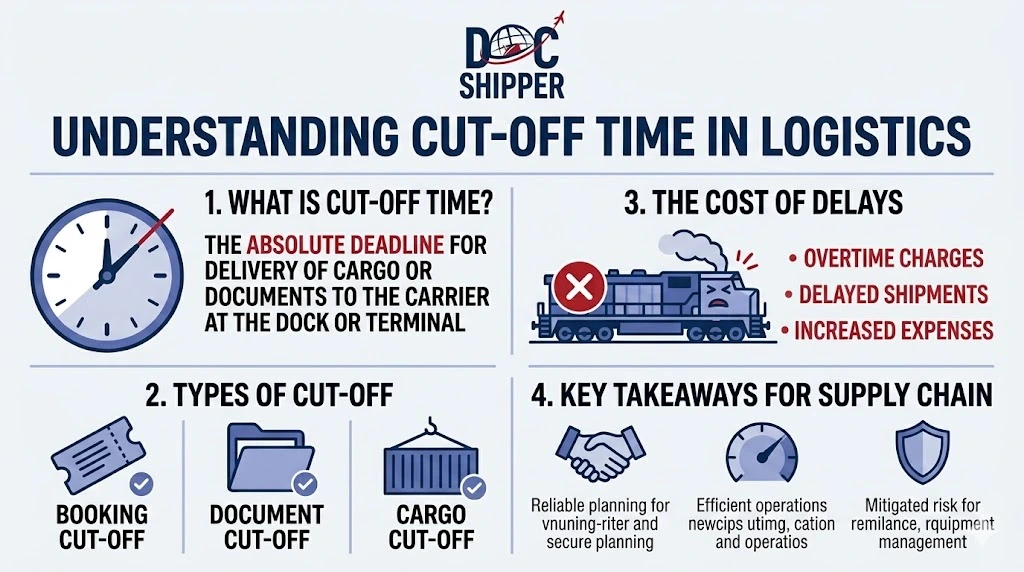
Cut-off time is the deadline by which cargo, documentation, or booking confirmations must be received by carriers, freight forwarders, or terminals to guarantee loading on a scheduled vessel, flight, or truck. Missing this critical window results in shipment delays, additional costs, and potential supply chain disruptions.
Introduction
One of the most common causes of shipment delays in international logistics is missing the cut-off time. Many shippers assume that if a vessel departs on Friday, they can deliver cargo on Thursday evening. This misconception leads to costly rollover fees and missed delivery commitments.
In global trade, cut-off time serves as the operational boundary between preparation and execution. It ensures carriers have sufficient time to complete documentation verification, container positioning, loading operations, and customs clearance before departure.
Key characteristics of cut-off time include:
- Documentation cut-off: Deadline for submitting bills of lading, customs declarations, and shipping instructions
- Physical cut-off: Last moment for delivering containers to the terminal or consolidation warehouse
- VGM cut-off: Verified Gross Mass submission deadline (mandatory under SOLAS regulations)
- Booking cut-off: Final time to confirm space reservation with the carrier
- Hazardous goods cut-off: Earlier deadline for dangerous cargo requiring special documentation and handling
Understanding Cut-Off Time Mechanisms
Cut-off times vary significantly based on transport mode, carrier policy, destination, and cargo type. Ocean freight typically requires documentation 24-48 hours before vessel departure, while physical cargo must arrive at the terminal 12-24 hours prior. Air freight operates on tighter windows, often requiring cargo delivery 4-6 hours before flight departure.
The documentation cut-off exists because carriers must transmit manifest information to destination customs authorities before departure. This advance filing requirement, such as the US ISF (Importer Security Filing) or EU ICS2 system, necessitates complete and accurate paperwork well before physical loading begins.
Terminal cut-off allows port operators to organize container stacking, verify weights, conduct security scans, and position boxes for efficient vessel loading. Modern container terminals use sophisticated yard management systems that require data finalization hours before crane operations commence.
The VGM (Verified Gross Mass) cut-off became mandatory after the 2016 SOLAS amendment. Shippers must provide verified container weights through approved methods before the carrier’s deadline, typically 24 hours before vessel loading. Non-compliance results in automatic cargo rejection.
Carrier-specific variations mean that two vessels departing the same port on the same day may have different cut-off times. Major carriers like Maersk, MSC, or CMA CGM establish their own policies based on operational efficiency, terminal agreements, and service reliability targets.
At DocShipper, we monitor cut-off times across all major trade lanes and automatically alert clients 48 hours in advance. Our systems integrate with carrier platforms to ensure documentation and cargo arrive within required windows, minimizing rollover risks.
For regulatory context, the International Maritime Organization (IMO) provides comprehensive guidelines on VGM requirements and cut-off compliance standards.
Practical Examples & Data
Understanding theoretical cut-off times differs significantly from managing them in real-world scenarios. The following examples demonstrate how different industries and trade routes experience cut-off time challenges.
Comparative Cut-Off Times by Transport Mode
| Transport Mode | Documentation Cut-Off | Physical Cut-Off | Typical Rollover Cost |
|---|---|---|---|
| Ocean Freight (FCL) | 24-48 hours before ETD | 12-24 hours before ETD | $150-$500 + 7-day delay |
| Ocean Freight (LCL) | 48-72 hours before ETD | 24-48 hours before ETD | $75-$200 + 7-day delay |
| Air Freight | 6-12 hours before ETD | 4-6 hours before ETD | $200-$800 + 1-2 day delay |
| Road Freight (FTL) | 2-4 hours before departure | 1-2 hours before departure | $100-$300 + 1-day delay |
| Rail Freight | 12-24 hours before departure | 6-12 hours before departure | $150-$400 + 3-5 day delay |
Case Study: Electronics Shipment from Shenzhen to Los Angeles
Scenario: A US retailer orders 15 pallets of consumer electronics (4,800 kg) for Black Friday inventory. The vessel departs Yantian Port on October 15th at 18:00.
Cut-off timeline:
- October 12, 09:00: Booking cut-off (space confirmation required)
- October 13, 15:00: Documentation cut-off (commercial invoice, packing list, B/L instructions)
- October 14, 12:00: VGM cut-off (verified container weight submission)
- October 14, 18:00: Physical cut-off (container gate-in at terminal)
- October 15, 18:00: Vessel departure
Outcome: The shipper submitted documentation at 16:30 on October 13th—90 minutes after the deadline. The carrier rejected the booking, forcing a rollover to the next available vessel departing October 22nd. This 7-day delay resulted in $450 in rollover fees, $2,800 in detention charges for the container, and missed the retailer’s inventory deadline, causing an estimated $35,000 in lost sales.
Key Data Points for Cut-Off Management
- 67% of missed cut-offs occur due to incomplete or incorrect documentation rather than late physical delivery
- Average rollover cost for ocean freight: $350 per container plus 5-7 days transit delay
- Peak season impact: Cut-off times may advance by 12-24 hours during high-volume periods (Q4, Chinese New Year)
- Hazmat shipments: Require cut-off compliance 24-48 hours earlier than standard cargo
- Transshipment ports: Often have stricter cut-offs due to connection coordination requirements
DocShipper’s automated tracking system monitors carrier cut-off schedules across 180+ ports worldwide. We provide real-time alerts and pre-submission document verification to ensure 99.2% on-time compliance for our clients.
Conclusion
Cut-off time represents the critical boundary between successful shipment execution and costly delays. Understanding the distinction between documentation, physical, VGM, and booking cut-offs enables shippers to maintain supply chain reliability and avoid unnecessary expenses.
Need assistance managing complex cut-off schedules across multiple carriers and trade lanes? Contact DocShipper for expert logistics support tailored to your shipping requirements.
📚 Quiz
Test Your Knowledge: Cut-Off Time
Q1 — What does "cut-off time" mean in international freight logistics?
Q2 — According to industry data, what is the most common reason shippers miss cut-off times?
Q3 — A shipper needs to send an LCL ocean freight shipment. Compared to an FCL shipment on the same vessel, when should they expect the documentation cut-off to be?
🎯 Your Result
📞 Free Quote in 24hFAQ | Cut-Off Time: Definition, Calculation & Practical Examples
Your cargo will be rolled over to the next available sailing, resulting in transit delays (typically 5-7 days for ocean freight), rollover fees ($150-$500), potential detention charges, and possible disruption to your supply chain commitments.
Extensions are rarely granted and depend on carrier discretion, terminal capacity, and operational constraints. High-volume shippers with strong carrier relationships may receive occasional accommodations, but this should never be assumed or relied upon.
LCL shipments typically have earlier cut-offs (48-72 hours) because cargo must be consolidated at a warehouse before terminal delivery. FCL containers can be delivered closer to vessel departure (12-24 hours) since they don't require deconsolidation.
VGM (Verified Gross Mass) cut-off is the deadline for submitting container weight verification as required by SOLAS regulations. It's typically 24 hours before loading and exists separately because carriers need this data for vessel stability calculations and stowage planning.
Yes, carriers often advance cut-off times by 12-24 hours during high-volume periods (Q4 holidays, Chinese New Year) to manage terminal congestion and ensure schedule reliability. Always verify current cut-offs rather than assuming standard timelines.
Customs holidays can advance cut-offs significantly because documentation requiring customs pre-clearance must be submitted before the holiday period. This may push effective cut-offs back by 2-5 business days depending on the holiday duration.
Standard requirements include commercial invoice, packing list, shipping instructions, bill of lading details, and any regulatory documents (certificates of origin, phytosanitary certificates, etc.). Hazardous cargo requires additional safety documentation and declarations.
Yes, but terminals have "gate-open" times (typically 5-7 days before vessel departure). Delivering too early may result in extended storage fees. The optimal delivery window is usually 24-48 hours before cut-off, balancing flexibility with cost efficiency.
Transshipment shipments often have stricter cut-offs because carriers must coordinate with connecting vessels at intermediate ports. Documentation cut-offs may be 48-72 hours before the first vessel departure to ensure manifest transmission to all ports in the routing.
Carrier cut-off is the deadline set by the shipping line for receiving documentation and booking confirmation. Terminal cut-off is when the physical container must arrive at the port facility. Carrier cut-off is typically 12-24 hours before terminal cut-off.
Yes, even when multiple carriers share vessel space (through alliances or slot charters), each carrier may establish its own cut-off times based on internal processing requirements, service level commitments, and operational policies.
Professional freight forwarders use transportation management systems (TMS) that automatically track carrier-specific cut-offs and send advance notifications. Manual tracking requires monitoring each carrier's website or subscribing to their notification services, which becomes impractical for high-volume shippers.
Need Help with
Logistics or Sourcing ?
First, we secure the right products from the right suppliers at the right price by managing the sourcing process from start to finish. Then, we simplify your shipping experience - from pickup to final delivery - ensuring any product, anywhere, is delivered at highly competitive prices.


Fill the Form
Prefer email? Send us your inquiry, and we’ll get back to you as soon as possible.
Contact us




