


In short ⚡
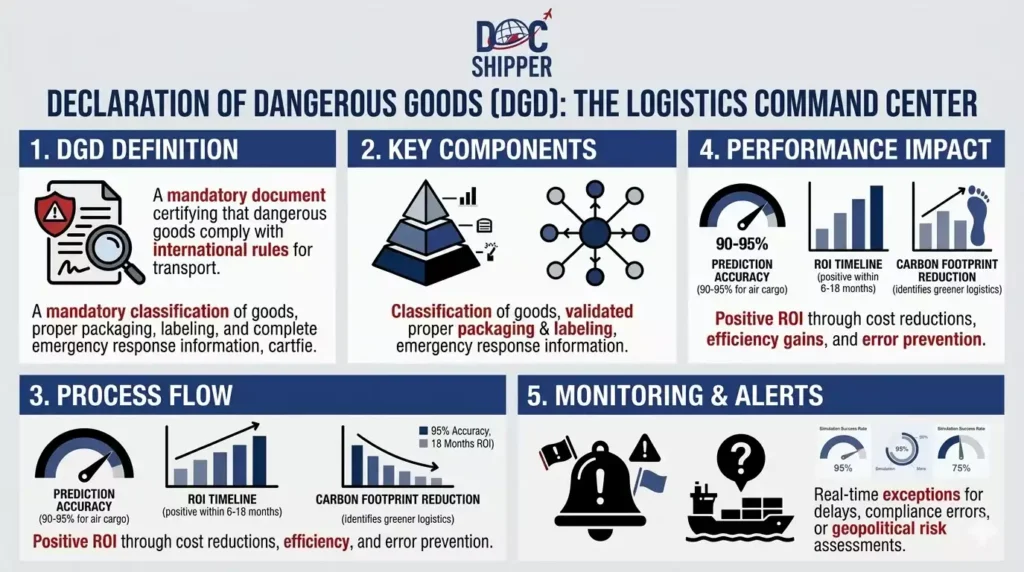
The Declaration of Dangerous Goods is a mandatory shipping document certifying that hazardous materials comply with international transport regulations. It details the classification, packaging, labeling, and emergency response information for substances that pose risks during transportation by air, sea, or land.
Introduction
Shipping batteries, chemicals, or aerosols without proper documentation can result in cargo rejection, hefty fines, or even criminal liability. The Declaration of Dangerous Goods serves as your legal shield and operational roadmap when transporting hazardous materials across borders.
In international logistics, this document bridges the gap between safety regulations and commercial necessity. It ensures that every party in the supply chain—from warehouse handlers to airline crews—understands the risks and handling protocols.
- Mandatory for all dangerous goods shipments across air, sea, and road transport modes
- Legally binding certification signed by the shipper confirming regulatory compliance
- Contains UN classification numbers, proper shipping names, and hazard classes
- Specifies packaging specifications and emergency contact information
- Required by IATA, IMDG, and ADR/RID regulations depending on transport mode
Misunderstanding this document costs companies millions annually in delays and penalties. Mastering its requirements is non-negotiable for import-export professionals handling hazardous materials.
Regulatory Framework & Compliance Requirements
The Declaration of Dangerous Goods operates under a complex web of international conventions. The UN Recommendations on the Transport of Dangerous Goods provide the foundation, which regional authorities adapt into enforceable regulations.
For air transport, the IATA Dangerous Goods Regulations (DGR) mandate specific declaration formats. Airlines refuse cargo without properly completed DGR declarations, as they assume legal liability for non-compliant shipments. The document must include the shipper’s certification statement: “I hereby declare that the contents of this consignment are fully and accurately described by the proper shipping name(s) and are classified, packaged, marked and labeled, and are in all respects in proper condition for transport according to applicable international and national governmental regulations.”
Maritime shipments follow the International Maritime Dangerous Goods (IMDG) Code, administered by the International Maritime Organization. This regulation requires shippers to provide container packing certificates alongside the dangerous goods declaration. According to IMO guidelines, non-compliance can result in cargo being refused at port or disposed of at the shipper’s expense.
Road and rail transport in Europe requires adherence to ADR (road) and RID (rail) agreements. These regulations specify driver training requirements, vehicle placarding, and documentation protocols. The dangerous goods declaration must accompany the transport document and remain accessible to authorities during transit.
The shipper bears ultimate responsibility for declaration accuracy. Falsifying information or omitting hazardous materials can lead to criminal prosecution. Most jurisdictions impose penalties ranging from $5,000 to $500,000 per violation, with potential imprisonment for willful violations causing harm.
At DocShipper, we systematically verify dangerous goods declarations against the latest regulatory updates, ensuring your shipments meet all jurisdiction-specific requirements before departure. Our compliance team cross-references UN numbers, packaging codes, and emergency response information to eliminate costly errors.
Practical Examples & Industry Data
Understanding theoretical requirements means little without seeing how declarations function in real-world scenarios. The following examples demonstrate common situations and critical data points.
Case Study: Lithium Battery Shipment (Air Freight)
A consumer electronics manufacturer ships 500 lithium-ion batteries from Shenzhen to Frankfurt. The declaration must specify:
- UN Number: UN3480 (Lithium ion batteries)
- Proper Shipping Name: “Lithium ion batteries”
- Class: 9 (Miscellaneous dangerous goods)
- Packing Group: II
- Quantity: 150 kg net weight
The shipper must also confirm compliance with Section II of Packing Instruction 965, which limits lithium content to 30% state of charge for cargo aircraft. Failure to complete this declaration correctly resulted in a $75,000 fine for one major electronics company in 2023.
Comparative Regulatory Requirements by Transport Mode
| Transport Mode | Governing Regulation | Declaration Format | Key Requirement |
|---|---|---|---|
| Air Freight | IATA DGR | Shipper’s Declaration (DGD) | 24-hour emergency contact mandatory |
| Sea Freight | IMDG Code | Container Packing Certificate + DG Declaration | Segregation requirements for incompatible goods |
| Road (Europe) | ADR Agreement | Transport Document with DG details | Driver ADR certification required |
| Rail (Europe) | RID Agreement | Consignment Note with DG annex | Tank wagon specifications for bulk liquids |
Industry Compliance Statistics
According to 2023 IATA data, dangerous goods incidents occur in approximately 1 in every 1.3 million packages shipped by air. Analysis reveals that 68% of incidents stem from improper documentation, with incomplete declarations being the primary cause.
The U.S. Pipeline and Hazardous Materials Safety Administration (PHMSA) reported 19,000 dangerous goods violations in 2022, with average fines of $12,500 per incident. The most common errors include:
- Incorrect UN numbers (32% of violations)
- Missing emergency contact information (24% of violations)
- Inadequate packaging descriptions (19% of violations)
- Omitted shipper certification signatures (15% of violations)
- Wrong hazard class declarations (10% of violations)
These statistics underscore why professional verification is critical. DocShipper’s dangerous goods specialists review every declaration against a 47-point compliance checklist, reducing client violation rates to less than 0.2%.
Conclusion
The Declaration of Dangerous Goods transforms hazardous material shipping from a legal minefield into a manageable process. Mastering its requirements protects your business from financial penalties while ensuring supply chain continuity.
Need expert assistance with dangerous goods documentation? Contact DocShipper for comprehensive compliance support tailored to your specific shipping requirements.
📚 Quiz
Declaration of Dangerous Goods
Q1 — What is the primary purpose of a Declaration of Dangerous Goods?
Q2 — Who bears the legal responsibility for completing and signing the Declaration of Dangerous Goods?
Q3 — A company ships lithium-ion batteries by air freight. Which UN number and hazard class must appear on their Declaration of Dangerous Goods?
🎯 Your Result
📞 Free Quote in 24hFAQ | Declaration of Dangerous Goods: Definition, Requirements & Practical Examples
The shipper or consignor bears legal responsibility for completing and signing the declaration. This cannot be delegated to freight forwarders, though they may assist with preparation. The shipper's signature certifies compliance under penalty of law.
Yes, one declaration can cover multiple dangerous goods items if they're part of the same consignment. Each item must be listed separately with its UN number, proper shipping name, class, packing group, and quantity. Ensure compatibility and segregation requirements are met.
Errors typically result in shipment rejection at the departure point. If discovered in transit, cargo may be offloaded and held at the shipper's expense. Serious violations can lead to regulatory fines, legal action, and permanent carrier blacklisting.
Yes, most regulations require shippers to receive dangerous goods training every two years. Training covers classification, packaging, marking, labeling, and documentation. Untrained personnel cannot legally complete or sign dangerous goods declarations.
Retention periods vary by jurisdiction but typically range from 2 to 5 years. U.S. regulations require 3 years, while EU standards mandate 5 years. Electronic copies are acceptable if they meet authenticity and accessibility requirements.
Exceptions exist for limited quantities and excepted quantities that meet specific packaging and marking criteria. However, these still require simplified declarations or markings. Consult the relevant regulation (IATA, IMDG, ADR) for threshold limits.
Electronic submissions are increasingly accepted, particularly for air freight through systems like IATA's e-DGD. However, a signed paper copy must often accompany the shipment. Verify carrier and destination country requirements before relying solely on electronic versions.
A Safety Data Sheet (SDS) provides detailed chemical information for workplace safety, while the dangerous goods declaration is a transport-specific document certifying regulatory compliance. Both may be required, but they serve different purposes and contain different information.
The declaration must be in a language understood by the origin and destination authorities. English is widely accepted internationally. For countries with specific language requirements (e.g., French in France), certified translations may be necessary alongside the English version.
Consult the UN Recommendations on the Transport of Dangerous Goods (Model Regulations), which lists over 3,500 UN numbers. Manufacturers should provide this information in the SDS. If uncertain, contact a dangerous goods classification specialist to avoid costly errors.
Yes, carriers retain the right to refuse dangerous goods even with proper documentation. Reasons include capacity limitations, route restrictions, or internal safety policies. Always confirm carrier acceptance before tendering dangerous goods shipments.
You must provide a 24-hour emergency contact number with personnel knowledgeable about the shipment's hazards and emergency procedures. This cannot be a general company switchboard. The contact must be reachable immediately and able to provide technical guidance in case of incidents.
Need Help with
Logistics or Sourcing ?
First, we secure the right products from the right suppliers at the right price by managing the sourcing process from start to finish. Then, we simplify your shipping experience - from pickup to final delivery - ensuring any product, anywhere, is delivered at highly competitive prices.


Fill the Form
Prefer email? Send us your inquiry, and we’ll get back to you as soon as possible.
Contact us




