


In short ⚡
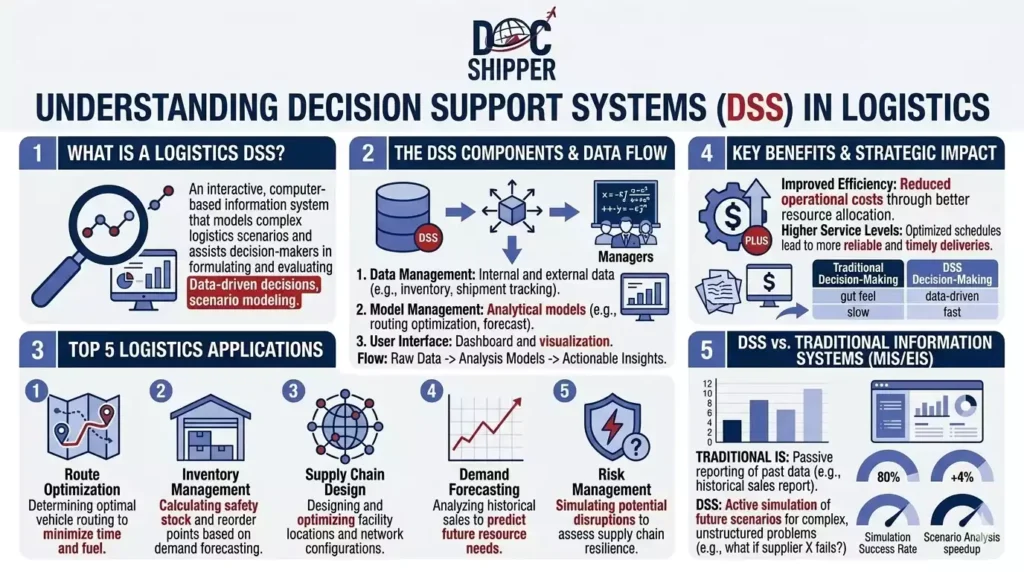
A Decision Support System (DSS) is a computer-based information system that supports business decision-making activities by analyzing large volumes of data and presenting actionable insights. In international logistics, DSS tools enable freight forwarders to optimize routes, predict costs, and mitigate supply chain risks through real-time analytics and scenario modeling.
Introduction
International freight operations involve countless variables: fluctuating fuel prices, customs regulations, carrier availability, and unpredictable transit times. Making optimal decisions without analytical support often leads to cost overruns and service failures.
Decision Support Systems have become indispensable in modern logistics management. They transform raw operational data into strategic intelligence, enabling companies to respond faster to market changes and customer demands.
- Data integration: Consolidates information from TMS, WMS, customs platforms, and carrier APIs into unified dashboards.
- Predictive analytics: Forecasts demand patterns, transit delays, and cost variations using historical data and machine learning algorithms.
- Scenario simulation: Models alternative routing options, carrier selections, and inventory strategies before execution.
- Real-time alerts: Notifies stakeholders of exceptions like shipment delays, documentation errors, or compliance issues.
- Performance tracking: Measures KPIs such as on-time delivery rates, cost per shipment, and carbon footprint metrics.
Technical Framework & Strategic Applications
A robust Decision Support System in logistics operates through three core layers: data acquisition, analytical processing, and user interface. The data layer pulls information from multiple sources including ERP systems, IoT sensors on cargo, port management systems, and external databases like weather services or geopolitical risk indices.
The analytical engine applies optimization algorithms to solve complex problems such as multi-modal route selection or warehouse location planning. Advanced DSS platforms incorporate artificial intelligence to identify patterns invisible to human analysts. For instance, machine learning models can predict which shipments face high customs inspection risk based on historical clearance data.
From a regulatory perspective, DSS tools help ensure compliance with international trade laws. The European Union’s Customs Decision System (CDS) exemplifies how governments use DSS frameworks to process import/export declarations. Companies must align their internal systems with such platforms to avoid penalties. The World Customs Organization provides detailed guidelines on electronic data interchange standards at wcoomd.org.
Cost-benefit analysis modules within DSS platforms allow logistics managers to compare scenarios instantly. Should a company choose air freight at $8/kg with 3-day delivery or ocean freight at $0.80/kg with 30-day transit? The system calculates total landed costs including inventory carrying costs, potential stockout penalties, and customer satisfaction impacts.
At DocShipper, we integrate DSS capabilities into our client operations to provide transparent cost projections and risk assessments before shipment execution. This proactive approach reduces surprises and builds trust throughout the supply chain process.
The collaborative dimension of modern DSS cannot be overlooked. Cloud-based platforms enable real-time information sharing between shippers, freight forwarders, customs brokers, and final consignees. This visibility reduces communication delays and allows coordinated responses to disruptions like port congestion or sudden tariff changes.
Concrete Examples & Performance Data
Leading logistics providers report measurable improvements after implementing Decision Support Systems. A European electronics importer reduced customs clearance time by 40% by using predictive analytics to pre-classify HS codes and prepare documentation before cargo arrival.
| DSS Application | Key Benefit | Typical ROI |
|---|---|---|
| Route Optimization | Reduces transit time and fuel costs through dynamic path selection | 15-25% cost savings |
| Demand Forecasting | Minimizes inventory holding costs while preventing stockouts | 20-30% inventory reduction |
| Carrier Performance Analysis | Identifies reliable partners and negotiates better contracts | 10-18% rate improvements |
| Risk Management | Alerts to geopolitical events, weather disruptions, or compliance changes | 50-70% reduction in critical incidents |
| Carbon Footprint Tracking | Supports sustainability reporting and regulatory compliance | Compliance + brand value |
Use Case: A pharmaceutical company shipping temperature-sensitive vaccines from Belgium to Southeast Asia implemented a DSS with IoT sensor integration. The system monitored real-time temperature data and automatically rerouted shipments when cold chain integrity was at risk. This prevented $2.3 million in potential product losses over one year.
Another example involves customs duty optimization. A textile importer used DSS analytics to identify tariff classification opportunities under free trade agreements. By adjusting product descriptions and sourcing strategies, the company reduced annual duty payments by 22%, equivalent to $450,000 in savings.
In the e-commerce sector, DSS platforms enable dynamic pricing strategies for shipping options. By analyzing customer behavior data, delivery speed preferences, and competitive rates, companies can offer personalized shipping choices that maximize both customer satisfaction and profit margins.
DocShipper leverages similar analytical frameworks to provide clients with scenario-based quotations. Before committing to a shipment method, our clients receive detailed comparisons showing cost, time, and risk factors across multiple logistics options.
Conclusion
Decision Support Systems represent a fundamental shift from reactive to proactive logistics management. By transforming data into strategic intelligence, DSS tools empower companies to navigate the complexities of international trade with confidence and precision.
Need expert guidance on implementing analytical solutions for your supply chain? Contact DocShipper to discuss how we can optimize your logistics operations.
📚 Quiz
Test Your Knowledge: Decision Support System (DSS)
Q1. What best defines a Decision Support System (DSS) in the context of international logistics?
Q2. A logistics manager believes that a DSS simply replaces human judgment entirely and makes final decisions autonomously. Is this interpretation correct?
Q3. A pharmaceutical company needs to ship temperature-sensitive vaccines and wants to prevent cold chain failures in real time. Which DSS application is most relevant to this scenario?
🎯 Your Result
📞 Free Quote in 24hFAQ | Decision Support System (DSS): Definition, Applications & Concrete Examples
Unlike basic reporting systems that display historical data, a DSS actively analyzes information to recommend actions, simulate outcomes, and support complex decision-making through predictive models and optimization algorithms.
Cloud-based DSS platforms offer scalable pricing models starting at $200-500 monthly. Many providers offer modular solutions where companies pay only for features they need, making advanced analytics accessible to SMEs.
Modern DSS platforms use API connections to integrate with existing TMS, ERP, and WMS systems without requiring complete infrastructure overhauls. Implementation typically takes 4-12 weeks depending on data complexity.
Typical inputs include shipment tracking data, carrier rate tables, customs documentation, warehouse inventory levels, customer order histories, weather forecasts, fuel price indices, and geopolitical risk assessments.
Advanced systems achieve 85-92% accuracy for ocean freight and 90-95% for air cargo when trained on sufficient historical data. Accuracy improves continuously as the system processes more shipments.
User-friendly interfaces designed for logistics professionals minimize training needs. Most users become proficient within 2-3 days of guided instruction, though advanced analytics features may require additional expertise.
Yes, specialized modules track regulatory changes, validate HS code classifications, calculate duty rates, and flag documentation errors before shipment to reduce clearance delays and penalty risks.
Most organizations report positive ROI within 6-18 months through cost reductions, efficiency gains, and error prevention. High-volume shippers often see returns in under 6 months.
Enterprise systems automatically convert currencies using real-time exchange rates and can lock rates for quotations. They also track forex exposure and recommend hedging strategies for large shipments.
Reputable providers implement bank-grade encryption, multi-factor authentication, and regular security audits. Cloud platforms often offer better security than on-premise solutions due to dedicated security teams.
Modern platforms calculate carbon emissions per shipment using methodologies aligned with GHG Protocol standards, enabling companies to meet ESG reporting requirements and identify greener logistics alternatives.
Effective DSS design allows users to override system recommendations while logging the rationale. Over time, these exceptions help refine algorithms to better reflect real-world constraints and business priorities.
Need Help with
Logistics or Sourcing ?
First, we secure the right products from the right suppliers at the right price by managing the sourcing process from start to finish. Then, we simplify your shipping experience - from pickup to final delivery - ensuring any product, anywhere, is delivered at highly competitive prices.


Fill the Form
Prefer email? Send us your inquiry, and we’ll get back to you as soon as possible.
Contact us




:%20Definition,%20Applications%20&%20Concrete%20Examples)