


In short ⚡
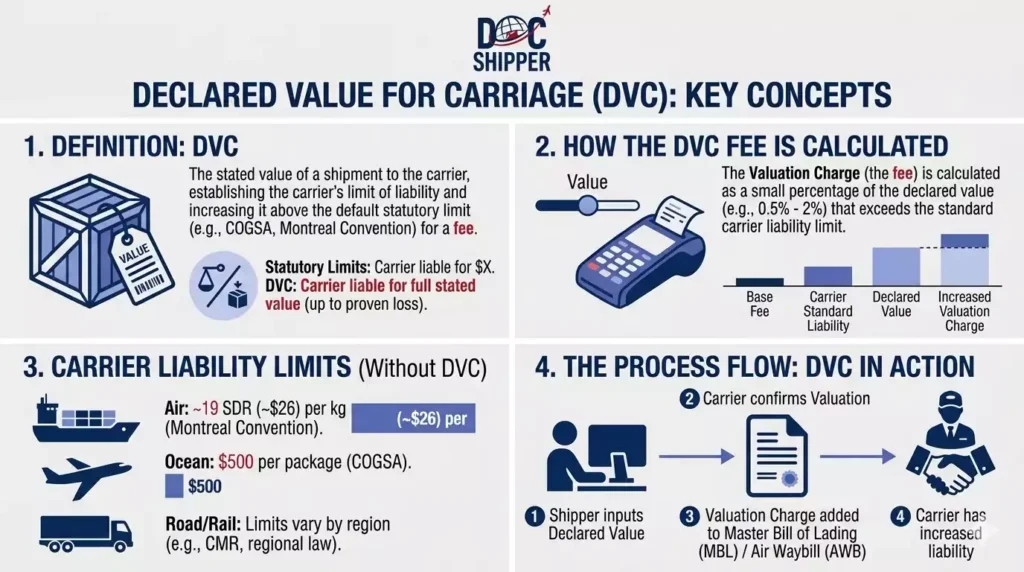
Declared Value for Carriage is the monetary value stated by the shipper to the carrier for transported goods, establishing the maximum carrier liability in case of loss or damage. This declaration directly affects freight rates and insurance premiums, serving as a critical risk management tool in international logistics.
Introduction
A common mistake in international shipping is confusing declared value with customs value or insurance coverage. While customs value determines duties and taxes, the Declared Value for Carriage specifically limits carrier responsibility.
This distinction becomes critical when goods are damaged or lost during transit. Without proper declaration, shippers may receive minimal compensation based on weight-based limitations under international conventions.
Key characteristics of Declared Value for Carriage include:
- Liability cap: Establishes maximum carrier compensation regardless of actual damage
- Rate determination: Higher declared values typically increase freight charges
- Convention compliance: Must align with CMR, Warsaw Convention, or maritime law requirements
- Documentation requirement: Must appear on bill of lading, air waybill, or consignment note
- Insurance distinction: Complements but does not replace cargo insurance coverage
Technical Framework & Legal Implications
The legal foundation for declared value varies by transport mode. Air freight follows the Montreal Convention (1999), limiting liability to 22 SDR per kilogram unless a higher value is declared. Road transport under CMR Convention caps compensation at 8.33 SDR per kilogram of gross weight.
Maritime shipments operate under different rules. The Hague-Visby Rules limit liability to 666.67 SDR per package or 2 SDR per kilogram, whichever is higher. Shippers must explicitly declare higher values on the bill of lading to exceed these limits.
The calculation methodology requires understanding actual value versus declared value. Actual value includes cost of goods, freight, and insurance (CIF). Declared value should reflect replacement cost, not depreciated value, to ensure adequate protection.
Carriers charge ad valorem rates based on declared value. A typical formula applies 0.5% to 1.5% of declared value as additional freight charge. This percentage decreases for higher values due to economies of scale.
At DocShipper, we systematically review declared values against invoice amounts to ensure compliance with carrier requirements and optimize cost-liability balance for our clients. This verification prevents both under-declaration penalties and unnecessary premium payments.
The burden of proof shifts depending on declaration. With proper declaration, carriers must prove they exercised due diligence. Without declaration, shippers must demonstrate carrier negligence—a significantly harder legal burden according to UNCTAD maritime transport reviews.
Practical Examples & Calculation Methods
Understanding declared value through real scenarios clarifies its financial impact. Consider three common shipping situations with different declaration strategies.
Comparative Scenario Analysis
| Scenario | Goods Value | Declared Value | Additional Charge | Max Compensation |
|---|---|---|---|---|
| No Declaration (Air) | $50,000 | $0 | $0 | $660 (30kg × 22 SDR) |
| Partial Declaration | $50,000 | $25,000 | $250 (1%) | $25,000 |
| Full Declaration | $50,000 | $50,000 | $375 (0.75%) | $50,000 |
Electronics Shipment Use Case
A technology distributor ships 100 laptops from Shanghai to Rotterdam. Invoice value: €80,000. Weight: 250kg.
Without declaration: Maximum compensation under CMR = 250kg × 8.33 SDR × €1.15 = €2,395. The shipper loses €77,605 in a total loss scenario.
With full declaration: Additional freight charge = €80,000 × 0.8% = €640. In case of loss, full €80,000 is recoverable from the carrier, minus the €640 premium paid.
Strategic approach: The shipper declares €80,000, pays €640 extra, but also purchases cargo insurance for €320 (0.4% rate). Total protection cost: €960, providing dual coverage through carrier liability and insurance policy.
Key Decision Factors
- Goods fragility: High-value electronics justify full declaration; bulk commodities may not
- Route risk: Emerging market routes warrant higher protection levels
- Carrier reputation: Established carriers with strong claims handling reduce need for maximum declaration
- Insurance availability: When cargo insurance is expensive or unavailable, declared value becomes primary protection
- Regulatory compliance: Some countries mandate minimum declared values for specific product categories
DocShipper’s logistics specialists analyze these variables to recommend optimal declared values, balancing cost efficiency with risk mitigation across your supply chain.
Conclusion
Declared Value for Carriage remains a fundamental yet often misunderstood component of freight liability management. Strategic declaration protects financial interests while optimizing transportation costs.
Need expert guidance on declared value strategies for your shipments? Contact DocShipper for customized logistics solutions that balance protection and cost efficiency.
📚 Quiz
Declared Value for Carriage
Q1 — What does the Declared Value for Carriage primarily establish?
Q2 — A shipper sends $50,000 worth of electronics by air without declaring any value. What is the likely maximum compensation under the Montreal Convention (30 kg shipment)?
Q3 — A freight forwarder books a shipment without receiving any declared value instructions from the shipper. What will the forwarder most likely do?
🎯 Your Result
📞 Free Quote in 24hFAQ | Declared Value for Carriage: Definition, Calculation & Practical Examples
No. Declared value determines carrier liability, while customs value calculates duties and taxes. They serve different regulatory purposes and often differ in amount.
Technically yes, but carriers may request proof of value. Over-declaration increases costs without additional benefit and may constitute fraud if used to claim inflated losses.
No. Declared value only covers carrier negligence. Cargo insurance provides broader protection including theft, natural disasters, and non-carrier-related damage during transit.
Carrier liability defaults to convention limits based on weight—typically $20-30 per kilogram for air freight and even less for sea/road transport, regardless of actual goods value.
Carriers may request commercial invoices, packing lists, or purchase orders. Significant discrepancies between declared and documented values can result in declaration rejection or adjusted rates.
Yes. Most carriers impose caps—often $100,000 to $500,000 per shipment. Higher values require special arrangements or mandatory insurance coverage.
Indirectly. Large discrepancies between declared carriage value and customs value may trigger audits. Both should reasonably align with commercial invoice amounts to avoid scrutiny.
Generally yes, before shipment pickup, by amending the transport document. After pickup, changes require carrier approval and may incur administrative fees.
Each transport leg may have different liability regimes. The multimodal transport operator typically applies the most restrictive convention unless a unified declared value covers the entire journey.
Transport documents (bill of lading, air waybill) showing declared value, commercial invoices, purchase orders, and payment receipts establish the basis for compensation claims.
No. Shippers must explicitly instruct forwarders on desired declared values. Without instructions, forwarders typically apply minimum or no declaration to reduce freight costs.
Warehouse operators often have separate liability limits. Declared value for carriage typically doesn't extend to storage periods unless specifically contracted through warehouse receipts.
Need Help with
Logistics or Sourcing ?
First, we secure the right products from the right suppliers at the right price by managing the sourcing process from start to finish. Then, we simplify your shipping experience - from pickup to final delivery - ensuring any product, anywhere, is delivered at highly competitive prices.


Fill the Form
Prefer email? Send us your inquiry, and we’ll get back to you as soon as possible.
Contact us




