



In short ⚡
A delivery appointment is a pre-scheduled time slot arranged between a shipper, carrier, and receiving facility to ensure coordinated goods delivery. This logistics mechanism prevents congestion, reduces wait times, and optimizes warehouse operations by controlling inbound freight flow and resource allocation.
Introduction
In international trade, unannounced deliveries create chaos at receiving docks. Trucks queue for hours. Warehouse staff scramble. Inventory systems falter. The delivery appointment solves this fundamental coordination problem.
This scheduling practice has become essential as supply chains grow more complex. Major retailers, distribution centers, and manufacturing facilities now mandate appointments to maintain operational efficiency.
- Time precision: Specific date and hour window (typically 2-4 hours)
- Documentation requirement: Confirmation numbers or reference codes
- Penalty structure: Fees for missed or late appointments ($50-$200 average)
- Advance booking: Usually 24-72 hours prior notice required
- Digital coordination: Portal-based or EDI systems for scheduling
Delivery Appointment Mechanisms & Logistics Impact
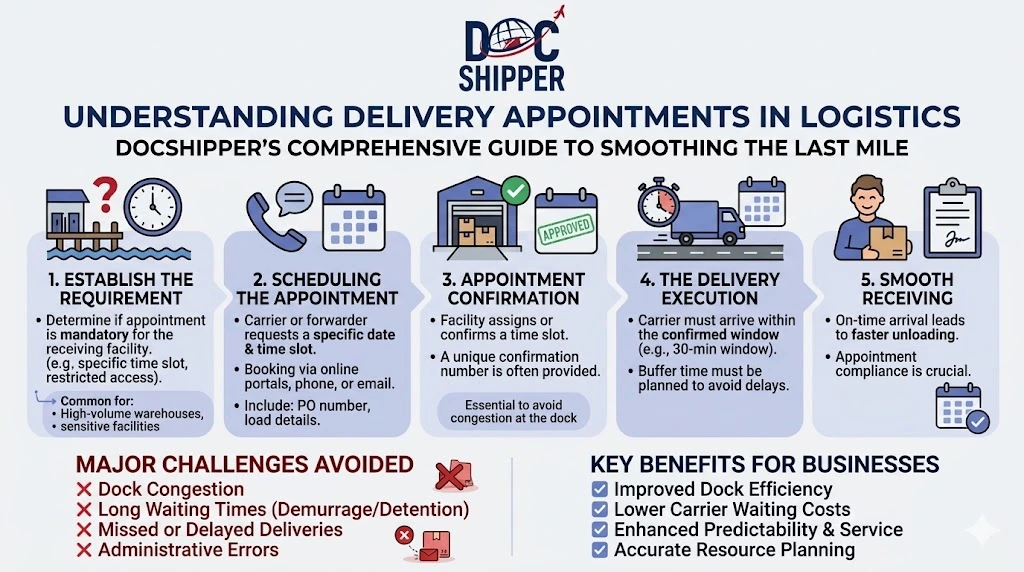
The appointment system functions as a capacity management tool. Warehouses allocate limited dock doors across multiple inbound shipments. Without scheduling, facilities face either overcrowding or underutilization.
Booking procedures vary by facility type. Retailers like Walmart use proprietary systems (MABD portal). Third-party logistics providers often employ Transportation Management Systems (TMS) with integrated scheduling. Some facilities still accept phone-based appointments, though digital methods dominate.
The confirmation process creates contractual obligation. Carriers receive appointment numbers that function as entry authorization. Arriving without valid confirmation typically results in rejection or extended wait times until a slot opens.
Regulatory considerations intersect with appointment systems. The U.S. Federal Motor Carrier Safety Administration (FMCSA) monitors detention time—hours drivers spend waiting beyond appointments. Facilities must balance scheduling efficiency against Hours of Service compliance for drivers. Reference: FMCSA Official Guidelines.
Technological integration enables real-time visibility. Modern systems connect with GPS tracking, allowing facilities to monitor approaching trucks and adjust dock assignments dynamically. At DocShipper, we coordinate delivery appointments across global supply chains, ensuring our clients’ shipments arrive punctually with all required documentation and confirmation codes in place.
The cost-benefit equation favors appointments. Studies show scheduled deliveries reduce average dwell time by 40-60%. Labor costs decrease when receiving staff know exactly when freight arrives. Inventory accuracy improves with predictable inbound flow.
Practical Examples & Operational Data
Real-world implementation reveals appointment systems’ operational impact. Consider these comparative scenarios across different facility types:
| Facility Type | Appointment Window | Advance Notice | Late Fee | Average Wait Time |
|---|---|---|---|---|
| Retail Distribution Center | 2 hours | 48-72 hours | $150-$250 | 15-30 minutes |
| Manufacturing Plant | 4 hours | 24-48 hours | $75-$150 | 30-60 minutes |
| Cross-Dock Facility | 1 hour | 12-24 hours | $100-$200 | 10-20 minutes |
| Port Terminal | 3 hours | 24 hours | $50-$125 | 45-90 minutes |
Use Case: Electronics Importer
A consumer electronics company imports 40-foot containers from Shenzhen to Los Angeles. Their distribution center requires appointments booked 72 hours in advance through an online portal. Without appointments, their previous carrier experienced 4-6 hour dock waits, costing $800-$1,200 in driver detention fees per delivery. After implementing systematic appointment booking, wait times dropped to 20 minutes average, eliminating detention charges and improving delivery predictability by 85%.
Operational efficiency metrics demonstrate appointment value:
- Dock utilization: Increases from 60% to 92% with scheduled arrivals
- Labor productivity: Receiving staff handle 35% more shipments per shift
- Inventory accuracy: Improves by 28% with predictable receiving schedules
- Carrier satisfaction: Driver detention complaints decrease by 70%
- Cost reduction: Average $3,500 monthly savings per 10-door facility
Peak season amplifies appointment importance. During Q4 retail rushes, facilities without appointment systems experience 200-300% wait time increases. Scheduled operations maintain consistent throughput even during volume surges.
Conclusion
Delivery appointments transform logistics chaos into coordinated operations. This simple scheduling mechanism delivers measurable efficiency gains across the supply chain. Modern international trade demands this level of coordination.
Need assistance managing delivery appointments for your international shipments? Contact DocShipper for comprehensive logistics coordination that ensures your freight arrives on schedule, every time.
📚 Quiz
Test Your Knowledge: Delivery Appointment
Q1 — What is the primary purpose of a delivery appointment in logistics?
Q2 — A carrier arrives at a retail distribution center 2 hours before their scheduled appointment window. What is the most likely outcome?
Q3 — An electronics importer previously experienced 4–6 hour dock waits and $800–$1,200 detention fees per delivery. After implementing systematic delivery appointment booking, what was the main operational outcome?
🎯 Your Result
📞 Free Quote in 24hFAQ | Delivery Appointment: Definition, Process & Practical Examples
Most facilities charge late fees ranging from $50-$250. You'll need to reschedule, which may delay delivery by 24-72 hours depending on facility capacity. Repeated violations can result in carrier blacklisting.
Standard practice requires 24-72 hours notice. Retail distribution centers typically need 48-72 hours. Manufacturing facilities often accept 24-48 hours. Always check specific facility requirements as policies vary significantly.
Yes, but policies vary. Most facilities allow changes up to 24 hours before the scheduled time without penalty. Last-minute changes (under 24 hours) may incur fees or require supervisor approval.
No, but the practice is increasingly common. Large retailers, major distribution centers, and most cross-dock facilities mandate appointments. Smaller warehouses and some manufacturing plants still accept unscheduled deliveries, though this is becoming rare.
Typically: delivery address, shipment reference number, carrier name, truck number, delivery date/time preference, freight type, weight, pallet count, and purchase order numbers. Some facilities require additional documentation like BOL copies.
Essentially yes, though terminology varies. "Appointment" implies confirmed reservation, while "time slot" or "delivery window" describes the available timeframe. Both refer to scheduled delivery coordination mechanisms.
Most facilities enforce strict windows. Arriving more than 15-30 minutes early often results in waiting until your scheduled time. Some high-security facilities won't allow early entry under any circumstances for security protocol reasons.
Detention time begins when a truck arrives for its scheduled appointment and waits beyond the agreed timeframe (typically 2 hours) for loading or unloading. Facilities must compensate carriers for excessive detention, usually $50-$100 per hour.
Yes, this is standard practice. Professional freight forwarders and logistics providers routinely coordinate delivery appointments as part of their service. They maintain relationships with facilities and understand specific booking requirements for different locations.
For the final delivery leg, yes. After customs clearance, goods moving to warehouses or distribution centers follow the same appointment protocols as domestic freight. Port terminals may have separate appointment systems for container pickup.
Digital platforms allow carriers to view available time slots, select preferred windows, and receive instant confirmation. Integration with Transportation Management Systems (TMS) enables automatic scheduling based on shipment data, reducing manual coordination effort by 70-80%.
Facilities maintain carrier performance records. Chronic violators face escalating penalties: increased fees, restricted time slot access, mandatory cash-on-delivery terms, or complete facility ban. Major retailers share blacklists, affecting carrier reputation industry-wide.
Need Help with
Logistics or Sourcing ?
First, we secure the right products from the right suppliers at the right price by managing the sourcing process from start to finish. Then, we simplify your shipping experience - from pickup to final delivery - ensuring any product, anywhere, is delivered at highly competitive prices.


Fill the Form
Prefer email? Send us your inquiry, and we’ll get back to you as soon as possible.
Contact us




