


In short ⚡
Delivery Performance to Request Date (DPRD) is a key supply chain metric measuring the percentage of orders delivered by the customer's originally requested date. It evaluates supplier reliability and fulfillment accuracy, directly impacting customer satisfaction and operational efficiency in international logistics.Introduction
In global trade, delayed shipments cost businesses billions annually. A manufacturer promises delivery by March 15th, but the container arrives March 22nd. Who bears the cost of production downtime?
Delivery Performance to Request Date answers this question by tracking fulfillment against customer expectations, not arbitrary internal deadlines. Unlike Delivery Performance to Commit Date (which measures against supplier promises), DPRD reflects true customer demand alignment.
Why DPRD matters in import/export operations:
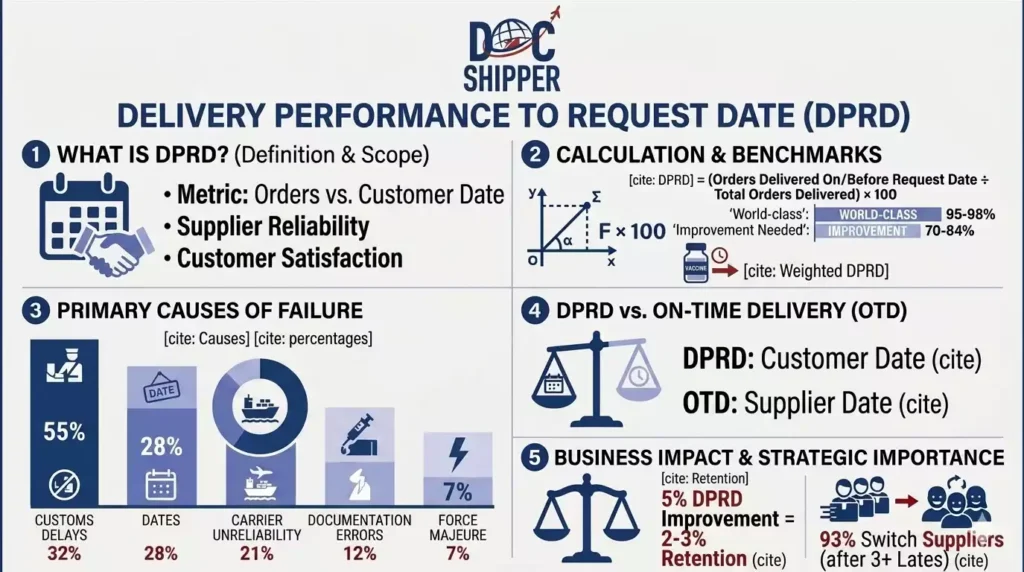
- Customer retention: 93% of buyers switch suppliers after repeated late deliveries (Supply Chain Digest, 2023)
- Inventory optimization: Accurate DPRD enables just-in-time manufacturing strategies
- Contract compliance: Many international agreements include DPRD-based penalty clauses
- Competitive differentiation: High DPRD scores (>95%) become market advantages
- Cash flow management: Late deliveries trigger payment disputes and working capital issues
Understanding DPRD & Strategic Importance
DPRD operates as the ultimate customer-centric performance indicator. While internal metrics track warehouse efficiency or carrier transit times, DPRD measures what truly matters: did the customer receive their order when they needed it?
The metric’s power lies in its simplicity. Calculate DPRD by dividing on-time deliveries by total deliveries, then multiply by 100. An order counts as “on-time” only if it arrives on or before the original request date specified by the customer at order placement.
Three critical distinctions separate DPRD from similar metrics:
Request Date vs. Commit Date: The request date reflects customer needs, while commit dates represent supplier promises. A supplier might commit to April 10th for a March 30th request—meeting the commit date still fails DPRD.
Partial Delivery Treatment: Industry standards vary. APICS defines partial shipments as late if any line item misses the request date. Other frameworks use weighted calculations based on order value or quantity fulfilled.
Date Definition Precision: International shipments require clarity. Does “delivery” mean port arrival, customs clearance, or final destination? At DocShipper, we align DPRD definitions with Incoterms to eliminate ambiguity in cross-border transactions.
According to the APICS Supply Chain Operations Reference (SCOR) model, DPRD belongs to the “Perfect Order” family of metrics. A perfect order requires on-time delivery, complete quantity, accurate documentation, and damage-free condition.
Legal implications intensify in international trade. EU Regulation 2023/1230 on supply chain due diligence mandates transparent performance reporting. Poor DPRD scores can trigger contractual penalties, insurance disputes, and reputational damage in tightly networked industries.
The metric also reveals operational bottlenecks. Consistent DPRD failures in specific trade lanes indicate customs delays, carrier reliability issues, or unrealistic customer expectations. DocShipper’s logistics audits frequently uncover that 40% of DPRD problems stem from inaccurate initial request dates rather than fulfillment failures.
Calculation Methods & Concrete Examples
DPRD calculation follows a straightforward formula, but real-world application requires nuanced interpretation. The basic equation:
DPRD = (Orders Delivered On/Before Request Date ÷ Total Orders Delivered) × 100
Consider this practical scenario from a European electronics importer:
| Order ID | Request Date | Actual Delivery | Status |
|---|---|---|---|
| PO-2401 | Feb 15, 2024 | Feb 14, 2024 | On-Time |
| PO-2402 | Feb 20, 2024 | Feb 23, 2024 | Late |
| PO-2403 | Feb 28, 2024 | Feb 28, 2024 | On-Time |
| PO-2404 | Mar 5, 2024 | Mar 8, 2024 | Late |
| PO-2405 | Mar 12, 2024 | Mar 10, 2024 | On-Time |
Calculation: 3 on-time orders ÷ 5 total orders × 100 = 60% DPRD
This 60% score signals critical performance gaps. Industry benchmarks show:
- World-class logistics: 95-98% DPRD
- Competitive performance: 85-94% DPRD
- Improvement needed: 70-84% DPRD
- Critical failure: Below 70% DPRD
Advanced Scenario – Weighted DPRD: A pharmaceutical distributor ships temperature-controlled products. Not all delays carry equal impact:
| Product Category | Order Value | Status | Weight Factor |
|---|---|---|---|
| Vaccines | $500,000 | Late (2 days) | 3x penalty |
| Bandages | $5,000 | On-Time | 1x standard |
Weighted DPRD accounts for business impact: (0 × 3 + 1 × 1) ÷ (3 + 1) = 25% weighted DPRD, versus 50% simple DPRD. This reveals the vaccine delay’s disproportionate damage.
Use Case – Seasonal Demand: A fashion retailer orders summer inventory with a May 1st request date. Delivery on May 5th misses peak selling season. The 4-day delay causes 30% markdowns, costing $120,000 in lost margin. Standard DPRD captures the failure, but financial DPRD quantifies true cost.
DocShipper tracks DPRD across 15 industry verticals, revealing that automotive clients average 91% DPRD while consumer electronics struggle at 78%. The difference? Automotive suppliers build 10-day buffers into production schedules, while electronics chase shorter lead times.
Conclusion
Delivery Performance to Request Date transforms abstract logistics data into customer satisfaction reality. Tracking DPRD exposes hidden costs, strengthens supplier relationships, and drives operational excellence in international supply chains.
Need expert support optimizing your delivery performance metrics? Contact DocShipper for customized logistics solutions that prioritize customer request dates.
📚 Quiz
Delivery Performance to Request Date (DPRD)
Q1 — What does Delivery Performance to Request Date (DPRD) actually measure?
Q2 — A supplier commits to delivering by April 10th for a customer's March 30th request date, and delivers exactly on April 10th. How does this affect DPRD?
Q3 — A European electronics importer has 5 orders in February–March 2024. Three are delivered on or before the request date, two arrive late. What is their DPRD score?
🎯 Your Result
📞 Free Quote in 24hFAQ | Delivery Performance to Request Date (DPRD): Definition, Calculation & Real-World Examples
On-time delivery measures against promised dates (commit dates), while DPRD measures against customer-requested dates. DPRD is more customer-centric and reflects true demand alignment.
Industry standards vary. Conservative approaches count any incomplete order as late. Alternative methods weight by quantity fulfilled or order value delivered by the request date.
World-class performance exceeds 95%. Competitive operations maintain 85-94%. Scores below 70% indicate systemic failures requiring immediate corrective action.
Yes, but requires clear Incoterms definitions. Specify whether "delivery" means port arrival, customs clearance, or final destination to avoid measurement disputes.
Research shows 93% of buyers switch suppliers after 3+ late deliveries. Every 5% DPRD improvement correlates with 2-3% higher customer retention in B2B contexts.
Standard DPRD treats early deliveries as on-time. However, some industries penalize early arrivals (e.g., just-in-time manufacturing) using modified "delivery window" metrics.
Top causes: customs delays (32%), inaccurate initial request dates (28%), carrier unreliability (21%), documentation errors (12%), and force majeure events (7%).
Monthly tracking identifies trends, while weekly monitoring enables rapid corrective action. High-volume operations benefit from real-time dashboards with daily DPRD updates.
Absolutely. Leading procurement teams weight DPRD at 25-40% of total supplier scores, combined with quality metrics, cost competitiveness, and responsiveness.
DPRD is one component of perfect order measurement. A perfect order requires on-time delivery (DPRD), complete quantity, accurate documentation, and damage-free condition.
Standard practice excludes documented force majeure delays from DPRD calculations, but only with proper notification and evidence. Contractual terms should define exclusion criteria.
Yes. Higher DPRD reduces expedited shipping needs, penalty payments, safety stock requirements, and customer service overhead. Companies improving DPRD by 10% typically see 3-5% total logistics cost reduction.
Need Help with
Logistics or Sourcing ?
First, we secure the right products from the right suppliers at the right price by managing the sourcing process from start to finish. Then, we simplify your shipping experience - from pickup to final delivery - ensuring any product, anywhere, is delivered at highly competitive prices.


Fill the Form
Prefer email? Send us your inquiry, and we’ll get back to you as soon as possible.
Contact us




:%20Definition,%20Calculation%20&%20Real-World%20Examples)