


In short ⚡
Distributed inventory is a supply chain strategy where stock is strategically positioned across multiple geographic locations rather than centralized in a single warehouse. This approach reduces delivery times, minimizes shipping costs, and enhances customer satisfaction by placing products closer to end consumers or regional markets.
Introduction
Many importers struggle with balancing inventory costs against customer expectations for fast delivery. Centralized warehousing often creates bottlenecks, inflates shipping expenses, and extends lead times—especially for businesses serving geographically dispersed markets.
Distributed inventory addresses these challenges by decentralizing stock across strategic nodes. This model is particularly relevant in international trade, where proximity to demand centers directly impacts competitiveness and operational efficiency.
- Geographic optimization: Stock positioned near high-demand regions reduces last-mile delivery costs
- Risk mitigation: Multiple locations protect against disruptions at any single facility
- Demand responsiveness: Regional warehouses enable faster order fulfillment and inventory adjustments
- Cost efficiency: Reduced long-distance transportation and lower expedited shipping requirements
- Scalability: Flexible network expansion as market presence grows
In-Depth Analysis & Strategic Expertise
Distributed inventory operates on the principle of network optimization—balancing inventory holding costs against transportation and service level objectives. Unlike centralized systems, this model requires sophisticated demand forecasting and inventory allocation algorithms.
The inventory positioning decision involves analyzing customer density, order frequency, product velocity, and transportation infrastructure. High-volume SKUs typically warrant broader distribution, while slow-moving items may remain centralized to avoid overstocking.
From a regulatory perspective, distributed networks must comply with local storage requirements, customs bonded warehouse regulations, and tax implications. The European Union’s VAT regulations, for instance, require careful consideration when distributing inventory across member states. Reference frameworks like the EU Customs Code provide essential guidance on cross-border inventory management.
Technology integration is critical for success. Warehouse Management Systems (WMS) must communicate seamlessly across locations, providing real-time visibility into stock levels, transfers, and replenishment needs. Advanced systems employ predictive analytics to optimize allocation dynamically.
The replenishment strategy determines how inventory flows between distribution points. Push systems preposition stock based on forecasts, while pull systems respond to actual demand signals. Hybrid approaches balance both methods to minimize stockouts and excess inventory.
At DocShipper, we design distributed inventory networks tailored to your supply chain requirements, ensuring compliance with international trade regulations while optimizing cost and service levels across your distribution footprint.
Practical Examples & Comparative Data
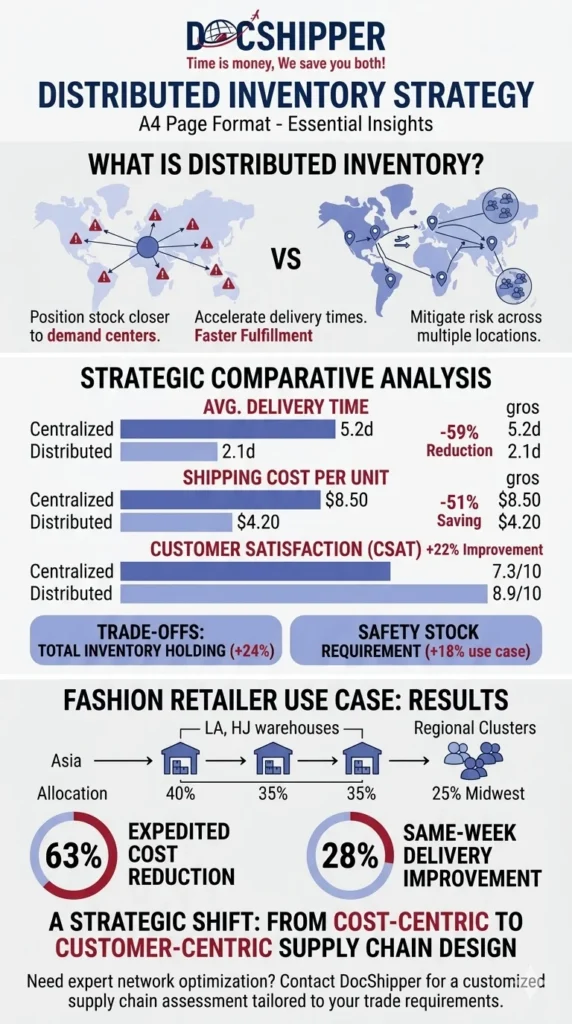
Consider an electronics importer serving the North American market. A comparative analysis reveals significant operational differences between centralized and distributed approaches:
| Metric | Centralized (Single Warehouse) | Distributed (4 Regional Centers) |
|---|---|---|
| Average Delivery Time | 5.2 days | 2.1 days |
| Shipping Cost per Unit | $8.50 | $4.20 |
| Total Inventory Holding | $2.1M | $2.6M (+24%) |
| Order Fill Rate | 91% | 97% |
| Customer Satisfaction Score | 7.3/10 | 8.9/10 |
Use Case: A fashion retailer importing apparel from Asia implements a distributed inventory model with warehouses in Los Angeles, Chicago, and New Jersey. During peak season, they allocate 40% of inventory to the East Coast facility based on historical demand patterns, 35% to the West Coast for proximity to ports, and 25% to the Midwest hub.
The result: a 63% reduction in expedited shipping costs and a 28% improvement in same-week delivery capability. However, safety stock requirements increased by 18% to buffer against demand variability across locations.
Key implementation factors include:
- Demand segmentation: ABC analysis determines which products justify distribution across all nodes
- Network design: Facility locations selected based on proximity to customer clusters and transportation hubs
- Inventory allocation algorithms: Dynamic rebalancing based on real-time sales velocity and forecast accuracy
- Cross-docking capabilities: Strategic transfer points enable efficient inter-facility movements
- Performance metrics: Service level agreements (SLAs) tracked by region to identify optimization opportunities
Conclusion
Distributed inventory represents a strategic shift from cost-centric to customer-centric supply chain design. While it increases inventory investment, the gains in delivery speed, customer satisfaction, and market responsiveness typically justify the additional holding costs for businesses serving broad geographic markets.
Need expert guidance on designing your distributed inventory network? Contact DocShipper for a customized supply chain assessment tailored to your international trade requirements.
📚 Quiz
Test Your Knowledge: Distributed Inventory
Q1 — What best defines a distributed inventory strategy?
Q2 — A common misconception about distributed inventory is that it always reduces total inventory costs. What actually happens to inventory investment when switching from centralized to distributed?
Q3 — A fashion retailer imports apparel from Asia and wants to cut expedited shipping costs while improving same-week delivery across the US. Which approach best applies distributed inventory principles?
🎯 Your Result
📞 Free Quote in 24hFAQ | Distributed Inventory: Definition, Calculation & Practical Examples
Distributed inventory spreads stock across multiple locations to reduce delivery times and shipping costs, while centralized inventory consolidates all stock in a single warehouse, simplifying management but potentially increasing transportation expenses and lead times.
The optimal number depends on customer geography, order volume, and service level targets. Most businesses start with 2-4 strategic locations, expanding as demand patterns justify additional nodes. Network modeling tools help determine the cost-benefit balance.
Yes, total inventory investment typically increases by 15-30% due to safety stock requirements at each location. However, reduced transportation costs and improved sales from faster delivery often offset this increase, resulting in better overall profitability.
A cloud-based Warehouse Management System (WMS) with multi-location visibility, automated replenishment logic, and integration with Transportation Management Systems (TMS) is critical. Advanced systems incorporate demand forecasting and inventory optimization algorithms.
Allocation strategies use historical sales data, regional demand forecasts, and product velocity analysis. Dynamic allocation models adjust stock levels based on real-time performance, seasonality, and promotional activities to minimize stockouts and overstock situations.
Cross-border distributed networks may require bonded warehouses, foreign trade zones, or customs warehousing procedures. Each location must comply with local import regulations, and inventory transfers between countries trigger customs declarations and potential duty implications.
Yes, through third-party logistics (3PL) providers offering multi-warehouse fulfillment networks. This allows small importers to access distributed infrastructure without capital investment, paying only for space and services used while gaining geographic reach.
Turnover rates may initially decrease due to higher total inventory levels. However, improved demand matching at the regional level often increases local turnover velocity, and reduced obsolescence from better market responsiveness can improve overall inventory health metrics.
High-velocity items with consistent demand, products with short lead times from suppliers, and goods where delivery speed creates competitive advantage are ideal candidates. Slow-moving or high-value specialty items typically remain centralized to minimize carrying costs.
Key performance indicators include average delivery time, transportation cost per unit, inventory turnover by location, order fill rates, customer satisfaction scores, and total landed cost. Compare these metrics against centralized baseline performance to quantify network effectiveness.
Primary risks include inventory imbalances between locations, increased complexity in demand planning, higher administrative overhead, potential stockouts if allocation models fail, and coordination challenges across multiple facilities. Robust technology and clear processes mitigate these risks.
Regional distribution centers enable ship-from-store capabilities, buy-online-pickup-in-store (BOPIS) services, and same-day delivery options. This inventory positioning creates flexibility to fulfill orders from the optimal location, improving customer experience across all sales channels.
Need Help with
Logistics or Sourcing ?
First, we secure the right products from the right suppliers at the right price by managing the sourcing process from start to finish. Then, we simplify your shipping experience - from pickup to final delivery - ensuring any product, anywhere, is delivered at highly competitive prices.


Fill the Form
Prefer email? Send us your inquiry, and we’ll get back to you as soon as possible.
Contact us




