


In short ⚡
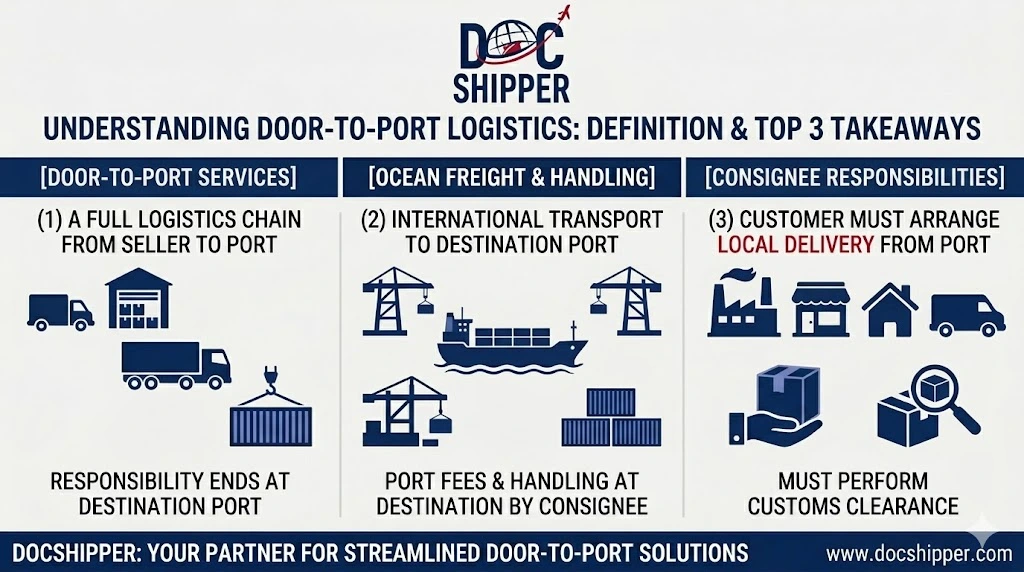
Door to Port is a shipping service where the freight forwarder collects cargo from the shipper's premises (door) and delivers it to the port of departure, managing all ground transportation and customs formalities. The consignee handles port-to-destination delivery independently. This partial logistics solution offers cost savings while requiring recipient coordination at destination.
Introduction
Many businesses struggle to determine which shipping service fits their operational capabilities and budget constraints. Choosing between full-service and partial logistics solutions directly impacts costs, control, and delivery timelines.
Door to Port shipping represents a strategic middle ground in international logistics. It transfers responsibility at a critical juncture—the departure port—allowing shippers to leverage professional collection services while maintaining destination-side autonomy.
Key characteristics of Door to Port services include:
- Origin collection: Freight forwarder picks up cargo from warehouse, factory, or business location
- Export customs clearance: Complete handling of export documentation and regulatory compliance
- Port delivery: Transportation to and delivery at the port of loading (POL)
- Responsibility transfer: Consignee assumes control once cargo reaches destination port
- Cost optimization: Lower total expense compared to door-to-door services
This service model proves particularly valuable for businesses with established networks at destination or those seeking to reduce logistics expenses without sacrificing origin-side convenience.
In-Depth Analysis & Expertise
Understanding Door to Port logistics requires examining the operational framework and legal implications that define this service model. The arrangement creates distinct zones of responsibility that affect insurance, liability, and documentation requirements.
The freight forwarder’s scope encompasses collection scheduling, cargo inspection, packaging verification, and ground transportation to the port. They coordinate with trucking partners, manage warehouse staging if necessary, and ensure compliance with export regulations. At DocShipper, we verify all documentation before port arrival to prevent customs delays that could incur demurrage charges.
Export customs procedures remain entirely within the forwarder’s domain. This includes preparing commercial invoices, packing lists, certificates of origin, and any product-specific documentation. According to World Customs Organization standards, accurate classification under the Harmonized System (HS) codes is mandatory to avoid clearance issues.
The transfer point at the port of loading represents the critical handover moment. The Bill of Lading (B/L) becomes the primary document transferring custody. Under Incoterms® 2020, this arrangement most closely aligns with FAS (Free Alongside Ship) or FOB (Free On Board), depending on where precisely responsibility shifts.
Destination-side obligations fall entirely on the consignee. They must arrange port pickup, import customs clearance, duty payment, and final delivery. This requires local logistics expertise or partnerships. Businesses lacking destination infrastructure often face unexpected costs when underestimating this complexity.
Insurance considerations become nuanced with Door to Port arrangements. Cargo insurance coverage must clearly define the protected journey segment. Standard forwarder insurance typically covers origin to port of loading, while consignees need separate policies for port-to-door destination segments. Gap coverage disputes frequently arise when this isn’t properly coordinated.
Practical Examples & Data
Examining real-world scenarios clarifies when Door to Port shipping delivers maximum value. Cost structures, operational requirements, and business contexts determine optimal service selection.
Comparative Cost Analysis
| Service Type | Origin Handling | Ocean Freight | Destination Handling | Total Estimate (20ft) |
|---|---|---|---|---|
| Door to Port | $450 | $1,800 | $0 (client arranged) | $2,250 |
| Door to Door | $450 | $1,800 | $850 | $3,100 |
| Port to Port | $0 (client arranged) | $1,800 | $0 (client arranged) | $1,800 |
This comparison demonstrates potential savings of 27% compared to door-to-door services when destination logistics are handled independently. However, hidden costs at destination can eliminate these savings if not properly managed.
Use Case: Electronics Manufacturer
A German electronics manufacturer ships components to their Brazilian assembly plant quarterly. They selected Door to Port service because:
- Established destination network: Their Brazilian facility has dedicated logistics staff and customs broker relationships
- Volume efficiency: Handling 4 annual shipments internally saves approximately €3,200 annually
- Inventory control: Direct port pickup allows immediate quality inspection before warehouse entry
- Customs expertise: Local team navigates Brazil’s complex import regulations more effectively than foreign forwarders
Key Decision Factors
Door to Port services work best when these conditions exist:
- Destination infrastructure: Established logistics partnerships or in-house capabilities at receiving location
- Regulatory knowledge: Import customs expertise to handle destination clearance independently
- Volume consistency: Regular shipments justify maintaining destination-side relationships
- Cost sensitivity: Budget constraints make partial service attractive despite added coordination
- Control preference: Desire for direct oversight of destination delivery and customs processes
At DocShipper, we assess client capabilities before recommending Door to Port arrangements. Businesses without destination expertise often discover that coordination costs and delays exceed initial savings, making full-service options more economical overall.
Conclusion
Door to Port shipping offers strategic value for businesses with destination-side logistics capabilities. It balances professional origin handling with cost optimization, though success requires careful assessment of receiving-end infrastructure and expertise.
Need guidance on selecting the right shipping service for your supply chain? Contact DocShipper for personalized logistics consulting tailored to your operational requirements.
📚 Quiz
Test Your Knowledge: Door to Port
Q1 — What does "Door to Port" shipping mean?
Q2 — A first-time importer with no local logistics partners is considering Door to Port service to save costs. Is this a good choice?
Q3 — In a Door to Port shipment, who is responsible for export customs clearance at the origin country?
🎯 Your Result
📞 Free Quote in 24hFAQ | Door to Port: Definition, Process & Practical Examples
"Door" refers to the shipper's physical location—warehouse, factory, or business premises—where the freight forwarder collects the cargo. It includes any accessible pickup point specified by the shipper, not limited to literal doorways.
The freight forwarder manages all export customs procedures, including documentation preparation, HS code classification, and regulatory compliance at the origin country. This remains within their service scope until port delivery.
Responsibility typically transfers when cargo is delivered to the port of loading, though the precise moment depends on the agreed Incoterm. FOB transfers at ship's rail, while FAS transfers alongside the vessel before loading.
Yes, Door to Port service includes ocean freight from the departure port to the destination port. The consignee only handles post-arrival port charges, customs clearance, and inland transportation at destination.
Consignees receive the original Bill of Lading, commercial invoice, packing list, and any certificates required for import clearance. These documents are essential for claiming cargo and completing customs procedures at destination.
Yes, ocean carriers provide container tracking through the Bill of Lading number. Most freight forwarders also offer tracking platforms that monitor vessel progress and estimated arrival times at destination ports.
Liability depends on where damage occurred. If during origin pickup or port delivery, the forwarder's insurance applies. If during ocean transit, carrier liability under the Bill of Lading terms governs. Comprehensive cargo insurance is strongly recommended.
Most forwarders require 48-72 hours' notice for standard pickups. Rush services may be available with 24-hour notice but typically incur additional charges. Scheduling flexibility depends on origin location and carrier availability.
Common charges include terminal handling fees (THC), documentation fees, port storage (if applicable), customs examination fees, and import duties/taxes. These vary significantly by country and port, ranging from $200 to $800+ for standard containers.
Generally not recommended for first-time importers without destination logistics partners. The complexity of import customs clearance, port coordination, and inland transportation requires expertise that inexperienced importers often lack, leading to costly delays and errors.
Yes, freight forwarders can consolidate multiple Door to Port shipments into shared containers (LCL). This reduces costs for smaller shipments while maintaining the service structure where consignees handle destination-side logistics independently.
The primary advantage is cost reduction—typically 20-30% savings on total logistics expenses. Businesses with established destination networks can leverage local relationships and expertise while still benefiting from professional origin-side handling and export compliance management.
Need Help with
Logistics or Sourcing ?
First, we secure the right products from the right suppliers at the right price by managing the sourcing process from start to finish. Then, we simplify your shipping experience - from pickup to final delivery - ensuring any product, anywhere, is delivered at highly competitive prices.


Fill the Form
Prefer email? Send us your inquiry, and we’ll get back to you as soon as possible.
Contact us




