


In short ⚡
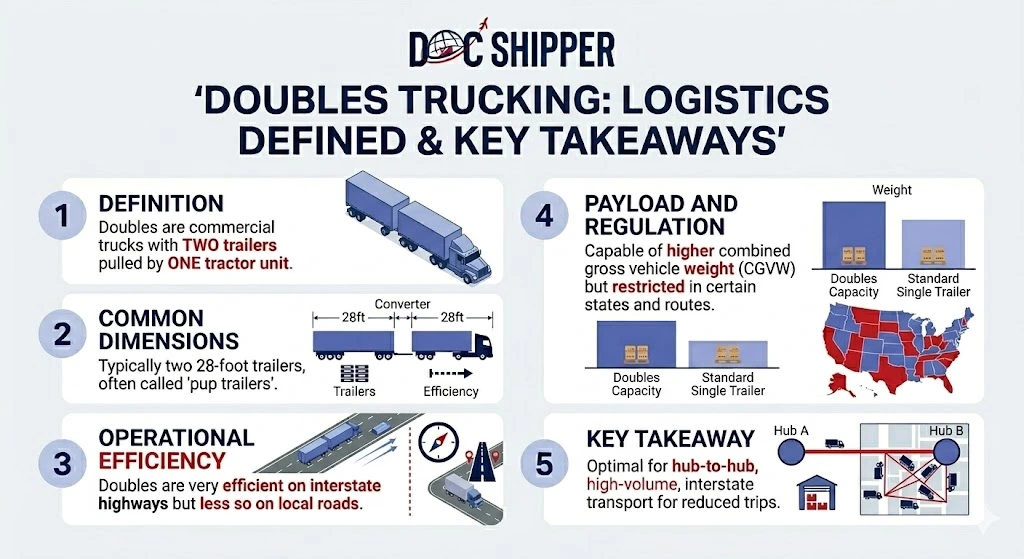
Doubles refer to truck configurations combining two trailers pulled by a single tractor unit, commonly used in freight transportation to maximize payload capacity while maintaining operational efficiency. This configuration is particularly prevalent in North America and Australia, where regulatory frameworks permit longer combination vehicles (LCVs) for intercity and long-haul freight movements.
Introduction
Many logistics professionals confuse doubles with standard semi-trailers or triple configurations, leading to compliance issues and inefficient route planning. Understanding this vehicle type is essential for optimizing freight costs, meeting regulatory requirements, and ensuring safety in international supply chains.
Doubles play a critical role in reducing per-unit transportation costs and carbon emissions. Their strategic deployment can significantly impact delivery timelines and operational margins in cross-border logistics.
- Configuration: One tractor pulling two separate trailers connected by a converter dolly
- Total length: Typically 25-28 meters (varies by jurisdiction)
- Payload capacity: 40-60 tons depending on axle configurations
- Primary markets: USA, Canada, Australia, Mexico (limited European use)
- Regulatory complexity: Requires specific permits and route approvals in most regions
Technical & Regulatory Framework
The legal operation of doubles depends on strict adherence to national and regional transportation codes. In the United States, the Federal Motor Carrier Safety Administration (FMCSA) governs dimensional and weight standards under the Surface Transportation Assistance Act (STAA).
Axle weight distribution is the primary technical consideration. Each trailer must distribute load evenly across designated axle groups to prevent infrastructure damage and ensure vehicle stability. Improper loading can lead to jackknifing or trailer sway, particularly in adverse weather conditions.
Converter dolly specifications vary significantly between manufacturers. This coupling mechanism must meet ISO 1102 standards for kingpin dimensions and possess adequate braking systems synchronized with both trailers. At DocShipper, we systematically verify dolly certifications during equipment inspections to prevent coupling failures during international transits.
Route restrictions apply extensively in urban areas and mountainous terrain. Many municipalities prohibit doubles on roads with tight turning radii or insufficient bridge clearances. Carriers must obtain special permits detailing approved corridors, often requiring GPS tracking for compliance verification.
Driver qualification requirements exceed standard commercial license thresholds. Operators must complete specialized training in multi-trailer handling, emergency braking procedures, and backing maneuvers. Insurance premiums typically increase 15-25% for doubles operations compared to single-trailer configurations.
Environmental considerations increasingly influence regulatory frameworks. California’s Advanced Clean Trucks regulation mandates zero-emission alternatives for certain freight corridors by 2035, potentially limiting diesel-powered doubles in key logistics zones.
Operational Examples & Data
Real-world applications demonstrate the strategic value of doubles in specific logistics scenarios. The following comparative analysis illustrates cost-efficiency differences across common freight routes.
| Configuration | Payload (tons) | Fuel Efficiency (L/100km) | Cost per Ton-Mile (USD) | Ideal Use Case |
|---|---|---|---|---|
| Single Semi-Trailer | 22-26 | 28-32 | 0.18 | Urban delivery, mixed cargo |
| Doubles | 40-50 | 35-40 | 0.12 | Long-haul, bulk goods |
| Triples (B-Trains) | 55-65 | 42-48 | 0.10 | Remote corridors, mining |
Case Study: Cross-Border Canada-USA Freight
A major retailer shipping consumer electronics from Vancouver to Chicago faces a 2,100-mile transit. Using doubles instead of two single trailers reduces:
- Driver costs by 45% (one operator versus two)
- Fuel consumption by 18% per ton-mile
- Carbon emissions by approximately 12 metric tons CO₂ annually
- Total logistics costs by 22% over 50 annual trips
Operational constraints emerged at the US border crossing. Customs clearance required separate documentation for each trailer, adding 35 minutes to processing time. DocShipper coordinated pre-clearance procedures to mitigate delays, demonstrating the importance of regulatory expertise in doubles operations.
Loading optimization follows the 60/40 weight distribution principle. Heavier cargo occupies the lead trailer to enhance traction and braking performance. Simulation data shows improper loading increases accident risk by 34% in emergency stopping scenarios.
Technology integration now includes telematics systems monitoring individual trailer weight, tire pressure, and brake temperature. Fleet managers receive real-time alerts when parameters deviate from safe thresholds, reducing breakdown incidents by 28% according to industry benchmarks.
Seasonal variations impact doubles utilization significantly. During peak retail seasons (Q4), capacity utilization reaches 95%, while off-peak periods drop to 62%. Dynamic pricing models adjust rates based on demand fluctuations and route-specific permit availability.
Conclusion
Doubles represent a strategic asset for high-volume, long-distance freight operations where regulatory environments permit their use. Proper implementation requires meticulous attention to weight distribution, route planning, and compliance protocols to maximize efficiency while maintaining safety standards.
Need expert guidance on integrating doubles into your logistics strategy? Contact DocShipper for tailored solutions across international freight corridors.
📚 Quiz
Test Your Knowledge: Doubles in Logistics
Q1 — What is the correct definition of "doubles" in freight transportation?
Q2 — A logistics manager assumes that doubles can be freely operated across all EU member states since they are widely used in North America. Is this correct?
Q3 — A retailer is shipping bulk goods from Vancouver to Chicago on a long-haul route. Which configuration best optimizes cost-per-ton-mile and driver costs?
🎯 Your Result
📞 Free Quote in 24hFAQ | Doubles in Logistics: Definition, Calculation & Practical Examples
Federal regulations permit doubles up to 28 feet per trailer on designated STAA routes, with total combination length not exceeding 65-75 feet depending on state laws. Western states generally allow longer configurations than eastern jurisdictions.
EU regulations severely restrict doubles, with most member states prohibiting them entirely. Only Finland, Sweden, and the Netherlands permit limited use under strict dimensional controls (25.25 meters maximum). Cross-border operations face significant regulatory barriers.
Commercial auto liability premiums increase 15-30% for doubles due to higher accident severity potential and increased cargo value. Carriers must maintain minimum coverage of $1 million per occurrence, with many shippers requiring $5 million umbrella policies.
Operators need a Class A commercial driver's license (CDL) with doubles/triples endorsement. Training includes 8-12 hours of specialized instruction covering coupling procedures, weight distribution, and emergency maneuvers. Annual recertification is mandatory in most jurisdictions.
Yes, doubles reduce fuel consumption by 18-25% per ton-mile compared to operating two single-trailer units over the same route. Aerodynamic drag decreases and driver labor costs are halved, though fuel efficiency declines in mountainous terrain.
Converter dollies are coupling devices connecting the lead trailer to the rear trailer, featuring a kingpin, axle assembly, and integrated braking system. They must meet SAE J2638 standards and undergo annual inspections to prevent catastrophic decoupling incidents.
Yes, but with additional restrictions. Placarding requirements apply to each trailer separately, and route approvals must account for hazmat classifications. Some states prohibit certain hazard classes in doubles configurations, particularly flammable liquids exceeding 1,000 gallons per trailer.
High crosswinds (above 40 mph) create severe trailer sway risks, often triggering operational shutdowns. Winter conditions require tire chain installations on all axles, reducing speed limits to 35-45 mph. Insurance claims data shows 40% higher accident rates during adverse weather.
Initial equipment investment for doubles (tractor, two trailers, dolly) ranges $180,000-$250,000 versus $120,000-$160,000 for single-trailer setups. However, operational costs per ton-mile decrease by 20-25%, achieving payback within 18-24 months on high-volume routes.
The industry standard applies a 60/40 split: 60% of total payload in the lead trailer, 40% in the rear. Federal Bridge Formula B governs axle spacing and weight limits, calculated as W = 500[(LN/N-1) + 12N + 36], where L is axle spacing and N is axle count.
Each trailer requires separate customs declarations, commercial invoices, and cargo manifests. Processing times increase 25-40% compared to single-trailer crossings. Pre-clearance programs like C-TPAT and PIP significantly reduce delays through expedited inspection lanes.
Modern systems integrate GPS tracking, electronic logging devices (ELDs), tire pressure monitoring (TPMS), and predictive maintenance algorithms. Telematics platforms provide real-time visibility into individual trailer locations, enabling dynamic route optimization and reducing empty miles by 12-18%.
Need Help with
Logistics or Sourcing ?
First, we secure the right products from the right suppliers at the right price by managing the sourcing process from start to finish. Then, we simplify your shipping experience - from pickup to final delivery - ensuring any product, anywhere, is delivered at highly competitive prices.


Fill the Form
Prefer email? Send us your inquiry, and we’ll get back to you as soon as possible.
Contact us




