


In short ⚡
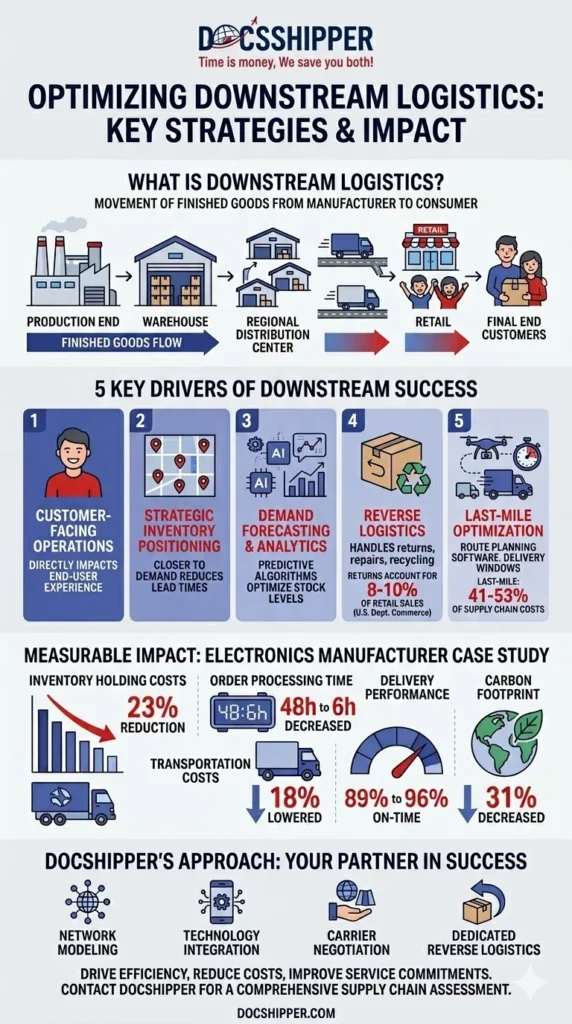
Downstream refers to all logistics activities occurring after production, including warehousing, distribution, transportation to retailers, and final delivery to end customers. It represents the flow of finished goods from manufacturer to consumer, encompassing inventory management, order fulfillment, and last-mile delivery operations.
Introduction
Many businesses struggle to understand where their supply chain responsibilities truly begin and end. The confusion between upstream and downstream operations often leads to inefficiencies, missed opportunities, and customer dissatisfaction.
In international trade and logistics, downstream activities represent the critical final phase where products reach their intended markets. This segment determines customer satisfaction, brand reputation, and ultimately, profitability.
Key characteristics of downstream logistics include:
- Customer-facing operations that directly impact end-user experience
- Distribution network management across multiple channels and geographies
- Inventory positioning at strategic locations closer to demand points
- Order fulfillment processes including picking, packing, and shipping
- Last-mile delivery coordination representing the final touchpoint with customers
Downstream Operations: Strategic Depth & Expertise
Downstream logistics encompasses the entire distribution infrastructure required to move finished goods from production facilities to end consumers. This includes warehouse network design, transportation mode selection, and channel partner coordination.
The distribution center hierarchy typically involves regional hubs, local fulfillment centers, and cross-dock facilities. Each level serves specific functions in balancing inventory costs against service level requirements. Strategic placement reduces transportation expenses while maintaining delivery speed commitments.
Modern downstream operations leverage demand forecasting algorithms to position inventory proactively. Predictive analytics analyze historical sales patterns, seasonal trends, and market signals to optimize stock levels across the network. This prevents both stockouts and excess inventory situations.
Order management systems orchestrate the entire fulfillment process from order capture through delivery confirmation. These platforms integrate with warehouse management systems, transportation management systems, and carrier networks to provide real-time visibility and control.
The reverse logistics component handles product returns, repairs, and recycling. According to the U.S. Department of Commerce, returns account for 8-10% of total retail sales, making efficient reverse flows critical for profitability. At DocShipper, we implement comprehensive downstream strategies that include dedicated reverse logistics protocols to minimize return processing costs.
Last-mile delivery represents the most expensive and complex downstream segment. It accounts for 41-53% of total supply chain costs while being the primary driver of customer satisfaction. Optimization strategies include route planning software, delivery time windows, and alternative delivery locations.
Concrete Examples & Industry Data
Understanding downstream logistics becomes clearer through practical scenarios and measurable outcomes across different industries.
Comparative Downstream Models
| Industry | Distribution Model | Average Lead Time | Key Metric |
|---|---|---|---|
| E-commerce | Direct-to-consumer fulfillment centers | 1-3 days | Order accuracy: 99.5% |
| Automotive | Regional distribution centers to dealerships | 5-10 days | Fill rate: 95% |
| Pharmaceuticals | Temperature-controlled hub-and-spoke | 24-48 hours | Temperature compliance: 100% |
| Consumer Electronics | Omnichannel (stores + online) | 2-5 days | Return rate: 8-12% |
Use Case: Electronics Manufacturer Downstream Optimization
A global electronics company restructured its downstream network by consolidating 12 regional warehouses into 4 strategic fulfillment centers equipped with automation technology.
Results achieved:
- Inventory holding costs reduced by 23% through centralized stock positioning
- Order processing time decreased from 48 hours to 6 hours using automated picking systems
- Transportation costs lowered by 18% through optimized routing algorithms
- Customer delivery performance improved from 89% to 96% on-time delivery rate
- Carbon footprint reduced by 31% through consolidated shipments and route optimization
At DocShipper, we’ve implemented similar downstream transformations for clients across electronics, textiles, and industrial equipment sectors. Our approach combines network modeling, technology integration, and carrier negotiation to deliver measurable improvements in both cost and service performance.
Conclusion
Downstream logistics represents the critical bridge between production and consumption, directly impacting customer satisfaction and business profitability. Effective downstream strategies balance inventory costs, transportation efficiency, and service level commitments through strategic network design and technology integration.
Need expert guidance on optimizing your downstream operations? Contact DocShipper for a comprehensive supply chain assessment tailored to your business requirements.
📚 Quiz
Test Your Knowledge: Downstream Logistics
Q1 — Which of the following best defines "downstream" in logistics?
Q2 — A logistics manager argues that last-mile delivery is a minor cost factor in downstream operations. Is this correct?
Q3 — A pharmaceutical company ships temperature-sensitive vaccines from its factory to hospitals across the country. Which downstream model best fits this scenario?
🎯 Your Result
📞 Free Quote in 24hFAQ | Downstream: Definition, Applications & Concrete Examples in Logistics
Upstream logistics covers raw material sourcing and transportation to manufacturing facilities, while downstream logistics handles finished goods distribution from factories to end customers. Upstream focuses on supply, downstream on distribution and delivery.
Key components include warehousing and distribution centers, transportation networks, order management systems, inventory positioning strategies, last-mile delivery operations, and reverse logistics for returns and repairs.
Downstream operations directly determine delivery speed, order accuracy, product availability, and return processing efficiency. These factors collectively shape the customer experience and influence repeat purchase decisions and brand loyalty.
Warehouse management systems (WMS), transportation management systems (TMS), route optimization software, demand forecasting algorithms, automated picking systems, and real-time tracking platforms significantly enhance downstream efficiency and visibility.
Downstream activities typically account for 50-65% of total supply chain costs, with last-mile delivery alone representing 41-53% of these expenses. Warehousing, inventory carrying, and transportation comprise the remaining downstream expenditures.
Cost reduction strategies include network consolidation, automation implementation, route optimization, demand forecasting improvements, carrier contract negotiation, inventory positioning optimization, and shared distribution models with complementary businesses.
Last-mile delivery represents the final transportation leg from a local distribution point to the customer's delivery address. It's the most expensive and visible downstream segment, directly impacting customer perception and satisfaction.
E-commerce demands faster delivery times, smaller shipment sizes, higher order accuracy, flexible delivery options, and efficient return processes. This requires distributed fulfillment networks closer to customers and advanced technology integration.
Reverse logistics manages product returns, repairs, refurbishment, and recycling flowing backward through the supply chain. It includes return authorization, inspection, disposition decision-making, and recovery value maximization from returned products.
Key performance indicators include on-time delivery rate, order accuracy, inventory turnover, fill rate, perfect order percentage, delivery cost per unit, return processing time, and customer satisfaction scores related to delivery experience.
Strategic inventory positioning balances service levels against holding costs by placing products at optimal network locations. Closer positioning reduces delivery time but increases inventory costs, requiring data-driven optimization based on demand patterns.
Industry variations include perishable goods requiring cold chain infrastructure, pharmaceuticals demanding regulatory compliance, automotive using just-in-time delivery, fashion needing seasonal flexibility, and electronics balancing speed with product protection requirements.
Need Help with
Logistics or Sourcing ?
First, we secure the right products from the right suppliers at the right price by managing the sourcing process from start to finish. Then, we simplify your shipping experience - from pickup to final delivery - ensuring any product, anywhere, is delivered at highly competitive prices.


Fill the Form
Prefer email? Send us your inquiry, and we’ll get back to you as soon as possible.
Contact us




