


In short ⚡
Distribution is the process of moving goods from manufacturer to end consumer through intermediaries, warehouses, and transportation networks. It encompasses inventory management, order fulfillment, logistics coordination, and delivery execution to ensure products reach their destination efficiently and cost-effectively.
Introduction
Many businesses struggle to understand why their products arrive late, damaged, or at inflated costs. The answer often lies in poor distribution strategy.
Distribution is the backbone of international trade. It determines delivery speed, customer satisfaction, and profit margins. Without optimized distribution, even the best products fail to reach their market potential.
- Multi-channel approach: Direct sales, wholesalers, retailers, e-commerce platforms
- Geographic coverage: Local, regional, national, or global reach
- Inventory positioning: Strategic warehouse placement to reduce delivery times
- Cost structure: Balance between speed, coverage, and operational expenses
- Technology integration: WMS, TMS, and tracking systems for visibility
Distribution Models & Logistics Expertise
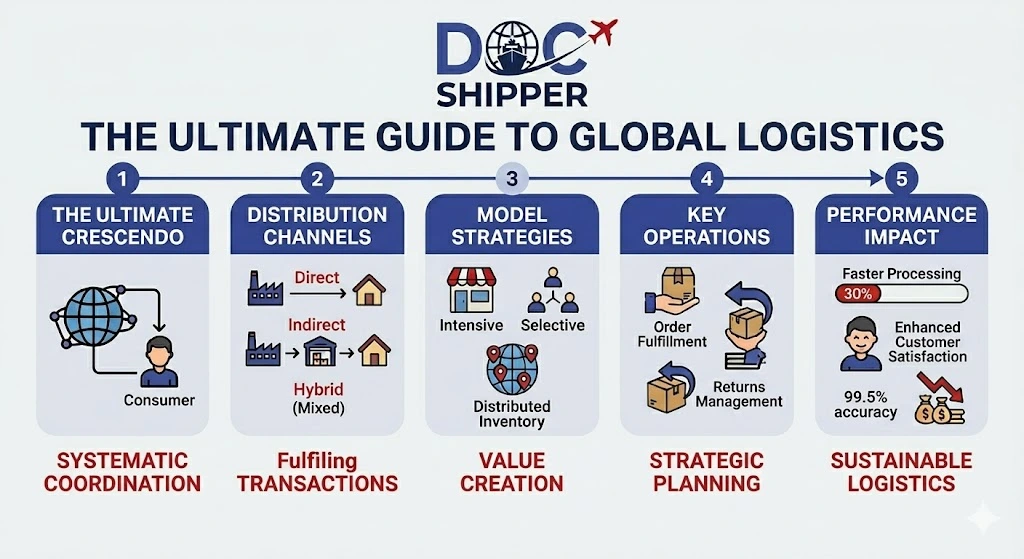
Distribution operates through distinct models, each with specific advantages. Direct distribution eliminates intermediaries, giving manufacturers full control over pricing and customer relationships. This model suits high-value or specialized products requiring technical support.
Indirect distribution leverages wholesalers, distributors, and retailers to expand market reach. This approach reduces capital requirements but sacrifices margin control. Most consumer goods follow this path for economies of scale.
The hybrid model combines both approaches. Manufacturers sell directly to large accounts while using distributors for smaller markets. This flexibility maximizes coverage while maintaining strategic relationships.
Fulfillment strategies determine inventory location. Centralized distribution uses one or few warehouses for cost efficiency. Decentralized networks position stock closer to customers, reducing delivery times but increasing complexity. At DocShipper, we analyze your product characteristics and customer distribution to recommend the optimal warehouse network.
Legal frameworks govern distribution agreements. The European Union Block Exemption Regulation sets rules for vertical agreements, protecting competition while allowing selective distribution. Understanding these regulations prevents costly legal disputes and market access issues.
Concrete Examples & Data
Distribution costs typically represent 15-30% of product retail price. Understanding these components helps optimize margins.
| Distribution Model | Cost Structure | Delivery Time | Best For |
|---|---|---|---|
| Direct E-commerce | 8-12% of sales | 3-7 days | Electronics, fashion, niche products |
| Wholesale Distribution | 18-25% of sales | 7-14 days | FMCG, consumer goods, bulk items |
| Retail Partnership | 25-35% of sales | Immediate (in-store) | Mass market products, impulse buys |
| Dropshipping | 5-8% of sales | 5-15 days | Low-margin, test products, startups |
Case Study: A European electronics importer reduced distribution costs by 22% through network optimization. Initially using five regional warehouses, they consolidated to two strategic hubs near major ports. Combined with cross-docking for fast-moving items, average delivery time decreased from 4.2 to 2.8 days while cutting warehousing expenses by €180,000 annually.
Amazon’s fulfillment network demonstrates advanced distribution. With over 175 fulfillment centers globally, they position inventory within 20 miles of 72% of US population. This enables same-day delivery for Prime members while maintaining inventory turnover of 8.1 times annually.
Temperature-controlled distribution for pharmaceuticals requires specialized infrastructure. Cold chain logistics adds 30-50% to standard distribution costs but ensures product integrity. A typical vaccine distribution network maintains 2-8°C throughout transit, with real-time monitoring and backup refrigeration systems.
DocShipper manages distribution networks across 50+ countries, coordinating customs clearance, warehousing, and last-mile delivery. Our clients benefit from consolidated shipping rates and optimized routing algorithms that reduce transit times by an average of 18%.
Conclusion
Distribution strategy directly impacts profitability, customer satisfaction, and market competitiveness. Choosing the right model and infrastructure requires analyzing product characteristics, target markets, and cost structures.
Need expert guidance on optimizing your distribution network? Contact DocShipper for a customized logistics assessment.
📚 Quiz
Test Your Knowledge: Distribution
Q1 — What is the core definition of "distribution" in logistics?
Q2 — Which statement correctly distinguishes distribution from logistics?
Q3 — A startup wants to test a new product line with minimal upfront investment and no need to hold inventory. Which distribution model best fits their situation?
🎯 Your Result
📞 Free Quote in 24hFAQ | Distribution: Definition, Models & Concrete Examples
Logistics focuses on transportation and warehousing operations. Distribution encompasses the broader commercial strategy of how products reach customers, including channel selection, inventory positioning, and partner relationships.
Direct distribution works best for high-margin products, technical goods, or when customer relationships matter. Indirect distribution suits mass-market items where volume and geographic coverage outweigh margin control.
Distribution rights grant exclusive or non-exclusive authority to sell products in specific territories. These agreements define pricing, marketing support, minimum purchase volumes, and territorial boundaries to prevent channel conflict.
This depends on delivery speed requirements, order volumes, and product characteristics. Fast-moving consumer goods typically need regional warehouses. Slow-moving or bulky items work better with centralized distribution to minimize inventory costs.
Cross-docking transfers goods directly from inbound to outbound trucks with minimal warehousing. This reduces handling costs and speeds delivery for time-sensitive or pre-sold products, common in retail and grocery distribution.
Pharmaceuticals incur 20-30% due to cold chain requirements. Electronics average 12-18% with high-value density. FMCG products range 18-25% due to volume and perishability. Luxury goods maintain 8-15% through selective distribution.
Selective distribution limits the number of intermediaries selling your products. Luxury brands use this to maintain exclusivity and brand image. It requires careful legal structuring to comply with competition law.
E-commerce enables direct-to-consumer models, bypassing traditional intermediaries. However, it requires investment in fulfillment infrastructure, returns management, and last-mile delivery capabilities. Many brands now use omnichannel strategies combining both.
Last-mile distribution covers the final delivery leg from local hub to customer. It represents 28% of total logistics costs despite being the shortest distance. Urban congestion and failed deliveries make this the most expensive distribution segment.
Key metrics include order fulfillment rate (target: 95%+), on-time delivery (target: 90%+), inventory turnover (varies by industry), distribution cost as percentage of sales, and customer satisfaction scores. Track these monthly for continuous improvement.
Reverse distribution manages product returns, repairs, and recycling. E-commerce returns average 20-30% of sales. Efficient reverse logistics recovers value through refurbishment, resale, or proper disposal while maintaining customer satisfaction.
Yes, DocShipper provides end-to-end distribution services including warehousing, inventory management, order fulfillment, customs clearance, and delivery coordination. We design customized solutions based on your product requirements and target markets.
Need Help with
Logistics or Sourcing ?
First, we secure the right products from the right suppliers at the right price by managing the sourcing process from start to finish. Then, we simplify your shipping experience - from pickup to final delivery - ensuring any product, anywhere, is delivered at highly competitive prices.


Fill the Form
Prefer email? Send us your inquiry, and we’ll get back to you as soon as possible.
Contact us




