


In short ⚡
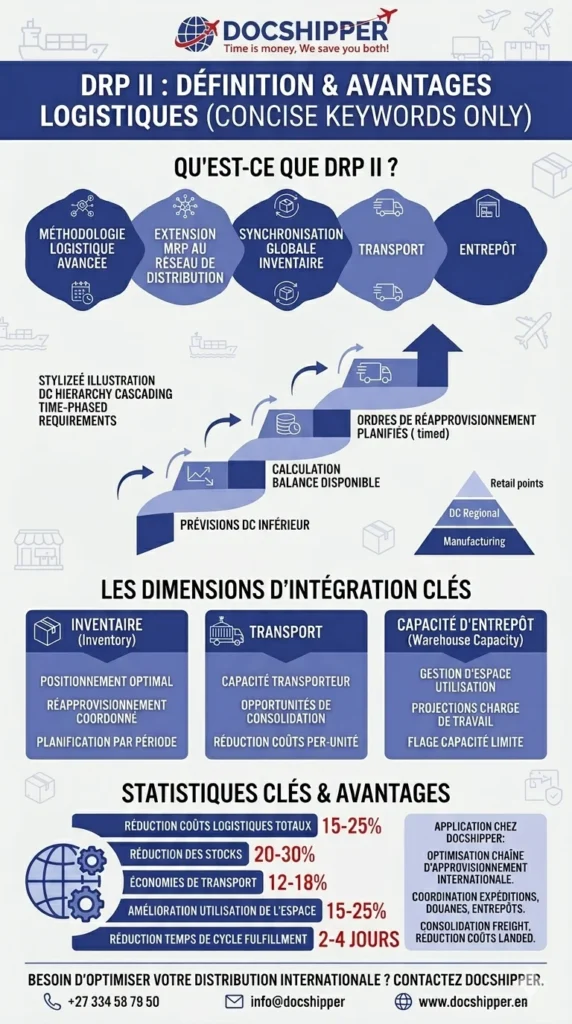
Distribution Resource Planning (DRP II) is an advanced logistics methodology that extends material requirements planning (MRP) to distribution networks, synchronizing inventory replenishment, transportation resources, and warehouse capacity across multiple distribution centers to optimize supply chain performance and customer service levels.
Introduction
Global supply chains face a persistent challenge: how to position inventory across distribution networks without creating excess stock or stockouts. Traditional planning methods treat warehouses as isolated units, leading to inefficient resource allocation and customer dissatisfaction.
DRP II emerged as a solution to coordinate distribution activities across entire networks. Unlike basic inventory management, it integrates demand forecasting, transportation planning, and warehouse capacity constraints into a unified system that drives operational decisions.
Key characteristics include:
- Time-phased planning based on actual customer demand patterns
- Coordinated replenishment across multi-echelon distribution networks
- Integration of transportation capacity and warehouse space constraints
- Synchronization between distribution planning and manufacturing schedules
- Real-time visibility into inventory positions and future requirements
For international freight operations, DRP II determines optimal shipping schedules, consolidation opportunities, and inventory positioning strategies that reduce total landed costs while maintaining service commitments.
DRP II Framework & Expert Insights
The DRP II methodology operates through a hierarchical planning structure. At the lowest level, individual distribution centers generate time-phased requirements based on customer demand forecasts and current inventory positions. These requirements cascade upward through regional distribution centers to central warehouses and ultimately to manufacturing facilities.
The planning logic follows a structured calculation sequence. Each distribution point maintains a projected available balance that considers on-hand inventory, scheduled receipts, and forecasted demand. When projected inventory falls below safety stock levels, the system generates planned replenishment orders timed to arrive before stockouts occur.
Critical to effective DRP II implementation is the concept of distribution lead times. These encompass order processing time, warehouse picking and packing, transportation transit, and receiving operations. Accurate lead time data ensures replenishment orders trigger at the correct moment to maintain inventory availability without excessive carrying costs.
Transportation resource planning represents a key advancement beyond basic DRP systems. DRP II evaluates carrier capacity constraints, consolidation opportunities, and routing efficiency. The system identifies situations where multiple distribution centers require shipments from the same source during overlapping timeframes, enabling freight consolidation that reduces per-unit transportation costs.
Warehouse capacity management forms another critical dimension. DRP II monitors space utilization projections across planning horizons, flagging periods when receiving volumes exceed handling capacity or storage availability. This visibility enables proactive adjustments to shipment schedules or temporary capacity arrangements.
At DocShipper, we implement DRP II principles when coordinating multi-country distribution projects, ensuring optimal timing of international shipments while balancing customs clearance windows, warehouse receiving schedules, and final delivery commitments across diverse markets.
According to the World Trade Organization’s logistics performance research, companies utilizing advanced distribution planning methodologies achieve 15-25% reductions in total logistics costs compared to reactive replenishment approaches.
Practical Applications & Data Analysis
Consider a European electronics distributor operating five regional warehouses serving 200 retail locations. Each warehouse maintains 3,000 SKUs with varying demand patterns and lead times from Asian manufacturing sources.
Scenario Analysis: A popular smartphone accessory shows the following weekly demand pattern at the German distribution center:
| Week | Forecast Demand | On-Hand Inventory | Scheduled Receipts | Projected Available | Planned Order |
|---|---|---|---|---|---|
| 1 | 450 units | 1,200 units | – | 750 units | – |
| 2 | 520 units | – | – | 230 units | 2,000 units |
| 3 | 480 units | – | – | -250 units | – |
| 4 | 510 units | – | 2,000 units | 1,240 units | – |
The DRP II system identifies Week 2 as the trigger point for replenishment. With a 2-week ocean freight lead time from Shanghai to Hamburg, the planned order must release immediately to prevent stockouts in Week 3.
Transportation Optimization: The system simultaneously evaluates requirements across all five European distribution centers. Analysis reveals:
- Consolidation opportunity: Three warehouses require shipments during the same 2-week window
- Container optimization: Combined volumes fill one 40-foot container versus three LCL shipments
- Cost reduction: Consolidated shipment reduces per-unit freight cost by 38%
- Lead time impact: Adds 3 days for deconsolidation but generates €4,200 savings
- Inventory trade-off: Additional safety stock of 150 units per location offsets extended lead time
Real-world implementation data from manufacturing sectors shows measurable performance improvements. Companies deploying DRP II typically achieve:
- Inventory reduction of 20-30% while maintaining service levels above 95%
- Transportation cost savings of 12-18% through improved consolidation
- Warehouse space utilization improvements of 15-25%
- Order fulfillment cycle time reductions of 2-4 days
- Planning labor productivity gains of 30-40% versus manual methods
At DocShipper, we apply these planning principles when managing complex distribution projects, coordinating ocean freight schedules with warehouse receiving capacity and final delivery windows to optimize total landed costs for our clients’ international supply chains.
Conclusion
Distribution Resource Planning II represents a comprehensive approach to managing multi-echelon distribution networks, integrating demand planning, inventory positioning, transportation optimization, and capacity management into unified decision frameworks that drive superior supply chain performance.
Need expert guidance on optimizing your international distribution strategy? Contact DocShipper for tailored logistics solutions.
📚 Quiz
Test Your Knowledge: DRP II (Distribution Resource Planning)
Q1 — What is the primary purpose of DRP II (Distribution Resource Planning II)?
Q2 — A common misconception about DRP II is that it functions the same as basic DRP. What is the key advancement DRP II offers over basic DRP?
Q3 — A European electronics distributor uses DRP II and finds that three of its five warehouses need shipments from the same Asian supplier within the same 2-week window. What action does DRP II recommend?
🎯 Your Result
📞 Free Quote in 24hFAQ | DRP II (Distribution Resource Planning): Definition, Calculation & Practical Examples
DRP II extends basic distribution requirements planning by incorporating transportation resource planning, warehouse capacity constraints, and financial planning dimensions. It provides integrated decision support across distribution, transportation, and inventory management functions rather than focusing solely on replenishment timing.
DRP II systems incorporate safety stock calculations based on demand variability and service level targets. The methodology uses statistical forecasting techniques to project demand distributions, then determines buffer inventory levels that balance stockout risk against carrying cost implications.
Modern DRP II solutions typically function as modules within enterprise resource planning platforms or integrate via APIs. They consume demand forecasts, inventory positions, and master data from ERP systems while generating planned orders that feed back into procurement and production planning workflows.
Successful DRP II implementation requires inventory accuracy above 95%, lead time data precision within ±10%, and forecast accuracy at aggregate levels exceeding 80%. Poor data quality undermines planning logic and generates excessive expediting or obsolescence costs.
Most organizations execute DRP II replanning weekly, though some industries with volatile demand patterns or short lead times implement daily cycles. The planning frequency should align with demand variability, replenishment lead times, and operational decision-making cadences.
E-commerce businesses leverage DRP II principles to position inventory across fulfillment networks, balancing proximity to customers against inventory carrying costs. The methodology proves particularly valuable for omnichannel retailers managing inventory across stores, fulfillment centers, and drop-ship arrangements.
For global supply chains, DRP II coordinates inventory flows across customs zones, managing extended ocean freight lead times, customs clearance windows, and regional distribution requirements. It optimizes container utilization and consolidation opportunities while accounting for international shipping constraints.
DRP II systems incorporate seasonal indices and promotional lift factors into demand projections. The planning logic adjusts safety stock levels and replenishment timing to build inventory in advance of peak periods while avoiding excess stock during slow seasons.
DRP II implementations typically require 6-12 months, encompassing system configuration, data cleansing, process redesign, user training, and phased rollout. Complex multi-country networks may extend to 18-24 months when integrating diverse legacy systems and organizational structures.
While enterprise-scale DRP II software may prove cost-prohibitive for smaller operations, the underlying planning principles apply universally. Simplified implementations using spreadsheet tools or entry-level planning software can deliver significant improvements over reactive replenishment approaches.
DRP II contributes to sustainability by optimizing transportation consolidation, reducing empty miles, minimizing expedited freight, and preventing obsolescence through improved demand-supply matching. These operational improvements directly reduce carbon emissions and waste generation across distribution networks.
Key performance indicators include inventory turnover rates, order fill rates, perfect order percentages, transportation cost per unit, warehouse space utilization, and planning forecast accuracy. Successful implementations show simultaneous improvements across service, cost, and asset efficiency dimensions.
Need Help with
Logistics or Sourcing ?
First, we secure the right products from the right suppliers at the right price by managing the sourcing process from start to finish. Then, we simplify your shipping experience - from pickup to final delivery - ensuring any product, anywhere, is delivered at highly competitive prices.


Fill the Form
Prefer email? Send us your inquiry, and we’ll get back to you as soon as possible.
Contact us




