


In short ⚡
Drum-Buffer-Rope (DBR) is a production scheduling methodology derived from the Theory of Constraints (TOC) that synchronizes the entire manufacturing flow to the pace of the bottleneck (drum), protects it with time buffers, and controls material release through a signaling mechanism (rope).Introduction
Many logistics and manufacturing operations struggle with inventory buildup, missed delivery dates, and resource inefficiencies despite having adequate capacity. The root cause often lies in poor synchronization between production stages.
Drum-Buffer-Rope (DBR) addresses this challenge by focusing the entire supply chain on the constraint—the slowest point that determines overall throughput. This approach transforms chaotic production into a predictable, flow-oriented system.
Key characteristics of DBR include:
- Identification of the system’s constraint (bottleneck)
- Scheduling production to match constraint capacity
- Time buffers to protect throughput from variability
- Material release control preventing overproduction
- Continuous monitoring of buffer consumption for early warnings
DBR Methodology & Strategic Implementation
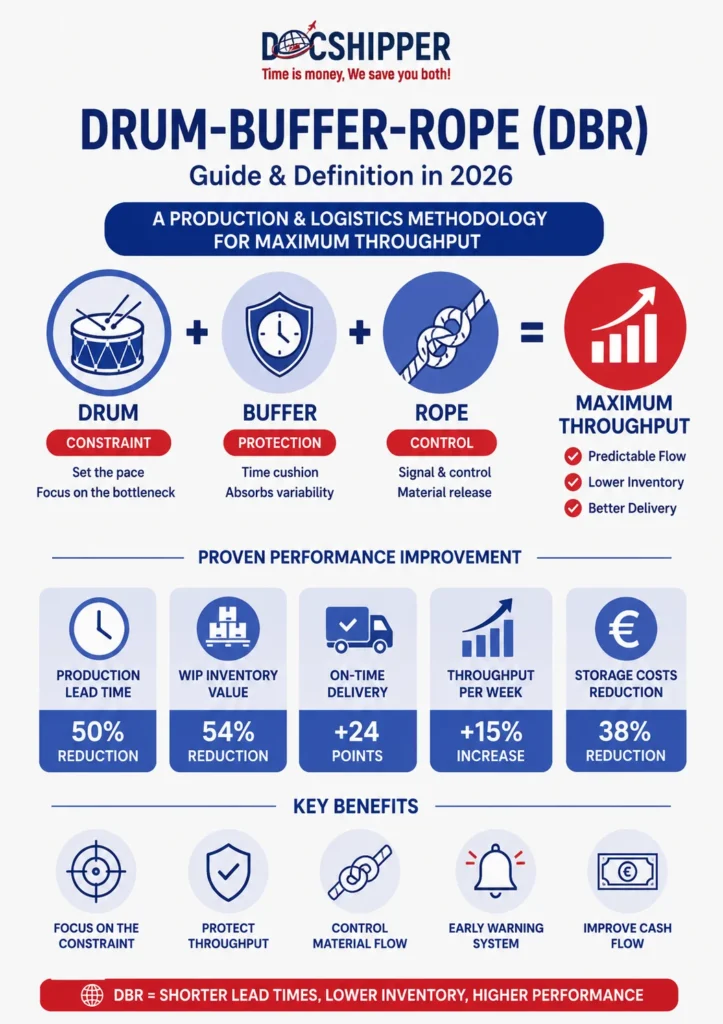
The Drum represents the constraint—the resource with the lowest capacity relative to demand. All production scheduling revolves around maximizing this bottleneck’s utilization, as it dictates the system’s overall output rate.
The Buffer is not physical inventory but rather a time cushion placed before the constraint. Typically measured in hours or days, this buffer absorbs normal variability in upstream processes, ensuring the constraint never starves for work. Buffer management involves monitoring consumption zones (green, yellow, red) to trigger corrective actions before disruptions occur.
The Rope is the communication mechanism linking material release to constraint consumption. It prevents raw materials from entering the system faster than the bottleneck can process them, thereby controlling work-in-process inventory. The rope length equals the buffer time plus the longest cumulative processing time before the constraint.
Implementation requires constraint identification through capacity analysis, followed by subordination of all non-constraint resources to the drum’s schedule. Organizations must resist the temptation to maximize local efficiencies, as this creates excess inventory without improving throughput.
According to the Theory of Constraints International Certification Organization (TOCICO), successful DBR implementations typically reduce lead times by 25-50% while simultaneously decreasing inventory levels. At DocShipper, we integrate DBR principles into our supply chain consulting to help clients optimize their international logistics flows and eliminate bottlenecks across multi-modal transportation networks.
Practical Examples & Performance Data
Consider an electronics manufacturer importing components from Asia for assembly in Europe. Their constraint is the surface-mount technology (SMT) line operating at 85% capacity. By implementing DBR:
| Metric | Before DBR | After DBR | Improvement |
|---|---|---|---|
| Production Lead Time | 18 days | 9 days | 50% reduction |
| WIP Inventory Value | €2.4M | €1.1M | 54% reduction |
| On-Time Delivery | 72% | 96% | +24 points |
| Throughput per Week | 850 units | 980 units | +15% |
A textile importer applied DBR to their distribution network. The constraint was identified as their customs clearance process, which could handle 12 containers per day. They established a 2-day buffer before clearance and controlled container releases from the port accordingly. This eliminated demurrage charges and reduced storage costs by 38%.
In automotive logistics, a Tier-1 supplier implemented DBR with these parameters:
- Drum: Heat treatment furnace (capacity: 200 pieces/hour)
- Buffer: 8-hour time buffer protecting the furnace
- Rope: Material release triggered when buffer drops to 6 hours
- Result: 99.2% constraint utilization, zero stockouts over 6 months
- Additional benefit: 42% reduction in expedited freight costs
DocShipper applies DBR concepts when coordinating international shipments, treating customs clearance or vessel loading schedules as the “drum” and adjusting upstream collection and consolidation activities accordingly. This approach has helped clients reduce dwell times by an average of 30%.
Conclusion
Drum-Buffer-Rope transforms production and logistics into a synchronized system focused on maximizing throughput while minimizing inventory and lead times. By subordinating all activities to the constraint’s rhythm, organizations achieve predictable delivery performance and improved cash flow.
Need assistance implementing DBR principles in your international supply chain? Contact DocShipper for expert guidance on optimizing your logistics operations.
📚 Quiz
Test Your Knowledge: Drum-Buffer-Rope (DBR)
Q1 — What does the "Drum" represent in the Drum-Buffer-Rope methodology?
Q2 — A common misconception about the "Buffer" in DBR is that it refers to physical safety stock. What does it actually represent?
Q3 — A textile importer identifies customs clearance as their constraint, handling 12 containers per day. Applying DBR correctly, what should they do?
🎯 Your Result
📞 Free Quote in 24hFAQ | Drum-Buffer-Rope (DBR): Definition, Implementation & Practical Examples
DBR schedules based on constraint capacity and uses time buffers, while MRP calculates backward from due dates assuming infinite capacity. DBR focuses on flow; MRP focuses on material availability.
Start with 50% of the current lead time, then adjust based on buffer penetration frequency. If the buffer frequently enters the red zone, increase it; if it stays green, reduce it gradually.
Yes, DBR is particularly effective in complex environments. The key is identifying the constraint across product families and using buffer management to handle variability in processing times and demand.
The drum moves to the new constraint, buffers are repositioned, and the rope is recalculated. This is part of the ongoing improvement process in Theory of Constraints methodology.
Rush orders are inserted into the drum schedule based on priority, and buffer holes are created. The rope mechanism adjusts material release to accommodate the urgent requirement without disrupting overall flow.
DBR principles apply to any flow-based operation, including logistics networks, healthcare facilities, software development, and professional services. The constraint might be a person, process, or policy rather than equipment.
Specialized TOC software exists, but DBR can be implemented using ERP systems with custom scheduling logic, or even spreadsheets for smaller operations. The methodology matters more than the technology.
Initial improvements in lead time and inventory often appear within 4-8 weeks. Full benefits, including cultural change and sustained throughput increases, typically materialize over 6-12 months.
Misidentifying the constraint, setting buffers based on worst-case scenarios, failing to subordinate non-constraints, and reverting to efficiency metrics that encourage local optimization over system performance.
DBR provides the scheduling framework while Lean eliminates waste and Six Sigma reduces variability. DBR determines where to focus improvement efforts—primarily at and before the constraint—making other methodologies more effective.
Yes, by stabilizing flow and improving schedule reliability, DBR reduces demand variability that drives safety stock requirements. Time buffers replace inventory buffers, decreasing working capital needs.
Key metrics include constraint utilization rate, buffer penetration frequency by zone, throughput dollar-days, inventory dollar-days, on-time delivery performance, and lead time distribution. These provide early warning of system degradation.
Need Help with
Logistics or Sourcing ?
First, we secure the right products from the right suppliers at the right price by managing the sourcing process from start to finish. Then, we simplify your shipping experience - from pickup to final delivery - ensuring any product, anywhere, is delivered at highly competitive prices.


Fill the Form
Prefer email? Send us your inquiry, and we’ll get back to you as soon as possible.
Contact us




:%20Guide%20&%20Definition%20in%202026)