


In short ⚡
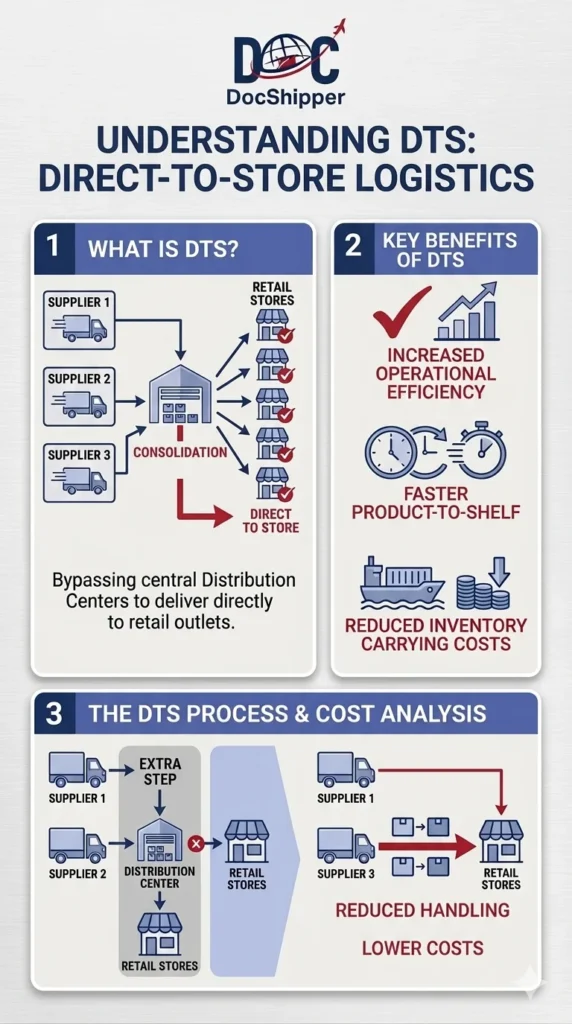
Direct-to-Store (DTS) delivery is a logistics model where products bypass distribution centers and are shipped directly from manufacturers or suppliers to retail locations. This streamlined approach reduces handling steps, accelerates inventory turnover, and minimizes storage costs while ensuring fresher products reach store shelves faster.Introduction
Many retailers struggle with inventory bottlenecks, expired perishables, and excessive warehousing expenses. Traditional distribution models require multiple handling points, creating delays and increasing operational complexity.
Direct-to-Store delivery addresses these challenges by eliminating intermediate storage facilities. This model has become essential for fast-moving consumer goods (FMCG), fresh produce, and time-sensitive products in international trade.
Key characteristics of DTS logistics include:
- Reduced transit time: Products move directly from production to retail shelves
- Lower handling costs: Elimination of warehouse storage and intermediate sorting
- Enhanced product freshness: Critical for perishable goods and seasonal items
- Improved inventory visibility: Real-time tracking from origin to destination
- Flexible replenishment: Responsive ordering aligned with actual sales patterns
DTS Mechanisms & Strategic Implementation
Direct-to-Store delivery requires precise coordination between suppliers, carriers, and retailers. The model relies on advanced forecasting systems that predict store-level demand with high accuracy.
Successful DTS operations depend on five critical components:
Vendor-managed inventory (VMI): Suppliers monitor retail stock levels and initiate replenishment automatically. This shifts inventory responsibility upstream, reducing retailer burden while maintaining optimal shelf availability.
Cross-docking capabilities: When minimal consolidation is needed, products pass through transit hubs without storage. Items are sorted and reloaded within 24 hours, preserving the speed advantage of direct delivery.
Route optimization technology: Sophisticated algorithms calculate the most efficient delivery sequences, considering store hours, traffic patterns, and vehicle capacity. This maximizes delivery density per route.
Compliance with retail requirements: Each retailer maintains specific delivery windows, labeling standards, and documentation protocols. According to U.S. International Trade Administration guidelines, non-compliance can result in chargebacks exceeding 15% of shipment value.
Temperature-controlled transport: For perishable goods, maintaining cold chain integrity throughout direct delivery is mandatory. Pharmaceutical and food products require continuous monitoring with IoT sensors.
At DocShipper, we coordinate DTS operations across multiple retail chains, ensuring compliance with each retailer’s specific receiving protocols while optimizing carrier selection for cost efficiency.
Concrete Examples & Performance Data
DTS delivery models vary significantly across product categories and retail formats. Quantifiable performance metrics demonstrate the operational impact:
| Product Category | Traditional Distribution | DTS Delivery | Improvement |
|---|---|---|---|
| Fresh Produce | 5-7 days transit | 24-48 hours | 70% time reduction |
| Apparel (seasonal) | 3 handling points | 1 handling point | 40% cost savings |
| Electronics | 12% shrinkage rate | 4% shrinkage rate | 67% loss reduction |
| Pharmaceuticals | 8 temperature transfers | 2 temperature transfers | 75% risk reduction |
Use Case: European Grocery Chain
A major European supermarket network implemented DTS for dairy products across 450 stores. Previous distribution required regional warehouses with 4-day average inventory hold. The DTS model achieved:
- Inventory reduction from 4 days to 18 hours average
- Product waste decreased by 62% (from spoilage)
- Warehouse operating costs reduced by €2.3 million annually
- Customer satisfaction scores improved 23% for dairy freshness
- Supplier delivery frequency increased from weekly to daily
Use Case: Asian Electronics Retailer
A technology retailer with 200 locations transitioned smartphone inventory to DTS. The manufacturer ships directly from Shenzhen to individual stores based on real-time sales data. Results included 89% reduction in stock-outs during product launches and 34% improvement in inventory turnover ratio.
Conclusion
Direct-to-Store delivery transforms supply chain efficiency by eliminating unnecessary handling and storage. This model delivers measurable improvements in product freshness, cost control, and inventory accuracy for retailers managing time-sensitive merchandise.
Need support implementing DTS logistics for your international shipments? Contact DocShipper for customized supply chain solutions.
📚 Quiz
Test Your Knowledge: DTS (Direct-to-Store) Delivery
Q1 — What is the core definition of Direct-to-Store (DTS) delivery?
Q2 — A common misconception about DTS delivery is that it always reduces total logistics costs because transportation is simpler. What is the correct interpretation?
Q3 — A European supermarket chain wants to reduce dairy product waste and cut warehouse costs across 450 stores. Which approach best describes a DTS implementation in this scenario?
🎯 Your Result
📞 Free Quote in 24hFAQ | DTS (Direct-to-Store) Delivery: Definition, Process & Concrete Examples
Perishable goods, seasonal merchandise, high-value electronics, and fast-moving consumer products gain maximum advantage. Products with short shelf life or rapid turnover rates see the greatest operational improvements from direct store delivery.
Traditional models route products through regional distribution centers for consolidation and sorting. DTS bypasses these intermediate facilities, shipping directly from supplier to retail location. This reduces handling steps from 4-6 to typically 1-2 touchpoints.
Key obstacles include coordinating delivery windows across multiple store locations, managing smaller shipment volumes economically, ensuring compliance with varied retailer requirements, and maintaining accurate demand forecasting at the store level.
Per-unit transportation costs may increase due to smaller shipment sizes. However, total logistics costs typically decrease 15-30% when accounting for eliminated warehousing expenses, reduced inventory holding costs, and decreased product loss from damage or expiration.
Modern DTS operations use electronic data interchange (EDI) systems, GPS tracking, and cloud-based visibility platforms. Retailers receive real-time updates on shipment location, estimated arrival times, and proof of delivery documentation electronically.
Yes, though it requires investment in transportation management systems and carrier partnerships. Many small suppliers collaborate with third-party logistics providers who consolidate shipments from multiple vendors while maintaining direct-to-store delivery speed.
Technology enables demand forecasting, route optimization, automated ordering, real-time inventory visibility, and compliance management. Advanced systems use machine learning to predict store-level needs and optimize delivery schedules dynamically.
DTS shifts inventory management responsibility toward suppliers through vendor-managed inventory arrangements. Retailers maintain lower safety stock levels, reduce storage space requirements, and improve working capital efficiency through faster inventory turnover.
Delivery frequency varies by product category. Perishables may require daily deliveries, while non-perishable goods might follow 2-3 times weekly schedules. High-volume stores often receive multiple daily deliveries from different suppliers.
International DTS requires pre-clearance arrangements, bonded transportation, or customs brokerage at destination. Suppliers must provide accurate commercial documentation and harmonized tariff codes to prevent delivery delays at border crossings.
Key performance indicators include on-time delivery rate, order accuracy, product damage rate, inventory turnover ratio, stock-out frequency, and total logistics cost per unit. Leading retailers track delivery window compliance and receiving efficiency.
Yes, hybrid models combine DTS for store replenishment with ship-from-store capabilities for online orders. This approach positions inventory closer to end consumers, enabling same-day or next-day delivery while maintaining retail shelf availability.
Need Help with
Logistics or Sourcing ?
First, we secure the right products from the right suppliers at the right price by managing the sourcing process from start to finish. Then, we simplify your shipping experience - from pickup to final delivery - ensuring any product, anywhere, is delivered at highly competitive prices.


Fill the Form
Prefer email? Send us your inquiry, and we’ll get back to you as soon as possible.
Contact us




%20Delivery:%20Definition,%20Process%20&%20Concrete%20Examples)