In short ⚡
The Airport and Airway Trust Fund (AATF) is a U.S. federal fund established to finance aviation infrastructure, air traffic control systems, and safety programs. Funded primarily through aviation-related taxes and fees, it ensures sustainable development of the national airspace system without burdening general taxpayers.
Introduction
Many international shippers and logistics professionals encounter confusion regarding how U.S. aviation infrastructure costs impact air freight operations. Unlike general transportation funding, the AATF operates as a dedicated revenue stream specifically for aviation needs.
Understanding this fund is critical for businesses engaged in air cargo import/export, as the taxes feeding into it directly affect shipping costs and operational planning. The fund’s health influences airport modernization, which impacts cargo handling efficiency and customs processing times.
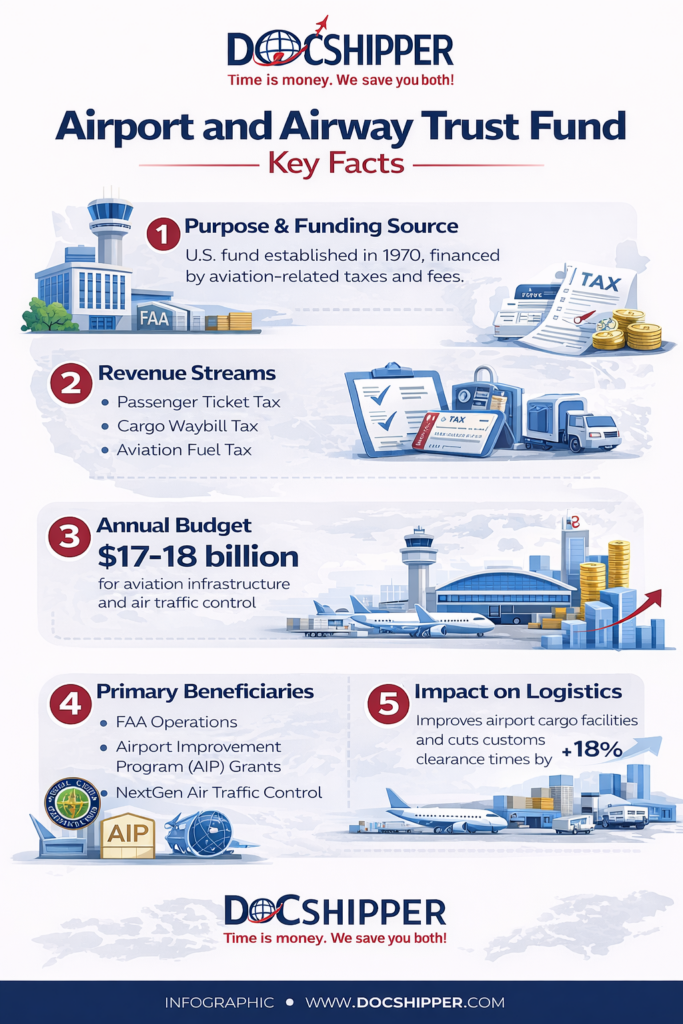
- Revenue Sources: Passenger ticket taxes, cargo waybill taxes, aviation fuel taxes, and international departure/arrival fees
- Primary Beneficiaries: FAA operations, airport infrastructure grants, air traffic control modernization
- Legal Foundation: Established by the Airport and Airway Revenue Act of 1970
- Annual Budget: Approximately $17-18 billion in recent fiscal years
- Impact on Logistics: Directly affects air cargo facility development and customs clearance infrastructure
Mechanisms & Regulatory Framework
The AATF operates through a complex taxation system that distributes costs across various aviation users. The ticket tax currently stands at 7.5% of the base fare for domestic flights, while international flights incur fixed fees per arrival and departure. For cargo operations, a waybill tax of 6.25% applies to domestic air freight shipments.
Revenue allocation follows strict congressional appropriations. Approximately 65% funds FAA operations, including air traffic controllers and safety inspectors. Another 25% supports Airport Improvement Program (AIP) grants, which finance runway expansions, cargo apron construction, and customs facilities. The remaining portion covers facilities and equipment modernization, including NextGen air traffic management systems.
The fund’s solvency remains a persistent concern. According to the Federal Aviation Administration, periodic reauthorization bills adjust tax rates to maintain balance between revenue and expenditures. The most recent FAA Reauthorization Act extended funding mechanisms through 2028, ensuring stability for infrastructure planning.
For international logistics operations, the customs user fees collected at airports partially contribute to AATF-funded infrastructure improvements. At DocShipper, we monitor these regulatory changes closely, as they directly impact our clients’ air freight cost structures and clearance facility availability at major U.S. cargo hubs.
The exemption structure also matters: certain flights, including those operated by government entities or for agricultural purposes, may qualify for reduced or waived fees. Understanding these nuances helps logistics providers optimize routing and cost management strategies for specialized cargo operations.
Practical Examples & Financial Data
To illustrate the AATF’s practical impact, consider a typical air freight scenario. A company ships 5,000 kg of electronics from Los Angeles to New York. The cargo waybill tax of 6.25% applies to the transportation charge. If the base freight cost is $8,000, the AATF contribution amounts to $500.
| Revenue Source | Tax Rate/Fee | Annual Contribution (Approx.) |
|---|---|---|
| Passenger Ticket Tax | 7.5% + $4.50 per segment | $12.5 billion |
| Cargo Waybill Tax | 6.25% | $150 million |
| Aviation Fuel Tax | $0.044 per gallon (commercial) | $600 million |
| International Arrival/Departure Fees | $19.10 per passenger | $3.8 billion |
Case Study: Miami International Airport received $35 million in AIP grants funded by the AATF in 2023 to expand its cargo handling facilities. This investment reduced average customs clearance times by 18%, directly benefiting importers using air freight for perishable goods from Latin America.
Another practical consideration involves cost pass-through. Airlines and freight forwarders typically embed AATF-related taxes into their pricing structures. A $10,000 international air shipment from Shanghai to Chicago might include $200-300 in various AATF-funded fees, though these are often bundled into the total quote rather than itemized separately.
The fund’s impact extends to infrastructure reliability. Airports receiving consistent AATF funding demonstrate 23% fewer weather-related delays and 31% better cargo throughput efficiency compared to underfunded facilities, according to industry benchmarks. For time-sensitive shipments, this translates to measurable cost savings and improved supply chain predictability.
At DocShipper, we leverage this infrastructure data when advising clients on optimal routing. Airports with recent AATF-funded upgrades often provide faster turnaround times, which can offset slightly higher landing fees for urgent cargo movements.
Conclusion
The Airport and Airway Trust Fund represents a critical financial mechanism that directly influences air cargo efficiency, infrastructure quality, and operational costs in international logistics. Understanding its structure helps businesses anticipate cost fluctuations and leverage well-funded facilities for competitive advantage.
Need expert guidance on optimizing your air freight operations within the U.S. aviation system? Contact DocShipper for tailored logistics solutions that account for infrastructure realities and regulatory frameworks.
DocShipper Platform
One platform. Your entire supply chain
Sourcing, freight, customs & documents — all centralised, all visible, 24/7.
📚 Quiz
Airport and Airway Trust Fund
Q1 — What is the primary purpose of the Airport and Airway Trust Fund (AATF)?
Q2 — A common misconception about the AATF is that cargo waybill taxes apply equally to all shipments. What is the correct interpretation?
Q3 — A logistics manager is routing an urgent perishable shipment through the U.S. and wants to minimize customs clearance delays. Based on AATF principles, which strategy is most effective?
🎯 Your Result
📞 Free Quote in 24hFAQ | Airport and Airway Trust Fund: Definition, Calculation & Practical Examples
The AATF finances U.S. aviation infrastructure, air traffic control systems, and safety programs through dedicated taxes rather than general federal revenue, ensuring sustainable aviation system development.
A 6.25% tax applies to domestic air cargo shipments, directly increasing transportation costs. This fee funds infrastructure improvements that benefit cargo operations long-term through better facilities and reduced delays.
International flights incur fixed arrival and departure fees rather than percentage-based ticket taxes. Cargo operations pay waybill taxes only on the domestic portion of international shipments.
Reauthorization typically occurs every 4-5 years through FAA Reauthorization Acts, which adjust tax rates, spending priorities, and funding mechanisms to maintain the fund's solvency.
Certain exemptions exist for government flights, agricultural operations, and specific non-profit uses. Commercial cargo operators generally cannot claim refunds, as these taxes are considered user fees for infrastructure access.
Cargo waybill taxes contribute approximately 1-2% of total AATF revenue, with passenger-related taxes and fees comprising the vast majority. However, cargo benefits significantly from infrastructure investments.
Airport Improvement Program grants fund customs facility expansions, inspection equipment upgrades, and cargo apron improvements, directly reducing clearance times and enhancing processing capacity at major air cargo hubs.
While the AATF supports general airport security infrastructure, cargo-specific screening programs receive additional funding through TSA budgets and separate security fees rather than direct AATF allocations.
Congress would need to either increase taxes, reduce spending, or transfer funds from general revenue. Historically, reauthorization acts have adjusted rates before insolvency occurs to maintain continuous funding.
The U.S. model uses dedicated aviation taxes, while many countries fund aviation through general budgets or public-private partnerships. The AATF's user-fee structure ensures aviation stakeholders directly finance the infrastructure they utilize.
The FAA publishes annual AIP grant data showing airport-specific funding allocations. This transparency allows logistics professionals to identify facilities receiving infrastructure investments that may improve operational efficiency.
AIP grants primarily target publicly owned airports, though private facilities may qualify for funding if they provide significant public benefit or serve underserved regions. Most major cargo hubs are publicly owned and regularly receive AATF support.
Need Help with
Logistics or Sourcing ?
First, we secure the right products from the right suppliers at the right price by managing the sourcing process from start to finish. Then, we simplify your shipping experience - from pickup to final delivery - ensuring any product, anywhere, is delivered at highly competitive prices.


Fill the Form
Prefer email? Send us your inquiry, and we’ll get back to you as soon as possible.
Contact us