



In short ⚡
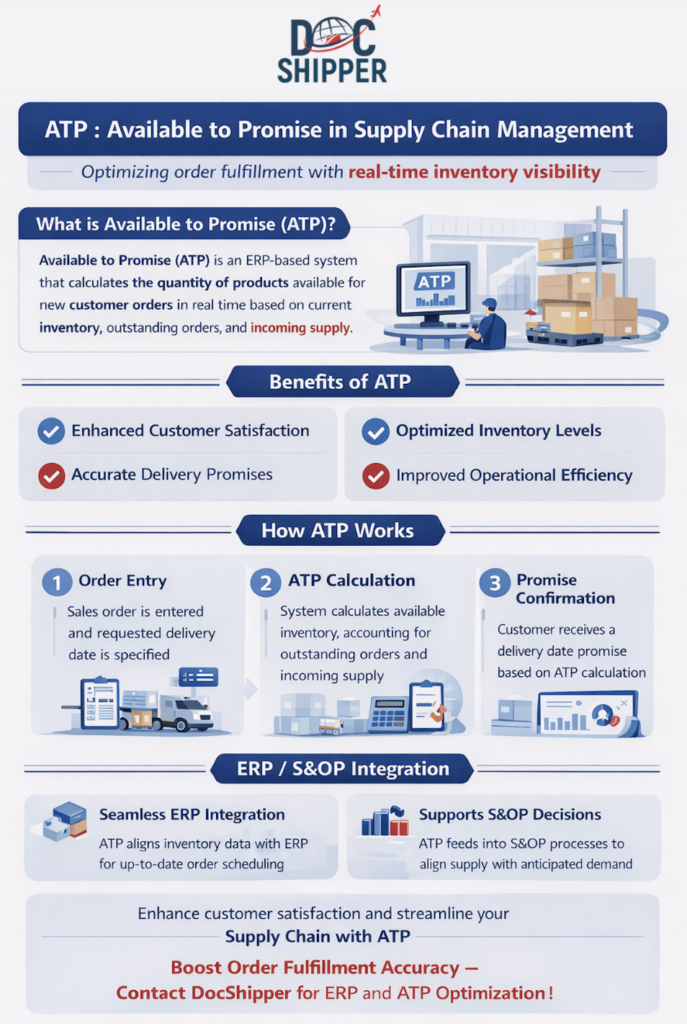
Available to Promise (ATP) is an inventory management metric that calculates the uncommitted portion of a company's stock that can be promised to customers for future delivery. ATP considers current inventory, scheduled production, and existing customer commitments to provide accurate delivery dates and prevent overselling in supply chain operations.Introduction
In international trade, one of the most common frustrations businesses face is promising delivery dates to customers, only to discover insufficient inventory exists to fulfill those commitments. This leads to order cancellations, damaged relationships, and lost revenue.
Available to Promise (ATP) emerged as a critical solution to this challenge. By providing real-time visibility into what can actually be committed to customers, ATP transforms inventory management from reactive guesswork into proactive planning.
Key characteristics of ATP include:
- Dynamic calculation: Updates continuously as orders are placed and production schedules change
- Time-phased visibility: Shows availability across specific future periods
- Multi-location support: Tracks inventory across warehouses, distribution centers, and production facilities
- Demand-supply balance: Accounts for both incoming supply and outgoing commitments
- Customer service optimization: Enables accurate delivery promises that improve satisfaction rates
ATP Mechanics & Supply Chain Expertise
Understanding ATP requires grasping how it integrates multiple supply chain components into a single, actionable metric. The calculation draws from several data sources simultaneously.
On-hand inventory represents the starting point—physical stock currently available in warehouses. However, not all on-hand inventory is available to promise, as some may already be allocated to existing customer orders or reserved for specific purposes.
Scheduled receipts include incoming inventory from production runs, purchase orders from suppliers, and inter-facility transfers. These future supply sources increase ATP in specific time periods when they’re scheduled to arrive.
Demand commitments reduce ATP and include confirmed customer orders, safety stock requirements, and forecasted demand that management has chosen to reserve inventory against. The sophistication of ATP systems varies in how they handle forecasted versus firm demand.
Planning horizons define the time periods over which ATP is calculated. Most systems use weekly or daily buckets, with longer horizons for strategic planning and shorter ones for immediate order fulfillment decisions.
Multi-echelon considerations become critical in complex supply chains. ATP must account for inventory across manufacturing plants, regional distribution centers, and local warehouses, considering transit times and transfer policies between locations.
At DocShipper, we integrate ATP calculations into our supply chain consulting services, helping clients establish real-time visibility systems that prevent stockouts while minimizing excess inventory across international operations.
According to the APICS Supply Chain Council, companies implementing advanced ATP systems report 15-25% improvements in order fill rates and 20-30% reductions in safety stock requirements.
Calculation Methods & Practical Examples
The basic ATP formula provides a foundation for understanding how available inventory is determined across time periods:
ATP = On-Hand Inventory + Scheduled Receipts – Demand Commitments
However, real-world applications require more sophisticated approaches. Let’s examine a practical scenario:
Use Case: Electronics Distributor ATP Calculation
| Week | On-Hand Start | Scheduled Receipts | Customer Orders | ATP |
|---|---|---|---|---|
| Week 1 | 500 units | 0 | 350 units | 150 units |
| Week 2 | 150 units | 1,000 units | 200 units | 950 units |
| Week 3 | 950 units | 0 | 400 units | 550 units |
| Week 4 | 550 units | 800 units | 300 units | 1,050 units |
In this scenario, a customer calls requesting 600 units for delivery in Week 3. The sales representative can immediately see that only 550 units are available to promise in that period. The system would suggest either reducing the order quantity or pushing delivery to Week 4, where 1,050 units are available.
Comparative ATP Approaches
| Method | Characteristics | Best For |
|---|---|---|
| Discrete ATP | Calculates availability for each time period independently | Simple supply chains with predictable demand |
| Cumulative ATP | Carries forward unused ATP from previous periods | Businesses with flexible delivery windows |
| Multi-Level ATP | Considers component availability in manufacturing | Make-to-order manufacturers with complex BOMs |
| Capable-to-Promise (CTP) | Includes production capacity and material availability | High-mix, low-volume production environments |
Industry benchmark data shows that companies with mature ATP processes achieve 95%+ on-time delivery rates compared to 75-80% for those relying on manual inventory checks. The financial impact is substantial: a 2022 supply chain study found that ATP implementation reduced emergency expediting costs by an average of $340,000 annually for mid-sized distributors.
DocShipper assists international businesses in configuring ATP logic within their ERP systems, accounting for customs clearance times, international transit durations, and multi-country inventory allocation rules that are essential for cross-border operations.
Conclusion
Available to Promise transforms inventory management from reactive firefighting into proactive customer service. By providing accurate, real-time visibility into what can genuinely be committed to customers, ATP reduces stockouts, improves delivery performance, and optimizes working capital.
Need expert guidance on implementing ATP calculations in your international supply chain? Contact DocShipper for customized consulting on inventory visibility systems.
📚 Quiz
Available to Promise (ATP)
Q1 — What does Available to Promise (ATP) measure in supply chain management?
Q2 — A company's ATP figure shows a negative value for Week 3. What does this indicate?
Q3 — A customer requests 600 units for delivery in Week 3, but your ATP table shows only 550 units available that week and 1,050 units in Week 4. What is the correct ATP-driven response?
🎯 Your Result
📞 Free Quote in 24hFAQ | Available to Promise (ATP): Definition, Calculation & Real-World Examples
On-hand inventory is the total physical stock available, while ATP subtracts already committed orders and adds scheduled receipts. ATP represents what you can actually promise to new customers, not just what exists in the warehouse.
Modern systems recalculate ATP in real-time with each transaction—order placement, production completion, or shipment receipt. At minimum, ATP should update daily to maintain accuracy for customer-facing teams making delivery commitments.
Yes, negative ATP indicates overcommitment—more has been promised than available supply can support. This signals the need for expedited production, alternative sourcing, or customer communication about delayed deliveries.
This depends on system configuration. Conservative approaches subtract safety stock from ATP to preserve buffers, while aggressive strategies allow promising safety stock but flag it for management review.
For make-to-order items, ATP considers production capacity and component availability rather than finished goods inventory. This evolves into Capable-to-Promise (CTP), which evaluates whether manufacturing resources exist to fulfill orders.
ATP enables unified inventory visibility across sales channels—online stores, physical retail, and wholesale. It prevents overselling by allocating inventory across channels and allowing real-time availability checks at checkout.
Lead times determine when scheduled receipts become available. A production order with a 3-week lead time increases ATP three weeks in the future, not immediately. International shipments require adding customs clearance and transit time to lead time calculations.
Yes, sophisticated systems calculate ATP for each SKU variant—size, color, configuration. This granularity is essential for fashion, electronics, and any industry where variants aren't interchangeable from a customer perspective.
Some organizations incorporate forecasted demand into ATP calculations, reserving inventory against predicted future orders. Others calculate ATP only against firm commitments. The approach depends on forecast accuracy and management risk tolerance.
Advanced ATP systems can reserve inventory for priority customer segments, ensuring key accounts receive preferential treatment during shortages. This requires configuring allocation rules that balance revenue optimization with service level commitments.
Basic ATP requires inventory management software with order tracking. Advanced implementations leverage ERP systems with integrated supply chain planning modules, real-time data synchronization, and API connections to e-commerce platforms for instant availability checks.
Accurate ATP reduces the need for excessive safety stock by improving demand-supply matching. Companies typically see 15-30% inventory reductions while maintaining or improving service levels, freeing significant working capital for other business investments.
Need Help with Logistics or Sourcing ?
First, we secure the right products from the right suppliers at the right price by managing the sourcing process from start to finish. Then, we simplify your shipping experience - from pickup to final delivery - ensuring any product, anywhere, is delivered at highly competitive prices.


Fill the Form
Prefer email? Send us your inquiry, and we’ll get back to you as soon as possible.
Contact us


:%20Definition%20&%20Guide%20for%202026)