In short ⚡
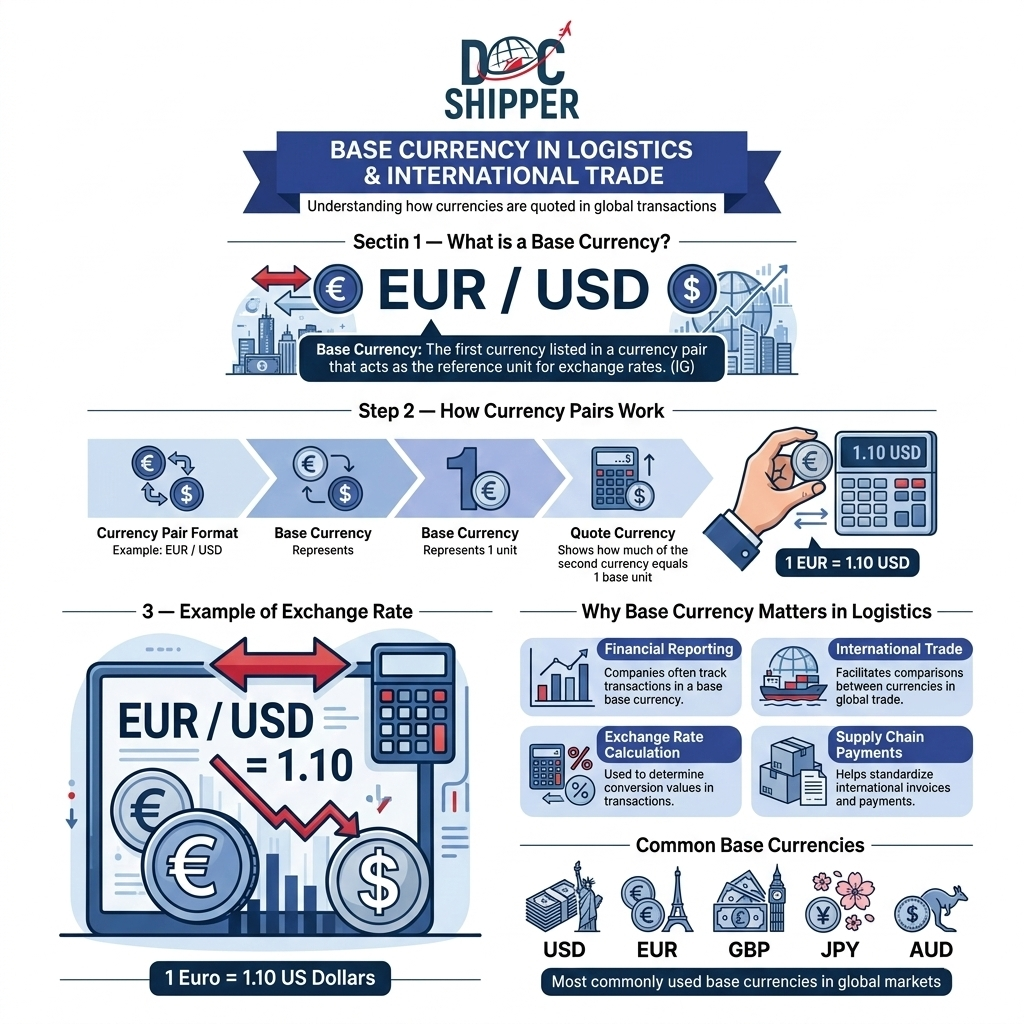
Base currency is the first currency listed in a currency pair quotation, representing the unit being valued. In international trade and logistics, it serves as the reference point for exchange rate calculations, pricing negotiations, and financial settlements across borders.
Introduction
Confusion often arises when businesses encounter currency pairs like EUR/USD or GBP/JPY without understanding which currency drives the transaction value. This misunderstanding can lead to costly errors in pricing, budgeting, and financial forecasting.
In import/export operations, the base currency determines how exchange rate movements affect your bottom line. Whether you’re negotiating container shipping rates, calculating customs duties, or managing foreign supplier payments, understanding base currency mechanics is fundamental to financial control.
- Establishes the pricing foundation for cross-border transactions
- Determines profit margins when exchange rates fluctuate
- Influences hedging strategies and financial risk management
- Affects invoice accuracy and payment reconciliation
- Impacts compliance with international accounting standards
Understanding Base Currency Mechanisms
The base currency convention follows a standardized format where the first currency in a pair represents one unit. In EUR/USD = 1.10, one euro equals 1.10 US dollars. This positioning isn’t arbitrary—it reflects historical trading volumes and international monetary agreements.
The quote currency (or counter currency) appears second and indicates how much is needed to purchase one unit of the base currency. This relationship creates the exchange rate that importers and exporters use daily. When the EUR/USD rate rises to 1.15, the euro has strengthened—meaning European exporters receive fewer dollars per euro, potentially reducing competitiveness.
According to the Bank for International Settlements, the US dollar appears in 88% of all foreign exchange transactions, making it the world’s dominant base currency in most trading pairs. This dominance stems from its role as the global reserve currency and its widespread acceptance in commodity pricing.
The direct quotation method uses the domestic currency as the quote currency (USD/EUR in the United States), while the indirect quotation method uses it as the base currency (EUR/USD in Europe). International freight forwarders must navigate both systems when dealing with multinational clients.
In logistics contracts, the currency of denomination often differs from the base currency used for internal accounting. At DocShipper, we systematically verify currency specifications in commercial invoices and transport documents to prevent payment discrepancies that could delay customs clearance or create financial exposure.
The ISO 4217 standard governs currency code formatting, ensuring that base currencies are universally recognized in electronic trading systems, banking platforms, and customs documentation. This standardization reduces errors in automated payment processing across supply chains.
Practical Applications & Data
Consider a French importer purchasing electronics from China. The supplier quotes $50,000 USD, but the importer’s accounting system operates in euros. With EUR/USD at 1.10, the base currency (EUR) calculation determines the actual cost: $50,000 ÷ 1.10 = €45,455.
If the rate shifts to 1.05 before payment, the same $50,000 now costs €47,619—a €2,164 increase without any change in product price. This demonstrates how base currency fluctuations directly impact procurement budgets and profit margins.
| Currency Pair | Base Currency | Quote Currency | Interpretation |
|---|---|---|---|
| EUR/USD 1.10 | EUR | USD | 1 euro = 1.10 dollars |
| GBP/JPY 165 | GBP | JPY | 1 pound = 165 yen |
| USD/CNY 7.20 | USD | CNY | 1 dollar = 7.20 yuan |
| AUD/CAD 0.92 | AUD | CAD | 1 Australian dollar = 0.92 Canadian dollars |
Scenario Analysis: A US-based logistics company invoices a German client €10,000 for warehousing services. Their accounting base currency is USD. At EUR/USD 1.12, they record revenue of $11,200. If payment arrives 30 days later when the rate drops to 1.08, the actual deposit equals $10,800—a $400 loss due to base currency depreciation.
Major commodity contracts illustrate base currency standardization. Oil trades in USD/barrel globally, making the US dollar the de facto base currency for energy logistics. A barrel priced at $80 costs a European buyer €71.43 at EUR/USD 1.12, but €74.07 at 1.08—demonstrating how base currency movements affect landed costs independently of market oil prices.
In customs valuation, authorities convert foreign currency invoices to the local base currency using official daily rates. The World Customs Organization recommends using the rate prevailing on the date of export declaration, but practices vary by jurisdiction. Importers must understand which currency serves as the valuation base to calculate accurate duty payments.
Hedging implications: When your operational base currency differs from contract currencies, forward contracts lock in exchange rates. A UK exporter selling to the US in dollars might use GBP/USD forwards to eliminate base currency risk, ensuring predictable sterling revenues regardless of market fluctuations.
Digital trade platforms increasingly offer multi-currency wallets, but settlement still requires base currency conversion. Transaction fees typically range from 0.5% to 3% depending on the currency pair liquidity and the base currency involved in the conversion chain.
DocShipper Platform
Cut logistics costs. Not corners.
See exactly where your logistics costs are bleeding — and how to fix it. Book your expert demo.

Conclusion
Mastering base currency mechanics is non-negotiable for businesses engaged in international logistics. It directly influences pricing accuracy, financial planning, and competitive positioning in global markets.
Need expert guidance on currency management in your supply chain operations? Contact DocShipper for tailored solutions that protect your margins across borders.
📚 Quizz
Test Your Knowledge: Base Currency
Q1 — In the currency pair EUR/USD = 1.10, what does the base currency represent?
Q2 — A common misconception is that you can permanently change the base currency of a standard market pair (e.g., EUR/USD). What is the correct interpretation?
Q3 — A US logistics company invoices a German client €10,000. Their accounting base currency is USD. The EUR/USD rate drops from 1.12 to 1.08 before payment is received. What is the financial impact?
🎯 Your Result
📞 Free Quote in 24hFAQ | Base Currency: Definition, Role & Practical Examples in International Trade
Historical trading conventions and liquidity determine base currency positioning. Major currencies like EUR, GBP, and AUD typically appear as base currencies against USD, reflecting established market practices and trading volume patterns.
No. The base currency remains fixed in a currency pair's quotation convention. However, you can express the same relationship inversely—EUR/USD 1.10 equals USD/EUR 0.909—but this changes which currency serves as the base.
Customs authorities convert invoice values to their national base currency using official exchange rates. This conversion determines the duty calculation basis, making exchange rate timing critical for cost management.
Your accounting base currency should match your primary operational currency—typically where you generate most revenue or incur most expenses. This minimizes conversion frequency and foreign exchange exposure.
Base currency refers to the first currency in an exchange rate pair. Functional currency is the primary currency of your business operations, defined by accounting standards like IAS 21 for financial reporting purposes.
Interbank rates update continuously during trading hours. For commercial transactions, banks typically set daily rates each morning. Customs authorities may use weekly or monthly official rates for duty calculations.
While some platforms quote crypto pairs (BTC/USD), traditional trade finance and customs systems don't recognize cryptocurrencies as base currencies. Conversion to fiat currency remains necessary for official documentation.
When direct pairs aren't liquid, traders use triangulation through a common base currency (usually USD). To find EUR/JPY, they calculate via EUR/USD and USD/JPY, using the dollar as an intermediary base.
You must convert at the transaction date's exchange rate for accounting purposes. This creates foreign exchange gain or loss when the invoice currency strengthens or weakens against your base currency before payment.
International contracts should specify the currency of payment and any conversion mechanisms. Financial statements must disclose the functional currency and translation methods under IFRS and GAAP standards.
Interest rate decisions, quantitative easing, and monetary policy statements directly impact base currency strength. Higher interest rates typically strengthen a base currency by attracting foreign capital inflows.
While you can't change market quotation conventions, you can negotiate the contract's currency of denomination. Choosing your operational currency as the payment currency eliminates your base currency conversion risk, transferring it to the counterparty.
Need Help with
Logistics or Sourcing ?
First, we secure the right products from the right suppliers at the right price by managing the sourcing process from start to finish. Then, we simplify your shipping experience - from pickup to final delivery - ensuring any product, anywhere, is delivered at highly competitive prices.


Fill the Form
Prefer email? Send us your inquiry, and we’ll get back to you as soon as possible.
Contact us