
In short ⚡
Buffer management is a strategic inventory control method that maintains safety stock levels to absorb demand variability and supply chain disruptions. It ensures operational continuity by preventing stockouts while minimizing excess inventory costs, crucial for maintaining customer service levels in international trade operations.Introduction
Many importers face a common dilemma: stock too much and tie up capital, stock too little and lose sales. This balancing act becomes even more critical when dealing with international supply chains where lead times span weeks or months.
Buffer management addresses this challenge by creating calculated inventory cushions that protect against uncertainty. In global logistics, where customs delays, shipping disruptions, and demand fluctuations are constant realities, effective buffer strategies separate successful operations from costly failures.
- Demand absorption: Protects against unexpected sales spikes without emergency shipments
- Supply variability: Compensates for transit delays, port congestion, or supplier issues
- Service level maintenance: Ensures consistent product availability despite uncertainties
- Cost optimization: Balances holding costs against stockout penalties
- Lead time coverage: Bridges gaps during lengthy international shipping periods
Buffer Management Fundamentals & Strategic Implementation
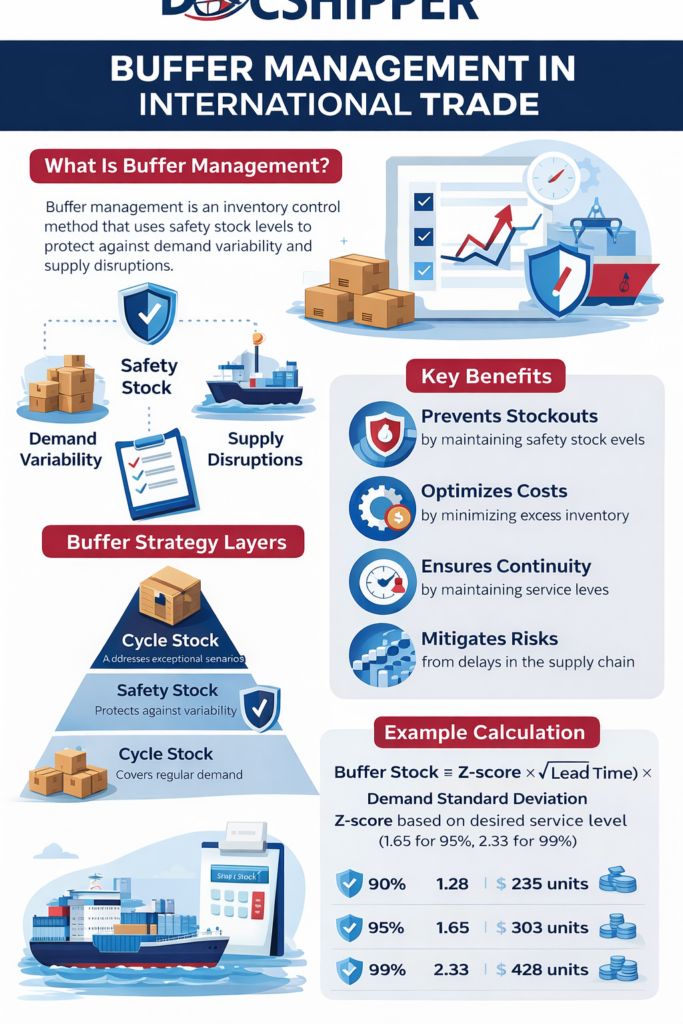
Buffer management operates on three distinct inventory layers. The cycle stock covers regular demand during normal replenishment cycles. The safety stock (buffer) protects against variability. The strategic stock addresses exceptional circumstances like supplier failures or market disruptions.
Calculating optimal buffer levels requires analyzing historical demand patterns, supplier reliability metrics, and acceptable service levels. The fundamental formula incorporates demand variability (standard deviation) and lead time variability into a single buffer calculation that accounts for both sources of uncertainty simultaneously.
International trade introduces unique buffer considerations. Customs clearance unpredictability, ocean freight schedule reliability, and documentation delays all extend effective lead times. At DocShipper, we analyze these factors across our clients’ supply chains to recommend buffer levels that reflect real-world transit variability rather than theoretical shipping schedules.
The service level target directly impacts buffer size. A 95% service level requires significantly less inventory than 99%, but the cost difference must be weighed against lost sales and customer satisfaction. Different product categories warrant different service levels based on margin, criticality, and market position.
Modern buffer strategies employ dynamic adjustment mechanisms. Rather than static safety stock levels, sophisticated systems recalculate buffers based on recent performance, seasonal patterns, and supply chain changes. This approach prevents both excess inventory accumulation and unexpected stockouts as conditions evolve.
According to the World Trade Organization, supply chain disruptions have increased 67% since 2019, making adaptive buffer management more critical than ever for international traders.
Calculation Methods & Practical Examples
The standard buffer stock formula is: Buffer Stock = Z-score × √(Lead Time) × Demand Standard Deviation. The Z-score corresponds to your desired service level (1.65 for 95%, 2.33 for 99%).
Practical Case Study: A European electronics importer sources components from China with a 45-day lead time. Average monthly demand is 1,000 units with a standard deviation of 150 units. For a 95% service level, the calculation would be: 1.65 × √1.5 months × 150 = 303 units buffer stock.
| Service Level | Z-Score | Buffer Units (Example) | Annual Holding Cost |
|---|---|---|---|
| 90% | 1.28 | 235 units | $4,700 |
| 95% | 1.65 | 303 units | $6,060 |
| 99% | 2.33 | 428 units | $8,560 |
For products with variable lead times, the formula adjusts: Buffer = Z × √[(Average Lead Time × Demand Variance) + (Average Demand² × Lead Time Variance)]. This accounts for uncertainty in both demand and supply timing.
Multi-echelon buffer optimization distributes inventory across warehouses and distribution centers. Centralizing buffers reduces total inventory but increases delivery times. Decentralizing improves responsiveness but multiplies safety stock requirements. The optimal configuration depends on demand patterns, transportation costs, and service requirements.
DocShipper helps clients implement buffer strategies that account for real shipping data. We’ve observed that theoretical lead times often underestimate actual transit by 15-30%, meaning buffers calculated on carrier schedules alone frequently prove insufficient during peak seasons or disruptions.
Conclusion
Effective buffer management transforms inventory from a cost center into a competitive advantage. By scientifically balancing availability against capital efficiency, companies maintain customer satisfaction while optimizing working capital in unpredictable international markets.
Need expert guidance on optimizing your inventory buffers for international supply chains? Contact DocShipper for a customized buffer analysis based on your specific trade lanes and product characteristics.
DocShipper Platform
One platform. Your entire supply chain
Sourcing, freight, customs & documents — all centralised, all visible, 24/7.
📚 Quiz
Test Your Knowledge: Buffer Management
1. What is the primary purpose of buffer management in supply chain operations?
2. A logistics manager wants to achieve a 99% service level instead of 95%. What is the correct implication for buffer stock?
3. A European importer sources goods from Asia with a 45-day lead time and notices frequent customs clearance delays. Which buffer management approach is most appropriate?
🎯 Your Result
📞 Free Quote in 24hFAQ | Buffer Management: Definition, Calculation & Real-World Examples
The terms are often used interchangeably. Both refer to inventory held above cycle stock to protect against uncertainty. Some practitioners distinguish "buffer" as demand-focused and "safety stock" as supply-focused, but functionally they serve the same purpose.
Review buffers quarterly at minimum, monthly for high-value or fast-moving items. Recalculate immediately after significant supply chain changes, demand pattern shifts, or service level adjustments to maintain optimal inventory positions.
Yes, but with modifications. Perishable items require time-based buffer calculations that account for shelf life. The buffer must turn over before expiration, often necessitating lower service levels or faster replenishment cycles than non-perishable products.
High-margin, critical items typically warrant 95-99% service levels. Commodity products may function well at 85-90%. Consider customer expectations, competitive positioning, and the cost of lost sales versus holding costs when setting targets.
Seasonal products require dynamic buffers that increase before peak periods and decrease afterward. Calculate separate buffers for high and low seasons, transitioning between them based on historical timing patterns and current market indicators.
Absolutely. Buffer requirements decrease proportionally to forecast accuracy improvements. Reducing demand standard deviation by 20% allows approximately 20% buffer reduction while maintaining the same service level, directly improving working capital efficiency.
Supplier consistency is critical. Unreliable suppliers with high lead time variability require significantly larger buffers. Improving supplier performance or switching to more reliable sources can reduce buffer requirements more effectively than any calculation refinement.
Use analogous products with similar characteristics as proxies. Apply industry benchmarks for demand variability, then adjust buffers monthly as actual sales data accumulates. Start conservative (higher service level) and optimize downward as uncertainty decreases.
Destination buffers provide faster customer response but multiply inventory across locations. Origin buffers reduce total inventory but extend delivery times. Hybrid approaches often work best, with fast-moving items buffered locally and slower items centralized at origin.
Typical holding costs range from 20-35% of inventory value annually, including warehousing, insurance, obsolescence, and capital costs. This makes buffer optimization financially significant, as every 10% buffer reduction directly improves bottom-line profitability.
Customs delays increase effective lead time variability, requiring larger buffers. Countries with unpredictable clearance processes may need 30-50% higher buffers than domestic shipments. Experienced customs brokers like DocShipper reduce this variability through documentation expertise.
Modern inventory systems automatically recalculate buffers based on real-time data, adjusting for demand changes, supplier performance, and lead time variations. However, human oversight remains essential for interpreting market shifts and validating algorithmic recommendations.
Need Help with
Logistics or Sourcing ?
First, we secure the right products from the right suppliers at the right price by managing the sourcing process from start to finish. Then, we simplify your shipping experience - from pickup to final delivery - ensuring any product, anywhere, is delivered at highly competitive prices.


Fill the Form
Prefer email? Send us your inquiry, and we’ll get back to you as soon as possible.
Contact us