


In short ⚡
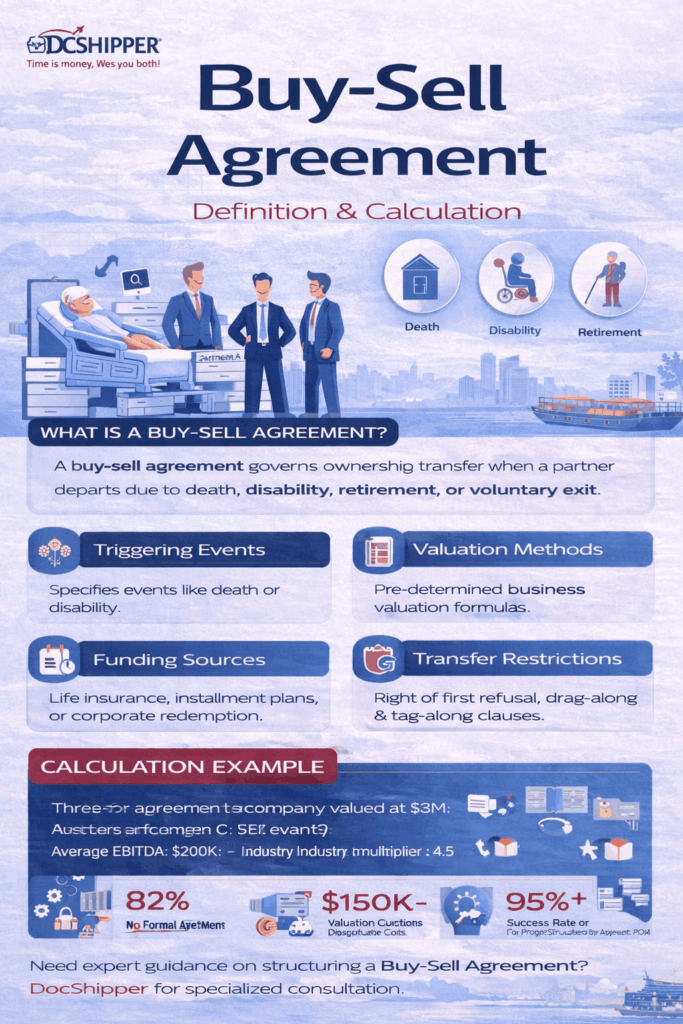
A Buy-Sell Agreement is a legally binding contract that governs the transfer of ownership interests in a business when specific triggering events occur, such as death, disability, retirement, or voluntary departure of a partner. It establishes predetermined valuation methods and purchase terms to ensure smooth business continuity.Introduction
What happens when a business partner suddenly passes away or decides to retire? Without a structured exit plan, companies face costly legal disputes, operational paralysis, and forced liquidations. This is precisely where Buy-Sell Agreements become indispensable.
In international trade and logistics partnerships, these contracts protect stakeholders by establishing clear protocols for ownership transitions. They prevent external parties from acquiring shares and maintain operational stability during critical transitions.
Key characteristics include:
- Triggering events: Death, disability, divorce, bankruptcy, retirement, or voluntary sale
- Valuation formulas: Predetermined methods to calculate business worth objectively
- Funding mechanisms: Life insurance, installment payments, or corporate redemption
- Transfer restrictions: Right of first refusal, drag-along, and tag-along provisions
- Dispute resolution: Arbitration clauses to avoid litigation costs
Legal Mechanisms & Expert Analysis
Buy-Sell Agreements operate through three primary structural models. The cross-purchase agreement allows remaining partners to buy departing owners’ shares directly. The entity-purchase (redemption) agreement enables the company itself to repurchase shares. The hybrid approach combines both methods, offering maximum flexibility.
Valuation methodology represents the contract’s most critical component. Common approaches include fixed-price formulas (updated annually), book value calculations (based on financial statements), multiple of earnings (EBITDA × industry multiplier), or independent appraisal by certified valuators. Each method carries distinct tax implications and fairness considerations.
The funding strategy determines practical enforceability. Life insurance policies remain the most common mechanism for death-triggered buyouts, providing immediate liquidity. Installment payments spread financial burden but create long-term obligations. Corporate reserves offer self-funding but may strain working capital.
According to the U.S. Small Business Administration, approximately 70% of business transitions fail due to inadequate succession planning. Properly structured Buy-Sell Agreements reduce this risk by establishing legally enforceable transfer protocols before disputes arise.
At DocShipper, we regularly advise logistics partnerships on implementing Buy-Sell Agreements that account for international asset holdings, cross-border tax treaties, and multi-jurisdictional enforcement requirements.
Practical Examples & Data
Consider a three-partner freight forwarding company valued at $3 million. Partner A owns 50%, while Partners B and C each hold 25%. Their Buy-Sell Agreement uses a multiple of earnings formula: average EBITDA (last 3 years) × 4.5 industry multiplier.
| Scenario | Valuation Method | Buyout Price | Funding Source |
|---|---|---|---|
| Partner A dies | EBITDA × 4.5 | $1,500,000 | Life insurance policy |
| Partner B retires | Book value | $750,000 | 5-year installment plan |
| Partner C disabled | Independent appraisal | $820,000 | Disability insurance proceeds |
Real-world case study: A customs brokerage with two equal partners experienced a sudden death. Their Buy-Sell Agreement, funded by $2M life insurance policies, enabled immediate buyout without operational disruption. The surviving partner maintained client relationships and avoided forced sale at depressed valuations.
Key data points from industry research:
- 82% of businesses lack formal Buy-Sell Agreements (Family Business Institute)
- Average valuation dispute costs $150,000-$500,000 in legal fees
- Life insurance funding costs 1-3% of coverage amount annually
- Tax savings through proper structuring can reach 15-25% of transaction value
- Enforcement success rate exceeds 95% when properly drafted and funded
Conclusion
Buy-Sell Agreements transform unpredictable ownership transitions into manageable, pre-planned events. They protect business value, preserve operational continuity, and eliminate costly disputes that can destroy decades of work.
Need expert guidance on structuring Buy-Sell Agreements for international logistics partnerships? Contact DocShipper for specialized consultation.
📚 Quizz
Test Your Knowledge: Buy-Sell Agreement
Q1 — What is the primary purpose of a Buy-Sell Agreement?
Q2 — What is the key difference between a cross-purchase agreement and a redemption (entity-purchase) agreement?
Q3 — A freight forwarding company has two equal partners. One partner suddenly passes away. Which funding mechanism in their Buy-Sell Agreement would most reliably provide immediate liquidity for the buyout?
🎯 Your Result
📞 Free Quote in 24hFAQ | Buy-Sell Agreement: Definition, Calculation & Concrete Examples
Common triggers include death, permanent disability, retirement, voluntary departure, bankruptcy, divorce, or breach of partnership terms. Each event activates predetermined purchase obligations and valuation protocols.
Valuation methods include fixed annual pricing, book value calculations, earnings multiples (typically 3-6× EBITDA), revenue multiples, or independent third-party appraisals. The chosen method should reflect industry standards and update regularly.
Cross-purchase agreements have remaining owners buy departing shares directly. Redemption agreements make the company itself repurchase shares. Tax implications and basis adjustments differ significantly between structures.
Life insurance provides the most reliable funding for death-triggered buyouts. Other options include corporate savings, installment payments, third-party financing, or disability insurance for incapacity events.
Yes, when properly drafted with choice-of-law provisions and arbitration clauses. International agreements require consideration of tax treaties, foreign asset holdings, and multi-jurisdictional enforcement mechanisms.
Properly structured agreements include funding mechanisms (insurance, installments) to prevent this scenario. Without funding, courts may force business liquidation or allow external buyers, defeating the agreement's purpose.
Review annually and update whenever significant business changes occur—new partners, major asset acquisitions, substantial revenue changes, or regulatory shifts. Outdated valuations create disputes and enforcement challenges.
Yes, through right-of-first-refusal clauses that require departing owners to offer shares to existing partners before external buyers. This maintains ownership control and prevents unwanted third-party involvement.
Tag-along rights allow minority owners to join majority sales at the same terms. Drag-along rights enable majority owners to force minority participation in sales, ensuring complete ownership transfers when needed.
Lenders often require Buy-Sell Agreements to ensure business continuity if key owners exit. Properly funded agreements can improve creditworthiness by demonstrating succession planning and risk management.
Structure impacts capital gains treatment, basis step-up, estate tax consequences, and corporate deductions. Cross-purchase agreements typically provide better tax basis for buyers, while redemptions may offer corporate deductions.
Yes, with unanimous partner consent. Modifications should address changing business valuations, new funding sources, additional partners, or updated triggering events. All amendments require formal documentation and legal review.
Need Help with
Logistics or Sourcing ?
First, we secure the right products from the right suppliers at the right price by managing the sourcing process from start to finish. Then, we simplify your shipping experience - from pickup to final delivery - ensuring any product, anywhere, is delivered at highly competitive prices.


Fill the Form
Prefer email? Send us your inquiry, and we’ll get back to you as soon as possible.
Contact us




