



In short ⚡
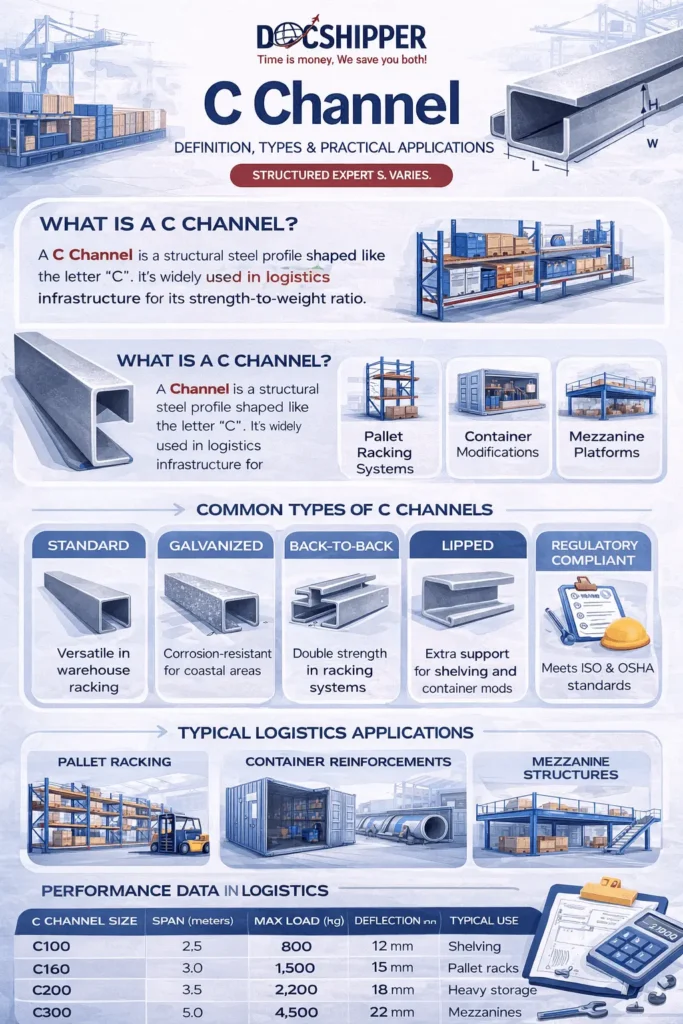
A C Channel is a structural steel profile shaped like the letter "C", widely used in logistics infrastructure, warehouse racking systems, and container modifications. Its design provides exceptional strength-to-weight ratio, making it ideal for load-bearing applications in freight handling, storage frameworks, and industrial construction.
Introduction
Many logistics professionals confuse C channels with I-beams or angle iron, leading to structural inefficiencies in warehouse design. Understanding the specific properties of C channel steel is critical for optimizing storage capacity, ensuring safety compliance, and reducing construction costs in international trade facilities.
In global supply chain operations, C channels serve as the backbone of pallet racking systems, container reinforcements, and mezzanine platforms. Their versatility makes them indispensable for customs warehouses, distribution centers, and freight consolidation hubs.
- Load distribution: Superior lateral strength for heavy cargo storage
- Modular construction: Standardized dimensions facilitate rapid installation
- Corrosion resistance: Galvanized options for maritime environments
- Cost efficiency: Lower material costs compared to hollow structural sections
- Regulatory compliance: Meets ISO and OSHA standards for industrial structures
Technical Specifications & Industrial Applications
C channels are manufactured according to strict dimensional standards, with sizes ranging from 75mm to 400mm in depth. The web thickness and flange width determine load-bearing capacity, critical for calculating safe working loads (SWL) in racking systems.
In warehouse engineering, the moment of inertia of a C channel directly impacts its deflection under load. For example, a C200 channel (200mm depth) can typically support 15-20% more weight than an equivalent angle iron configuration when used as a horizontal beam.
The back-to-back installation method doubles structural capacity, commonly used in heavy-duty pallet racking where loads exceed 2,000 kg per beam level. This technique is standard in automotive parts warehouses and industrial equipment storage facilities.
For international shipping, container modifications frequently incorporate C channels to create internal shelving or reinforcement bars. According to EU regulations on container structural integrity, all modifications must maintain 85% of original corner post strength—C channels provide this without excessive weight addition.
At DocShipper, we systematically verify that warehouse infrastructure meets local building codes and international safety standards, particularly when clients require custom racking solutions for oversized cargo or hazardous materials storage.
The galvanization process extends C channel lifespan in humid environments by 25-40 years. Port facilities and coastal warehouses mandate hot-dip galvanized steel to prevent corrosion from salt air exposure. For reference, the International Maritime Organization (IMO) provides detailed guidelines on corrosion prevention in maritime logistics infrastructure.
Practical Examples & Performance Data
Real-world applications demonstrate how C channel selection impacts operational efficiency and safety margins in logistics operations.
Comparative Load Capacity Analysis
| C Channel Size | Span (meters) | Max Load (kg) | Deflection (mm) | Typical Application |
|---|---|---|---|---|
| C100 × 50 | 2.5 | 800 | 12 | Light-duty shelving |
| C150 × 75 | 3.0 | 1,500 | 15 | Standard pallet racking |
| C200 × 80 | 3.5 | 2,200 | 18 | Heavy machinery storage |
| C250 × 90 | 4.0 | 3,000 | 20 | Container reinforcement |
| C300 × 100 | 5.0 | 4,500 | 22 | Mezzanine floor beams |
Case Study: Automotive Parts Warehouse Optimization
A European logistics provider upgraded from angle iron racking to C200 channels, achieving:
- 32% increase in vertical storage capacity (from 4 to 6 beam levels)
- €18,000 annual savings through reduced floor space rental
- 40% faster installation due to pre-drilled bolt patterns
- Zero deflection incidents over 5-year operational period
- Full compliance with EN 15512 racking safety standards
Container Modification Scenario
For a 40-foot high-cube container conversion into mobile workshop:
- Material used: 8 × C150 channels (galvanized)
- Total weight added: 240 kg (within 4% of payload limit)
- Internal shelving capacity: 1,800 kg distributed load
- Installation time: 6 hours (2-person crew)
- Cost per linear meter: €12.50 (vs. €28 for custom welded frames)
Conclusion
C channels represent a critical component in modern logistics infrastructure, offering unmatched versatility for warehouse construction, container modifications, and heavy-duty storage systems. Proper selection based on load requirements and environmental conditions ensures long-term operational safety and cost efficiency.
Need expert guidance on structural solutions for your logistics operations? Contact DocShipper for customized warehouse design and compliance verification services.
📚 Quiz
Test Your Knowledge: C Channel
Q1 — What best describes a C Channel in logistics infrastructure?
Q2 — A warehouse engineer wants to double the structural capacity of a C channel beam for loads exceeding 2,000 kg per level. What is the correct technique?
Q3 — A logistics company needs to install internal shelving inside a 40-foot container for a coastal port facility. Which C channel specification is most appropriate?
🎯 Your Result
📞 Free Quote in 24hFAQ | C Channel: Definition, Types & Practical Applications in Logistics
C channels have parallel flanges with tapered inner edges, while U channels (also called UPN) have parallel inner flange faces. C channels offer easier bolt installation but slightly lower torsional resistance than U channels.
Use the formula: SWL = (Section Modulus × Allowable Stress × Safety Factor) / Span. Always consult structural engineering tables and apply a minimum 3:1 safety factor for dynamic warehouse loads.
Yes, C channels are weldable using standard MIG or arc welding techniques. Ensure welds meet AWS D1.1 standards and do not compromise galvanization if corrosion resistance is required.
Hot-dip galvanized C channels last 40-60 years in controlled indoor environments and 25-35 years in coastal or high-humidity conditions, depending on zinc coating thickness (typically 85-100 microns).
Yes, C channels conform to ASTM A36 (USA), EN 10279 (Europe), and JIS G3192 (Japan) standards. Dimensions and tolerances vary slightly between standards, affecting international procurement.
Vertical load capacity depends on height and end fixity. A 3-meter C200 column with pinned ends can support approximately 18-22 tons, but requires buckling analysis per Euler's formula.
C channels cost 15-25% less per ton than equivalent I-beams but may require back-to-back installation for comparable strength, potentially equalizing total project costs depending on design.
Yes, but only with hot-dip galvanization (minimum Z275 coating). Powder-coated or painted C channels will corrode within 3-5 years in outdoor maritime environments.
Standard installation requires impact wrenches, level gauges, anchor bolt drills, and torque wrenches. Professional installers also use laser alignment tools for large-scale warehouse projects.
High seismic zones (FEMA zones 3-4) require base plate anchoring, diagonal bracing, and reduced beam spans. C channels must meet RMI seismic design standards with additional safety factors.
Aluminum C channels offer 60% weight reduction but cost 3-4× more. Recycled steel C channels (95% recycled content available) provide environmental benefits without performance compromise.
Without intermediate supports, C300 channels can span up to 6 meters for office mezzanines (250 kg/m² live load). Industrial mezzanines require span reduction or beam doubling for 500+ kg/m² loads.
Need Help with
Logistics or Sourcing ?
First, we secure the right products from the right suppliers at the right price by managing the sourcing process from start to finish. Then, we simplify your shipping experience - from pickup to final delivery - ensuring any product, anywhere, is delivered at highly competitive prices.


Fill the Form
Prefer email? Send us your inquiry, and we’ll get back to you as soon as possible.
Contact us




