


In short ⚡
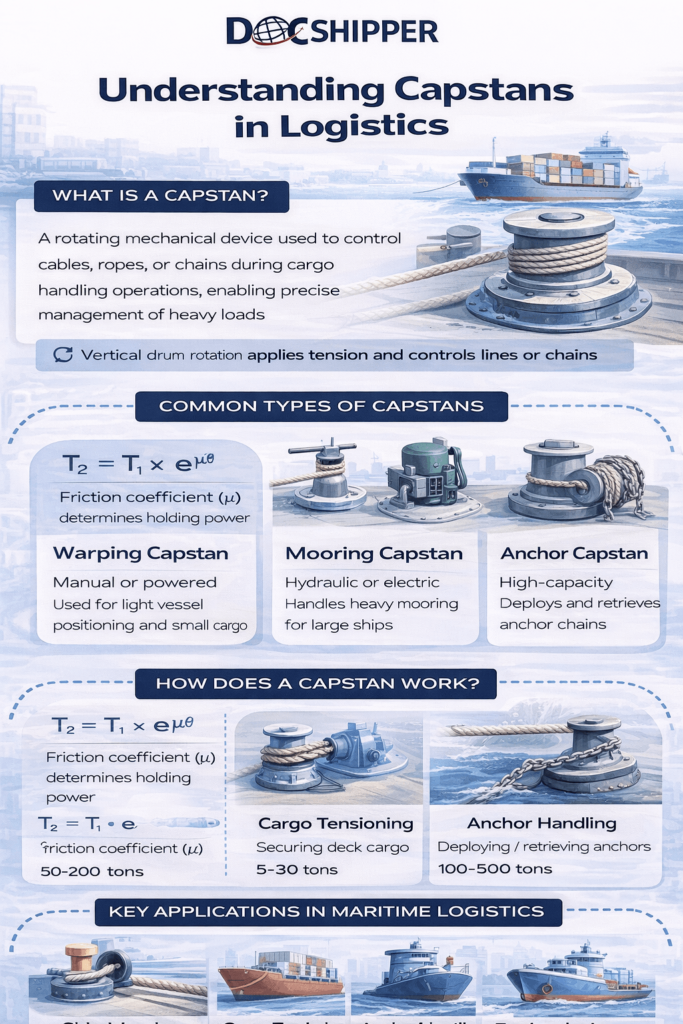
A capstan is a rotating mechanical device used to apply tension and control cables, ropes, or chains during cargo handling operations. Commonly found on ships and in port facilities, capstans enable operators to manage heavy loads with precision through controlled winding and unwinding mechanisms, making them essential for mooring, towing, and securing maritime cargo.
Introduction
In maritime logistics, confusion often arises between capstans, winches, and windlasses. Understanding the specific function of a capstan prevents operational errors during cargo handling and vessel mooring.
Capstans play a critical role in international shipping operations. They provide mechanical advantage when handling heavy mooring lines, anchor chains, and cargo securing systems.
Key characteristics of capstans in logistics operations:
- Vertical axis rotation distinguishes capstans from horizontal winches
- Manual or powered operation depending on load requirements and vessel size
- Friction-based control allows operators to manage tension without fixed attachments
- Multiple wraps around the drum increase holding power exponentially
- Safety mechanisms prevent overload and ensure controlled release
Technical Mechanisms & Operational Expertise
The capstan operates on the principle of friction multiplication. Each wrap of rope around the drum increases holding force according to the capstan equation: T₂ = T₁ × e^(μθ), where μ represents the friction coefficient and θ the wrap angle.
Modern maritime capstans feature electric or hydraulic drives that provide consistent torque. Manual capstans, still common on smaller vessels, utilize long bars inserted into sockets for leverage. The vertical drum design allows operators to feed rope from any horizontal direction, unlike winches that require aligned approach.
Regulatory compliance requires capstans to meet International Maritime Organization (IMO) standards for mooring equipment. The IMO Mooring Equipment Guidelines specify minimum breaking loads, drum dimensions, and safety features based on vessel tonnage.
The pawl and ratchet mechanism prevents reverse rotation under load. This safety feature proves essential when maintaining tension during cargo operations or when crew members need to secure lines temporarily. Advanced systems incorporate load monitoring sensors that alert operators when approaching safe working limits.
At DocShipper, we ensure that all cargo handling equipment, including capstans, meets international safety standards before loading operations commence. Our teams verify operational capacity and conduct pre-shipment inspections to prevent equipment-related delays.
The distinction between warping capstans and mooring capstans affects operational planning. Warping capstans handle lighter loads for vessel positioning, while mooring capstans manage the substantial forces of securing large ships to berths. Understanding this difference prevents equipment misuse and potential failure.
Practical Applications & Industry Data
Capstans serve distinct functions across different logistics scenarios. Their application varies significantly between vessel types, cargo categories, and port infrastructure.
| Application Type | Typical Load Capacity | Common Usage | Industry Sector |
|---|---|---|---|
| Ship Mooring | 50-200 tons | Securing vessels to berths | Container shipping, bulk carriers |
| Cargo Tensioning | 5-30 tons | Securing deck cargo | Ro-Ro vessels, project cargo |
| Anchor Handling | 100-500 tons | Deploying/retrieving anchors | Offshore operations |
| Warping Operations | 10-50 tons | Vessel positioning in port | General cargo, tankers |
| Towing Assistance | 20-100 tons | Managing tow lines | Tugboat operations |
Case Study: Container Terminal Operations
A major European container terminal processes 2.5 million TEU annually. Each vessel requires 6-8 mooring lines managed by electric capstans. With an average berthing time of 18 hours and 450 vessel calls monthly, capstans handle approximately 32,400 mooring operations yearly. Equipment reliability directly impacts terminal efficiency, as capstan failure can delay departures by 2-4 hours, costing $15,000-$30,000 in demurrage charges per incident.
Industry data reveals that hydraulic capstans reduce mooring time by 35% compared to manual systems. Automated tension monitoring decreases line breakage incidents by 60%, according to port authority safety reports. Modern capstans equipped with remote control capabilities improve crew safety by eliminating proximity to high-tension lines during critical operations.
In project cargo logistics, capstans secure oversized equipment during ocean transport. A recent shipment of wind turbine components required 12 capstan-controlled lashing points to maintain cargo stability across 8,000 nautical miles. Continuous tension monitoring prevented load shift, which could have resulted in cargo damage exceeding $2 million.
The offshore energy sector utilizes anchor handling capstans rated for extreme loads. These specialized units manage forces up to 500 tons when positioning drilling platforms. Precision control allows operators to adjust anchor tension within 2% tolerance, essential for maintaining platform stability in variable sea conditions.
Conclusion
Capstans remain indispensable in maritime logistics, providing controlled mechanical advantage for cargo securing, vessel mooring, and specialized handling operations. Understanding their technical specifications and operational limits ensures safe, efficient cargo movements across global supply chains.
Need expert guidance on cargo handling equipment or maritime logistics solutions? Contact DocShipper for comprehensive support tailored to your shipping requirements.
📚 Quiz
Test Your Knowledge: Capstan
1. What best defines a capstan in maritime logistics?
2. A dock operator needs to lift a heavy container vertically from the quayside. Should they use a capstan for this task?
3. A port team needs to reposition a large vessel along the berth without departing. Which type of capstan is most appropriate for this operation?
🎯 Your Result
📞 Free Quote in 24hFAQ | Capstan: Definition, Types & Practical Applications in Logistics
A capstan features a vertical rotating drum where rope wraps around without attachment, using friction for control. Winches have horizontal drums with fixed rope connections and storage capacity. Capstans excel at tension management; winches specialize in hauling and lifting.
Typically 3-5 wraps provide sufficient friction for most operations. Each additional wrap exponentially increases holding power. Excessive wraps can cause rope damage or jamming. Operators adjust based on load weight and rope material properties.
Capstans are not designed for vertical lifting. Their friction-based operation lacks the positive engagement required for safe overhead lifting. Winches or cranes should handle vertical cargo movements. Capstans manage horizontal pulling and tension control applications only.
Regular lubrication of bearings and drive mechanisms, inspection of pawl and ratchet systems, and checking electrical or hydraulic components. Monthly visual inspections identify wear on drum surfaces. Annual professional servicing ensures compliance with maritime safety regulations and operational reliability.
Synthetic ropes like nylon and polyester offer excellent friction characteristics and flexibility. Natural fiber ropes provide good grip but deteriorate faster. Wire rope requires specialized capstan drums with grooves. Material selection depends on load requirements, environmental conditions, and operational frequency.
Both systems offer high reliability when properly maintained. Electric capstans provide precise speed control and simpler installation. Hydraulic units deliver greater power density and perform better in extreme environments. Choice depends on vessel infrastructure, power availability, and operational requirements.
Manufacturers rate capacity based on drum diameter, motor power, and structural strength. Safe working load typically equals 25-33% of breaking strength. Calculations consider rope type, wrap count, and operational conditions. Always consult equipment specifications and regulatory guidelines before operation.
Yes, capstan design allows sequential handling of multiple lines. Operators manage one line at a time, securing each before proceeding. Simultaneous handling of multiple lines requires careful coordination and increases operational complexity. Larger vessels often employ multiple capstans for efficiency and safety.
Essential features include emergency stop controls, overload protection, automatic brake systems, and load monitoring displays. Guard rails prevent personnel contact with moving parts. Remote operation capabilities reduce crew exposure to hazardous areas. Compliance with IMO standards ensures adequate safety provisions.
Ice accumulation reduces friction and can jam mechanisms. High winds increase mooring line tension unpredictably. Saltwater corrosion degrades components over time. Operators must adjust techniques for wet conditions when rope slippage increases. Regular cleaning and protective coatings extend equipment lifespan in harsh environments.
Basic seamanship training covers manual capstan operation. Powered systems require certification in mechanical handling equipment. Advanced courses address load calculation, safety protocols, and emergency procedures. Many maritime authorities mandate periodic refresher training to maintain operational competency and safety awareness.
Absolutely. While automated systems handle routine operations, capstans provide essential backup and manual control capabilities. They remain standard equipment on vessels worldwide. Their mechanical simplicity ensures functionality when electronic systems fail. Capstans complement automation rather than being replaced by it.
Need Help with Logistics or Sourcing ?
First, we secure the right products from the right suppliers at the right price by managing the sourcing process from start to finish. Then, we simplify your shipping experience - from pickup to final delivery - ensuring any product, anywhere, is delivered at highly competitive prices.


Fill the Form
Prefer email? Send us your inquiry, and we’ll get back to you as soon as possible.
Contact us


