


In short ⚡
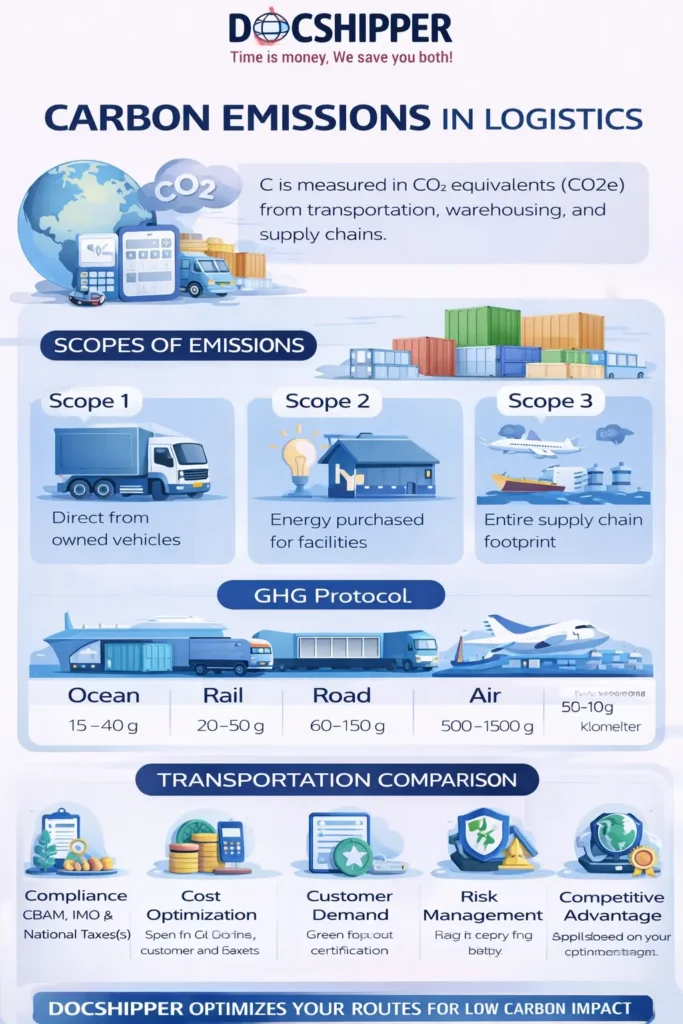
C in logistics refers to carbon emissions measured in CO2 equivalents. It quantifies greenhouse gas impact from transportation, warehousing, and supply chain operations. Tracking C enables businesses to reduce environmental footprint, comply with regulations, and optimize operational efficiency in international trade.Introduction
Many importers and exporters underestimate the carbon cost embedded in their supply chains. A single container shipment from Shanghai to Rotterdam generates approximately 2.5 tons of CO2. As carbon taxation spreads globally, understanding your C footprint becomes a competitive necessity.
Carbon measurement in logistics directly impacts customs procedures, carrier selection, and cost structures. The European Union’s Carbon Border Adjustment Mechanism (CBAM) now requires importers to declare embedded emissions. Ignoring this metric exposes businesses to penalties and lost market access.
- Regulatory compliance: CBAM, IMO 2030 targets, national carbon taxes
- Cost optimization: Fuel surcharges, carbon credits, modal shift incentives
- Customer demand: 73% of B2B buyers prioritize low-carbon suppliers (McKinsey 2023)
- Risk management: Supply chain resilience against carbon pricing volatility
- Competitive advantage: Green certifications unlock premium markets
Carbon Measurement & Regulatory Framework
Carbon accounting in logistics follows the GHG Protocol standard, dividing emissions into three scopes. Scope 1 covers direct emissions from owned vehicles. Scope 2 includes energy purchased for warehouses. Scope 3 captures the entire supply chain—the largest and most complex category for freight forwarders.
The GLEC Framework (Global Logistics Emissions Council) provides standardized calculation methods. It uses emission factors per ton-kilometer, adjusted for mode (sea, air, road, rail). Ocean freight generates 10-40g CO2/ton-km, while air cargo produces 500-1500g—a 50x difference that reshapes routing decisions.
The EU Emissions Trading System (ETS) now includes maritime transport for voyages to European ports. Shipping lines must surrender allowances for 40% of emissions in 2024, rising to 100% by 2027. This cost—currently €80-100 per ton CO2—gets passed to shippers through carbon adjustment factors (CAF) in freight rates.
The IMO 2023 Strategy mandates net-zero shipping by 2050, with intermediate targets: 40% carbon intensity reduction by 2030. Compliance mechanisms include the Carbon Intensity Indicator (CII) rating system. Ships rated D or E face operational restrictions, forcing carriers to slow-steam or upgrade fleets—impacting transit times and capacity.
At DocShipper, we integrate carbon calculations into routing proposals. Our platform automatically compares the CO2 impact of different carrier-mode combinations, helping clients balance speed, cost, and environmental goals. This transparency prevents greenwashing and supports ESG reporting requirements.
National carbon taxes add complexity. Singapore charges $25/ton CO2 (rising to $80 by 2030). Canada’s system reaches $170/ton by 2030. These costs appear as environmental surcharges on invoices, varying by jurisdiction and transport mode. Proper documentation through systems like the EU CBAM registry becomes mandatory for cross-border trade.
Calculation Methods & Concrete Examples
The basic formula multiplies activity data by emission factors. For a 20-foot container from Shenzhen to Hamburg (18,500 km), using a vessel consuming 150g CO2/ton-km with 10-ton cargo: 10 tons × 18,500 km × 0.15 kg CO2/ton-km = 27,750 kg (27.75 tons) CO2.
| Transport Mode | Route Example | CO2 per Ton-Km | 10-Ton Shipment (5000 km) |
|---|---|---|---|
| Ocean Freight | Shanghai-Los Angeles | 15-30g | 0.75-1.5 tons CO2 |
| Rail Freight | Chongqing-Duisburg | 20-50g | 1.0-2.5 tons CO2 |
| Road Freight | Paris-Berlin | 60-150g | 3.0-7.5 tons CO2 |
| Air Freight | Hong Kong-Frankfurt | 500-1500g | 25-75 tons CO2 |
Case Study: A European electronics importer ships 500 units (8 tons) monthly from Vietnam. Original routing: air freight to Amsterdam (9,200 km) = 8 × 9,200 × 1.2 kg = 88.3 tons CO2/shipment. Annual emissions: 1,059 tons at €90/ton CBAM cost = €95,310.
Switching to ocean freight (12,500 km, 25g/ton-km) reduces per-shipment emissions to 2.5 tons. Annual total: 30 tons CO2, costing €2,700—a 97% reduction. Transit time increases from 3 to 28 days, requiring inventory adjustments but saving €92,610 annually in carbon costs alone.
Warehouse emissions add another layer. A 10,000 m² facility consuming 200 kWh/m²/year in a coal-heavy grid (0.9 kg CO2/kWh) generates 1,800 tons CO2 annually. Switching to renewable energy contracts or on-site solar drops this to near zero, improving Scope 2 reporting.
Last-mile delivery represents 40% of logistics emissions. Electric vans produce 0g tailpipe emissions but require grid-intensity analysis. In France (nuclear-heavy, 60g CO2/kWh), an EV van emits 15g/km lifecycle. In Poland (coal-heavy, 700g CO2/kWh), the same van emits 175g/km—worse than a modern diesel at 140g/km.
DocShipper’s carbon calculator integrates real-time emission factors from the European Environment Agency and vessel-specific data from IMO databases. Clients receive detailed breakdowns showing emissions by leg, mode, and carrier—essential for Scope 3 reporting under standards like CDP and TCFD.
Conclusion
Carbon measurement transforms from compliance burden to strategic advantage when integrated into procurement decisions. Accurate C tracking reduces regulatory risk, lowers costs through modal optimization, and meets rising customer expectations for sustainable supply chains.
Need expert guidance on carbon-efficient logistics? Contact DocShipper for customized solutions that balance speed, cost, and environmental impact across your global operations.
📚 Quiz
Test Your Knowledge: Carbon Emissions in Logistics
Q1 — What does "C" (carbon emissions) measure in a logistics context?
Q2 — A shipper wants to reduce carbon emissions drastically. They switch from air freight (1,200g CO2/ton-km) to ocean freight (25g CO2/ton-km) for a regular Vietnam–Amsterdam route. Which statement best describes the trade-off?
Q3 — A logistics manager in Poland considers switching to electric delivery vans, assuming they will be carbon-neutral. Based on carbon accounting principles, is this assumption correct?
🎯 Your Result
📞 Free Personalized QuoteFAQ | C: Definition, Calculation & Real-World Examples in Logistics
CO2e (carbon dioxide equivalent) includes all greenhouse gases—methane, nitrous oxide, refrigerants—converted to CO2 impact. Logistics reports use CO2e for complete emissions accounting, while CO2 measures only carbon dioxide from fuel combustion.
CBAM requires importers of cement, steel, aluminum, fertilizers, and electricity to declare embedded emissions and purchase certificates. Non-compliance results in penalties equal to carbon costs plus fines. Full implementation starts January 2026 after a 2024-2025 reporting phase.
Offsets compensate emissions through projects like reforestation but don't reduce actual supply chain carbon. Regulators increasingly require direct emission reductions first. Offsets supplement but cannot replace operational efficiency improvements under frameworks like SBTi.
The Carbon Intensity Indicator rates vessels A-E based on CO2 per cargo-mile. Ships rated D for three years or E for one year face mandatory corrective action plans. Poor ratings reduce vessel charter rates and limit port access in some jurisdictions.
Accuracy depends on data granularity. Generic calculators using average emission factors achieve ±30% accuracy. Vessel-specific data from AIS tracking and actual fuel consumption reports improve precision to ±10%, meeting ISO 14083 standards for transport emission quantification.
Generally yes—slow steaming at 12 knots versus 20 knots cuts fuel use 40-50%. However, extended transit increases refrigeration emissions for reefer cargo and may require air freight backup for delays, potentially increasing total supply chain carbon.
Category 4 covers upstream transportation and distribution—all logistics services purchased by your company. This includes inbound freight, warehousing by third parties, and product distribution to customers. Most companies find 50-80% of emissions in Scope 3.
No—lifecycle emissions depend on electricity sources. An EV truck charged with renewable energy approaches carbon neutrality. Coal-powered charging produces 150-200g CO2/km, comparable to Euro 6 diesel trucks. Battery production adds 15-20 tons CO2 upfront per vehicle.
Carriers add Environmental Adjustment Factors (EAF) or Carbon Adjustment Factors (CAF) as percentage increases or per-container fees. Ocean lines typically charge $50-150 per TEU. Airlines include carbon costs in fuel surcharges, ranging from 5-15% of base freight rates.
Rail freight powered by renewable electricity produces 5-15g CO2/ton-km—lowest among motorized modes. Ocean shipping follows at 10-40g. Electric trucks range 15-175g depending on grid intensity. Air freight remains highest at 500-1500g, suitable only for time-critical low-weight cargo.
Only with third-party verification under standards like ISO 14064 or PAS 2060. Unsubstantiated claims risk greenwashing accusations and regulatory action. The EU Green Claims Directive requires lifecycle assessments and prohibits vague terms like "carbon-neutral" without detailed proof.
Annual updates suffice for strategic planning, but quarterly reviews align with financial reporting cycles. Real-time tracking through TMS integration enables route optimization and carrier performance monitoring. Regulatory reporting follows jurisdictional deadlines—CBAM requires quarterly submissions starting 2026.
Need Help with
Logistics or Sourcing ?
First, we secure the right products from the right suppliers at the right price by managing the sourcing process from start to finish. Then, we simplify your shipping experience - from pickup to final delivery - ensuring any product, anywhere, is delivered at highly competitive prices.


Fill the Form
Prefer email? Send us your inquiry, and we’ll get back to you as soon as possible.
Contact us




