


In short ⚡
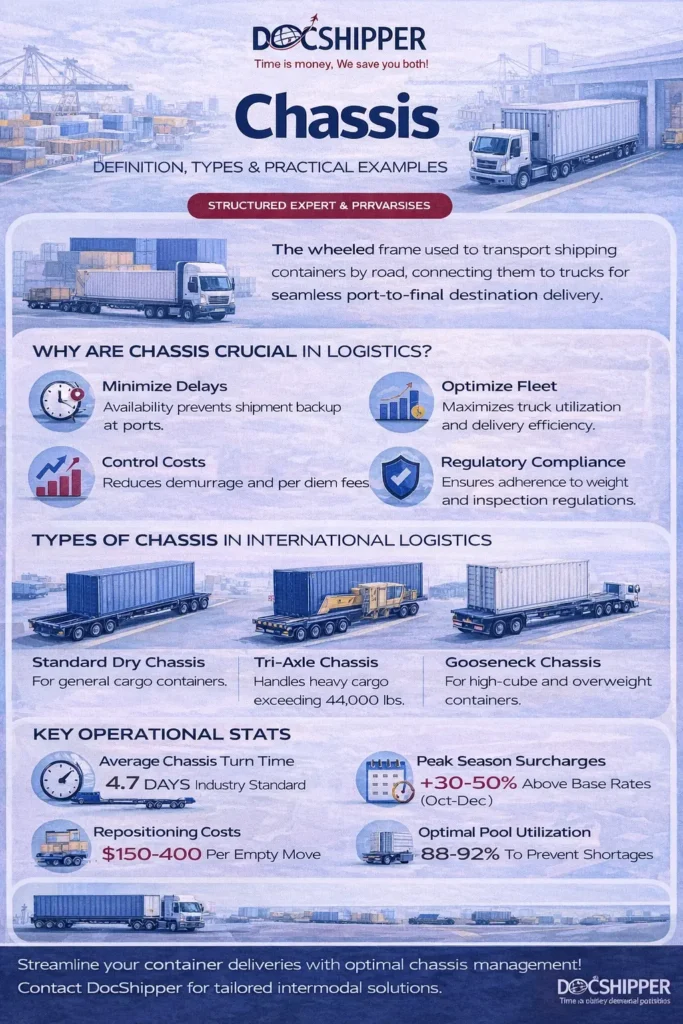
Chassis is a wheeled frame used to transport shipping containers by road. This essential equipment connects containers to trucks, enabling intermodal transport between ports, warehouses, and final destinations. Without proper chassis availability, container dwell times increase significantly, causing supply chain delays.Introduction
Container arrives at port. Truck driver shows up. No chassis available. Shipment delayed 48 hours.
This scenario costs importers thousands annually. The chassis represents the critical link between maritime and land transport. In international logistics, chassis management directly impacts delivery speed, demurrage costs, and customer satisfaction.
Understanding chassis operations is essential for:
- Freight forwarders coordinating intermodal shipments
- Importers managing port-to-door delivery timelines
- Trucking companies optimizing equipment utilization
- Warehouse operators planning container receiving schedules
- Supply chain managers reducing dwell time and storage fees
Technical Specifications & Regulatory Framework
A chassis consists of a steel frame mounted on axles with twist locks securing containers at corner castings. Standard configurations accommodate 20-foot, 40-foot, and 45-foot containers. Modern chassis include air ride suspension, LED lighting, and ABS braking systems compliant with FMCSA regulations.
The chassis pool system emerged after ocean carriers divested chassis ownership in 2009. Today, chassis providers like TRAC Intermodal, Flexi-Van, and Direct ChassisLink operate independent fleets. Shippers now face per-diem charges ranging from $25 to $75 daily, depending on equipment type and market conditions.
Regulatory compliance requires annual inspections per 49 CFR Part 396. Each chassis must display a valid USDOT inspection sticker. The Intermodal Association of North America (IANA) maintains technical standards referenced by customs authorities worldwide. According to IANA guidelines, chassis must support maximum gross weights of 67,200 lbs for highway transport.
Gray chassis pools allow neutral equipment sharing across multiple motor carriers. This system reduces empty repositioning but requires sophisticated tracking. At DocShipper, we verify chassis availability before container release, preventing costly port delays for our clients.
Three critical chassis categories exist:
- Standard dry chassis – General cargo containers
- Tri-axle chassis – Heavy cargo exceeding 44,000 lbs
- Gooseneck chassis – High-cube and overweight containers
- Genset chassis – Refrigerated containers requiring power
- Tank chassis – ISO tank containers for liquids
Practical Examples & Operational Data
Chassis shortages create measurable financial impact. Port of Los Angeles data shows average container dwell time increases 37% when chassis availability drops below 85%. Each delay day generates $150-$300 in demurrage and storage charges.
Comparative Chassis Costs (2024)
| Chassis Type | Daily Rate | Typical Use | Weight Capacity |
|---|---|---|---|
| Standard 20′ | $28-35 | General cargo | 44,000 lbs |
| Standard 40′ | $32-42 | Standard containers | 44,000 lbs |
| Tri-axle 40′ | $55-75 | Heavy machinery | 67,200 lbs |
| Genset chassis | $85-120 | Refrigerated goods | 44,000 lbs |
Case Study: Electronics Importer
A Los Angeles-based electronics distributor imported 150 TEU monthly. Original logistics setup used carrier-provided chassis with 5-day free time. Average overage: 2.3 days per container at $45/day = $15,525 monthly waste.
Solution implemented: Pre-arranged chassis pool access with 9-day free time. Result: 94% containers returned within free period. Monthly savings: $13,180. Annual impact: $158,160 cost reduction.
Key Operational Metrics
- Average chassis turn time: 4.7 days (industry standard)
- Optimal pool utilization: 88-92% to prevent shortages
- Repositioning costs: $150-$400 per empty chassis move
- Peak season surcharges: 30-50% above base rates (Oct-Dec)
- Maintenance downtime: 3-5% of fleet at any given time
Conclusion
Effective chassis management separates efficient importers from those bleeding money on avoidable fees. Understanding equipment types, pool systems, and cost structures enables strategic decisions that protect margins.
Need expert guidance on chassis logistics for your shipments? Contact DocShipper for customized intermodal solutions.
📚 Quiz
Test Your Knowledge: Chassis
Q1 — What is the primary function of a chassis in international logistics?
Q2 — A shipper needs to transport a 40-foot refrigerated container by road. Which chassis type is required?
Q3 — An importer's container has been sitting at the port for 6 days. Their chassis provider offers 3 days of free time at $45/day after that. What is the most accurate statement about this situation?
🎯 Your Result
📞 Free Quote in 24hFAQ | Chassis: Definition, Types & Practical Examples in International Logistics
A chassis is a specialized frame designed exclusively for container transport with twist locks. Trailers have enclosed bodies for loose cargo. Chassis cannot haul non-containerized freight.
Chassis are typically owned by independent leasing companies (TRAC, Flexi-Van, Direct ChassisLink). Importers rent them per-diem. Some trucking companies maintain private fleets for dedicated operations.
Free time varies by provider and contract, typically 3-5 days. After that, per-diem charges range $25-$75 daily. Peak seasons often reduce free time to 24-48 hours.
No. Container size (20'/40'/45'), type (standard/high-cube/reefer), and weight determine chassis requirements. Mismatched equipment causes safety violations and rejection at weigh stations.
Your container remains at the terminal accruing demurrage ($100-$300/day). You must wait for chassis availability or arrange repositioning from another depot at additional cost ($150-$400).
Commercial Driver's License (CDL) requirements depend on combined vehicle weight. Loads under 26,001 lbs may not require CDL. Over that threshold, Class A CDL is mandatory per FMCSA regulations.
Gray pools allow multiple carriers to access shared chassis inventory. You pick up any available unit matching your container specs, improving efficiency but requiring precise tracking systems to prevent loss.
Genset chassis power refrigerated containers during road transport. They include diesel generator units maintaining temperature-controlled cargo between -30°C to +30°C. Daily rates are 2-3x standard chassis costs.
Yes. Carriers reject chassis with broken twist locks, damaged frames, or expired inspections. Pre-trip inspections prevent roadside violations. Replacement chassis sourcing adds 4-24 hours to delivery timelines.
Strategies include: pre-scheduling unloading appointments, using drop-and-hook operations, negotiating extended free time, maintaining backup chassis pools, and implementing real-time tracking to expedite returns.
Yes. Chassis rental fees qualify as ordinary business expenses under IRS guidelines. They're deductible as transportation costs on Schedule C (sole proprietors) or corporate tax returns.
Chassis split occurs when ocean carriers stopped providing chassis (2009-2016). Importers now contract separately with chassis providers, adding complexity but enabling competitive pricing through independent leasing markets.
Need Help with
Logistics or Sourcing ?
First, we secure the right products from the right suppliers at the right price by managing the sourcing process from start to finish. Then, we simplify your shipping experience - from pickup to final delivery - ensuring any product, anywhere, is delivered at highly competitive prices.


Fill the Form
Prefer email? Send us your inquiry, and we’ll get back to you as soon as possible.
Contact us




