


In short ⚡
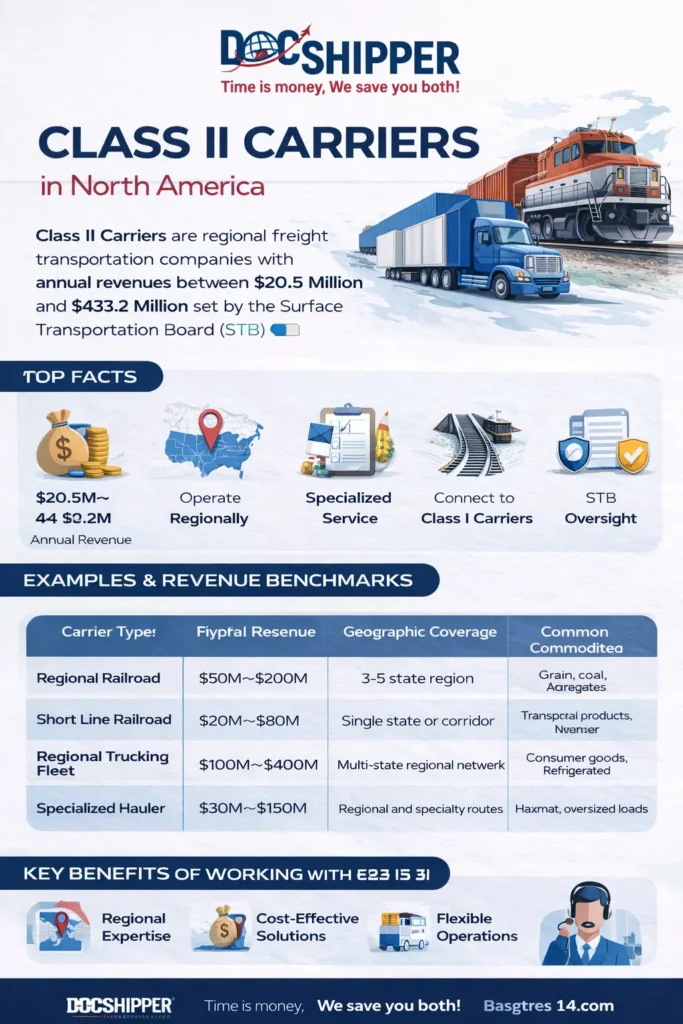
A Class II Carrier is a regional freight transportation company classified by the Surface Transportation Board (STB) with annual operating revenues between $20.5 million and $433.2 million. These carriers operate primarily within specific geographic regions, providing essential rail or trucking services that connect local shippers to national networks.
Introduction
Many importers and exporters struggle to identify the right transportation partner for regional logistics. The carrier classification system often appears confusing, especially when determining whether a provider can handle specific volume requirements or geographic coverage.
Understanding Class II Carriers is crucial for businesses managing domestic distribution after international shipments arrive. These mid-sized operators fill a critical gap between small local carriers and major national networks.
- Revenue threshold: Annual operating revenues between $20.5M and $433.2M (adjusted periodically by STB)
- Geographic scope: Typically regional operations covering multiple states or provinces
- Service specialization: Often focus on specific commodities or industry sectors
- Network connectivity: Provide interline services connecting to Class I carriers
- Regulatory status: Subject to STB oversight but with less stringent reporting than Class I
Classification Framework & Regulatory Context
The Surface Transportation Board establishes carrier classifications based on annual operating revenues, creating three primary categories. This system enables appropriate regulatory oversight while recognizing operational differences between small, medium, and large carriers.
Class II designation applies specifically to carriers exceeding Class III thresholds but remaining below Class I revenue requirements. The classification affects reporting obligations, rate-setting authority, and merger approval processes.
The revenue thresholds undergo periodic adjustment based on the Railroad Cost Recovery Index. The current Class II range ($20.5M to $433.2M) reflects 2023 inflation adjustments. Carriers must self-report annually to maintain accurate classification status.
Regulatory implications include mandatory annual financial reporting to the STB, though requirements remain less extensive than Class I carriers face. Class II carriers maintain greater pricing flexibility compared to larger operators, particularly for contract rates with shippers.
The operational independence of Class II carriers allows specialized service offerings. Many focus on specific industries—agricultural products, chemicals, or manufactured goods—developing expertise that larger carriers cannot economically maintain for regional markets.
At DocShipper, we regularly partner with Class II carriers for inland distribution after ocean freight arrival, particularly when clients require specialized handling or regional delivery networks beyond major metropolitan areas.
For official classification criteria and current revenue thresholds, consult the Surface Transportation Board regulatory guidelines.
Operational Examples & Revenue Benchmarks
Class II carriers demonstrate significant operational diversity. Understanding their typical characteristics helps shippers select appropriate transportation partners for specific logistics requirements.
| Carrier Type | Typical Revenue Range | Geographic Coverage | Common Commodities |
|---|---|---|---|
| Regional Railroad | $50M – $200M | 3-5 state region | Grain, coal, aggregates |
| Short Line Railroad | $20M – $80M | Single state or corridor | Industrial products, lumber |
| Regional Trucking Fleet | $100M – $400M | Multi-state regional network | Consumer goods, refrigerated |
| Specialized Hauler | $30M – $150M | Regional with specialty routes | Hazmat, oversized loads |
Practical Use Case: Import Distribution Scenario
Consider a European machinery manufacturer importing equipment through the Port of Savannah. The shipment requires inland rail transport to distribution centers in Tennessee and Alabama.
- Challenge: Class I carriers quote $8,500 with 7-day transit and limited flexibility for specialized handling
- Solution: Regional Class II carrier offers $6,200 with customized loading procedures and 5-day delivery
- Added value: Carrier provides warehousing at transload facility, reducing total logistics cost by 18%
- Service advantage: Direct communication with operations team enables real-time shipment modifications
- Result: Client establishes ongoing partnership, reducing quarterly transportation spend by $47,000
DocShipper evaluates carrier classifications systematically when designing distribution strategies. Our network includes vetted Class II partners specializing in post-import inland transportation, ensuring cost-effective regional delivery without compromising service quality.
Conclusion
Class II Carriers represent a critical middle tier in North American freight transportation, offering regional expertise and operational flexibility that larger carriers cannot economically provide. Understanding their classification helps importers optimize inland distribution strategies.
Need assistance selecting the right carrier classification for your logistics requirements? Contact DocShipper for expert guidance on transportation partner selection and freight optimization.
📚 Quizz
Test Your Knowledge: Class II Carrier
Q1 — What is the annual operating revenue range that defines a Class II Carrier according to the Surface Transportation Board (STB)?
Q2 — A common misconception is that Class II carriers handle international shipments end-to-end. What is the correct interpretation?
Q3 — A European manufacturer imports heavy machinery through the Port of Savannah and needs inland delivery to Tennessee. Which scenario best illustrates the advantage of choosing a Class II carrier over a Class I carrier?
🎯 Your Result
📞 Free Quote in 24hFAQ | Class II Carrier: Definition, Classification & Practical Examples
Class II carriers operate with annual revenues between $20.5M and $433.2M, while Class I carriers exceed $433.2M. Class II typically focus on regional operations with more flexible service offerings and direct customer relationships.
Class II carriers primarily manage domestic transportation but frequently partner with international freight forwarders for inland portions of import/export shipments, particularly for regional distribution after port arrival.
The Surface Transportation Board adjusts revenue thresholds annually based on inflation indexes. Individual carriers may change classification as their revenues grow or decline, requiring annual verification of status.
For regional shipments within their service territory, Class II carriers often provide 15-30% cost savings compared to Class I rates, plus enhanced service flexibility and direct operational communication.
Class II carriers frequently specialize in agricultural products, chemicals, lumber, coal, aggregates, and manufactured goods. Many develop expertise in specific commodity handling within their regional markets.
Many Class II carriers provide intermodal connections, partnering with Class I railroads and trucking companies to offer seamless multi-modal transportation solutions for shippers requiring extended geographic reach.
Class II carriers often achieve superior on-time performance compared to larger carriers for regional routes, with typical reliability rates of 92-96% due to focused geographic coverage and operational control.
Class II carriers must maintain minimum cargo insurance as mandated by federal regulations, typically $750,000 to $2 million depending on commodity type. Shippers should verify specific coverage limits before engagement.
Class II carriers generally offer greater rate negotiation flexibility than Class I operators, particularly for contract volumes or specialized service requirements. Long-term partnerships often yield 10-20% discounts.
Regional Class II carriers typically maintain better equipment availability than national carriers due to focused service areas. They often establish equipment-sharing agreements with partner carriers to ensure capacity during peak periods.
Modern Class II carriers increasingly adopt transportation management systems (TMS), GPS tracking, and electronic data interchange (EDI) capabilities, though technology sophistication varies significantly across individual operators.
Class II carriers face similar safety and operational regulations as Class I but have reduced financial reporting requirements to the STB. They must comply with all DOT, FRA, and FMCSA regulations applicable to their service mode.
Need Help with
Logistics or Sourcing ?
First, we secure the right products from the right suppliers at the right price by managing the sourcing process from start to finish. Then, we simplify your shipping experience - from pickup to final delivery - ensuring any product, anywhere, is delivered at highly competitive prices.


Fill the Form
Prefer email? Send us your inquiry, and we’ll get back to you as soon as possible.
Contact us




