


In short ⚡
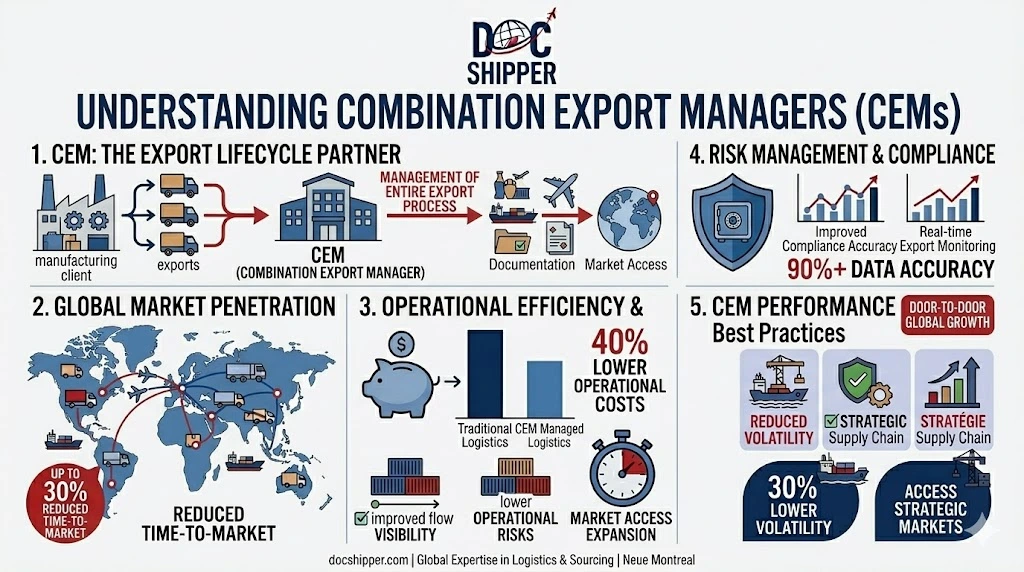
A Combination Export Manager is a logistics professional who simultaneously handles both direct export operations and indirect export coordination, managing shipments, documentation, compliance, and third-party relationships. This dual-function role optimizes export processes by consolidating responsibilities typically divided between separate departments, reducing operational costs and improving shipment efficiency.
Introduction
Many exporters struggle with fragmented export management—one team handles direct shipments while another coordinates with intermediaries. This creates communication gaps, documentation errors, and compliance risks.
The Combination Export Manager role emerged to address these inefficiencies. By merging direct and indirect export functions, this position streamlines international trade operations across multiple channels.
Key characteristics include:
- Dual operational oversight: Managing both manufacturer-to-customer exports and intermediary-based transactions
- Comprehensive compliance knowledge: Understanding regulations for various export methods and destinations
- Strategic vendor coordination: Maintaining relationships with freight forwarders, customs brokers, and export trading companies
- Documentation mastery: Preparing commercial invoices, certificates of origin, export licenses, and shipping instructions
- Risk management: Identifying potential regulatory, financial, and logistical obstacles across export channels
In-Depth Expertise & Responsibilities
The Combination Export Manager operates at the intersection of operational execution and strategic coordination. Unlike traditional export managers who focus on a single channel, this role requires fluency in multiple export methodologies.
Direct export management involves handling shipments where the company sells directly to foreign customers. The manager oversees logistics arrangements, negotiates with carriers, ensures proper Incoterms application, and manages payment collection through letters of credit or open account terms.
Indirect export coordination requires working with intermediaries such as export management companies (EMCs), export trading companies (ETCs), or foreign distributors. The manager must maintain these partnerships while ensuring brand standards and regulatory compliance are met.
According to the U.S. International Trade Administration, companies utilizing combination export strategies report 23% higher market penetration rates compared to single-channel exporters.
Regulatory compliance represents a critical function. The manager must navigate export control regulations (EAR, ITAR), sanctions programs (OFAC), and destination-specific requirements. At DocShipper, we work closely with Combination Export Managers to verify documentation accuracy and prevent costly customs delays.
Technology integration has become essential. Modern Combination Export Managers leverage ERP systems, trade management software, and automated compliance screening tools to manage the complexity of dual-channel operations efficiently.
Practical Examples & Data
Understanding the role through concrete scenarios demonstrates its practical value in international trade operations.
Use Case: Manufacturing Equipment Exporter
A mid-sized U.S. manufacturer of industrial machinery employs a Combination Export Manager to handle:
- Direct exports: 60% of sales to established customers in Canada, Mexico, and Germany
- Indirect exports: 40% through distributors in Southeast Asia and Latin America
- Annual export volume: $12 million across 18 countries
- Documentation processed: 340 export declarations, 280 certificates of origin, 150 AES filings
- Cost savings: 18% reduction in logistics expenses through consolidated carrier negotiations
Comparative Analysis: Single vs. Combination Management
| Metric | Separate Managers | Combination Manager |
|---|---|---|
| Staffing Cost | $180,000/year (2 positions) | $110,000/year (1 position) |
| Documentation Errors | 7.2% error rate | 3.1% error rate |
| Shipment Delays | 12% of shipments | 5% of shipments |
| Vendor Relationships | Fragmented communication | Unified account management |
| Compliance Incidents | 4 per year | 1 per year |
Key Performance Indicators
Successful Combination Export Managers typically achieve:
- On-time shipment rate: 95%+ across all export channels
- Documentation accuracy: 97%+ first-time approval rate
- Cost optimization: 15-20% reduction in per-shipment logistics expenses
- Market expansion: 3-5 new export destinations annually
- Compliance record: Zero critical violations in customs audits
Conclusion
The Combination Export Manager represents an evolved approach to international trade management, consolidating expertise and reducing operational friction. This role delivers measurable efficiency gains while maintaining compliance across complex multi-channel export operations.
Need assistance optimizing your export management structure? Contact DocShipper for expert guidance on streamlining your international logistics operations.
📚 Quiz
Test Your Knowledge: Combination Export Manager
Q1 — What best defines a Combination Export Manager?
Q2 — A common misconception is that a Combination Export Manager simply does the same job as a traditional Export Manager, just with a different title. What is the key difference?
Q3 — A U.S. manufacturer exports 60% of its goods directly to customers in Canada and Germany, and 40% through distributors in Southeast Asia. Which professional is best suited to manage this operation?
🎯 Your Result
📞 Free Quote in 24hFAQ | Combination Export Manager: Definition, Role & Practical Examples
Typically requires 5+ years in export operations, knowledge of international trade regulations, familiarity with logistics software, and experience managing both direct and indirect export channels. Professional certifications like CGBP or CCS are advantageous.
Traditional Export Managers focus on a single channel (either direct or indirect), while Combination Export Managers handle both simultaneously, requiring broader skillsets in vendor management, documentation, and compliance across multiple export methodologies.
Manufacturing sectors with diverse customer bases—industrial equipment, electronics, automotive parts, and consumer goods—gain the most value. Companies exporting to 10+ countries through multiple channels see significant operational improvements.
Common platforms include ERP systems (SAP, Oracle), trade management software (Amber Road, Descartes), compliance screening tools (Visual Compliance, Amber Road Denied Party Screening), and shipment tracking systems integrated with carrier APIs.
The manager determines license requirements for both direct and indirect shipments, prepares applications (EAR, ITAR, BIS), maintains license records, and ensures end-use compliance. They coordinate with legal teams on complex controlled technology exports.
Companies report 15-25% reduction in export-related operational costs through streamlined processes, reduced staffing redundancy, improved carrier negotiations, and fewer compliance incidents requiring remediation.
The manager serves as a single point of contact for all forwarders, consolidating shipment volumes for better rates, standardizing documentation procedures, and maintaining performance metrics across service providers for both direct and indirect exports.
Key risks include export control violations, incorrect tariff classifications, improper valuation, sanctions screening failures, and documentation inconsistencies. The unified oversight reduces gaps that occur when responsibilities are fragmented.
By analyzing performance data across both export channels, the manager identifies high-potential markets, recommends optimal entry strategies (direct vs. distributor), and coordinates pilot shipments with minimal risk exposure.
Critical KPIs include shipment on-time rate, documentation accuracy percentage, cost per shipment, compliance incident frequency, customer satisfaction scores, and year-over-year export growth across managed channels.
The manager provides export feasibility assessments for new opportunities, educates sales on Incoterms and payment terms, supports quote preparation with accurate logistics costs, and ensures customer expectations align with operational capabilities.
Common obstacles include managing competing priorities between direct and indirect channels, staying current with rapidly changing trade regulations across multiple jurisdictions, coordinating disparate IT systems, and balancing cost optimization with service quality requirements.
Need Help with
Logistics or Sourcing ?
First, we secure the right products from the right suppliers at the right price by managing the sourcing process from start to finish. Then, we simplify your shipping experience - from pickup to final delivery - ensuring any product, anywhere, is delivered at highly competitive prices.


Fill the Form
Prefer email? Send us your inquiry, and we’ll get back to you as soon as possible.
Contact us




