


In short ⚡
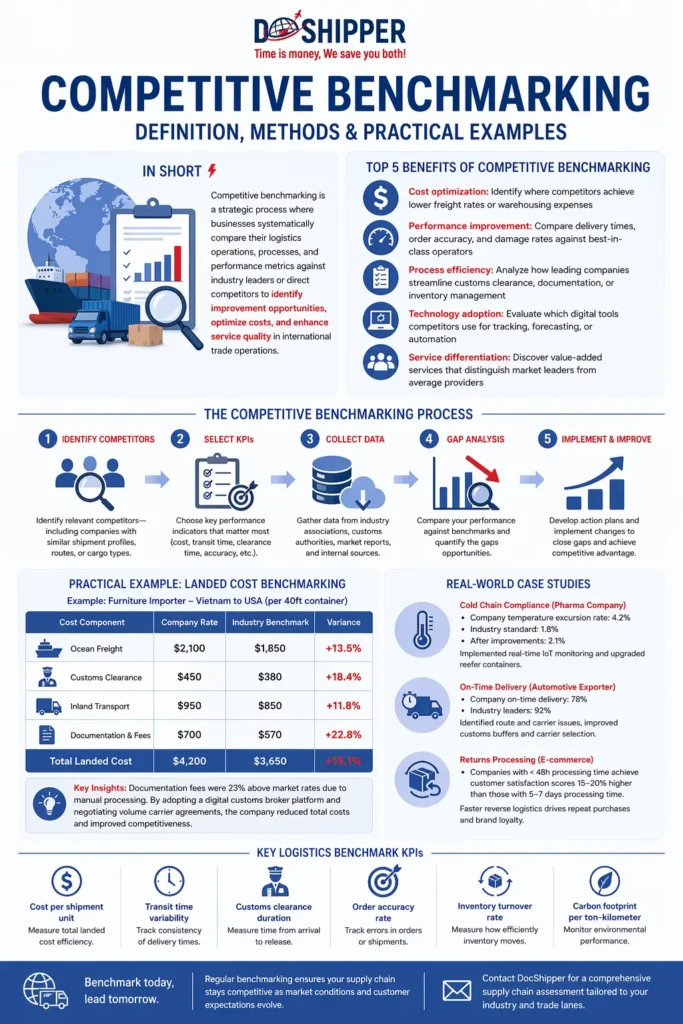
Competitive benchmarking is a strategic process where businesses systematically compare their logistics operations, processes, and performance metrics against industry leaders or direct competitors to identify improvement opportunities, optimize costs, and enhance service quality in international trade operations.Introduction
Many importers and exporters struggle to determine whether their logistics costs are competitive or if their delivery times meet market standards. Without objective comparison points, businesses risk overpaying for services or losing customers to more efficient competitors.
Competitive benchmarking addresses this challenge by providing measurable insights into how your supply chain performs relative to industry standards. This practice is essential for maintaining profitability in international logistics where margins are tight and customer expectations continuously evolve.
- Cost optimization: Identify where competitors achieve lower freight rates or warehousing expenses
- Performance improvement: Compare delivery times, order accuracy, and damage rates against best-in-class operators
- Process efficiency: Analyze how leading companies streamline customs clearance, documentation, or inventory management
- Technology adoption: Evaluate which digital tools competitors use for tracking, forecasting, or automation
- Service differentiation: Discover value-added services that distinguish market leaders from average performers
In-Depth Analysis & Strategic Implementation
Effective competitive benchmarking in logistics requires a structured methodology. The process begins with identifying relevant competitors—not just direct business rivals, but companies with similar shipment profiles, routes, or cargo types. A manufacturer shipping electronics from China to Europe should compare against others in the same trade lane rather than unrelated industries.
The second phase involves selecting key performance indicators (KPIs) that matter most to your operations. Common logistics benchmarks include cost per shipment unit, transit time variability, customs clearance duration, inventory turnover rates, and carbon footprint per ton-kilometer. Each metric must be normalized to account for differences in shipment volumes or distances.
Data collection methodology determines benchmarking accuracy. Primary sources include industry associations like FIATA, which publishes global freight forwarding standards, or customs authorities that provide clearance time statistics. Secondary sources encompass competitor annual reports, logistics provider rate cards, and third-party market research from firms like Gartner or Drewry.
The gap analysis phase quantifies differences between your performance and benchmarks. If your average ocean freight transit time from Shanghai to Rotterdam is 38 days while the industry median is 32 days, you face a 6-day competitive disadvantage. This gap might stem from suboptimal carrier selection, inefficient port handling, or inadequate shipment consolidation practices.
Finally, implementation planning translates insights into action. At DocShipper, we systematically benchmark our clients’ logistics performance against industry standards to identify specific improvement opportunities—whether renegotiating carrier contracts, optimizing container loading patterns, or implementing predictive analytics for demand forecasting. This evidence-based approach ensures resource allocation focuses on changes that deliver measurable competitive advantage.
Practical Examples & Performance Data
Consider a mid-sized furniture importer shipping 40-foot containers from Vietnam to the United States. Through competitive benchmarking, they discovered their all-in landed cost was $4,200 per container versus the industry average of $3,650—a 15% premium.
| Cost Component | Company Rate | Industry Benchmark | Variance |
|---|---|---|---|
| Ocean Freight | $2,100 | $1,850 | +13.5% |
| Customs Clearance | $450 | $380 | +18.4% |
| Inland Transport | $950 | $850 | +11.8% |
| Documentation & Fees | $700 | $570 | +22.8% |
| Total Landed Cost | $4,200 | $3,650 | +15.1% |
The benchmarking exercise revealed that documentation fees were 23% above market rates due to manual processing. By switching to a digital customs broker platform, the company reduced this cost to $580 per container. Similarly, consolidating shipments with a volume carrier agreement brought ocean freight rates down to $1,900—still above benchmark but significantly improved.
Another practical case involves an automotive parts exporter benchmarking on-time delivery performance. Their analysis showed 78% of shipments arrived within the promised delivery window, compared to 92% for industry leaders. Root cause analysis identified inconsistent carrier performance on specific routes and inadequate buffer time for customs inspections.
A pharmaceutical company benchmarking cold chain compliance discovered their temperature excursion rate (instances where products exceeded safe temperature ranges) was 4.2% versus the industry standard of 1.8%. This gap represented significant financial risk and regulatory exposure. Implementing real-time IoT temperature monitoring and upgrading to specialized reefer containers reduced their excursion rate to 2.1% within six months.
For e-commerce businesses, returns processing efficiency serves as a critical benchmark. Companies achieving reverse logistics processing times under 48 hours typically maintain customer satisfaction scores 15-20% higher than those requiring 5-7 days. This metric directly impacts repeat purchase rates and brand reputation in competitive online markets.
Conclusion
Competitive benchmarking transforms logistics from a cost center into a strategic advantage by providing objective performance standards and identifying specific improvement opportunities. Regular benchmarking ensures your supply chain remains competitive as market conditions and customer expectations evolve.
Need expert guidance on benchmarking your logistics operations or implementing performance improvements? Contact DocShipper for a comprehensive supply chain assessment tailored to your industry and trade lanes.
📚 Quiz
Test Your Knowledge: Competitive Benchmarking
Q1 — What is the primary purpose of competitive benchmarking in logistics?
Q2 — A company notices its ocean freight transit time from Shanghai to Rotterdam is 38 days, while the industry median is 32 days. According to competitive benchmarking methodology, what should the company do first?
Q3 — A furniture importer discovers their documentation & fees are 23% above the industry benchmark. Which action best reflects the correct application of competitive benchmarking insights?
🎯 Your Result
📞 Free Quote in 24hFAQ | Competitive Benchmarking: Definition, Methods & Practical Examples
Most businesses benefit from annual comprehensive benchmarking supplemented by quarterly reviews of critical KPIs like freight rates and transit times. Markets with high volatility may require more frequent assessments.
Priority metrics include total landed cost, transit time consistency, order accuracy rate, damage/loss percentage, customs clearance duration, and inventory carrying costs. The specific focus depends on your business model and customer requirements.
Industry associations, freight forwarder networks, government trade statistics, and logistics technology platforms provide accessible benchmarking data. Many freight forwarders also offer comparative analysis as part of their service packages.
Normalize data by creating comparable units—cost per kilogram, cost per TEU, or cost per shipment mile. Compare only similar cargo types, routes, and service levels to ensure meaningful analysis.
Ethical benchmarking focuses on publicly available performance metrics rather than confidential business intelligence. Industry averages and best-practice processes provide sufficient insight without requiring access to proprietary information.
Competitive benchmarking compares your performance against direct competitors, while functional benchmarking examines best practices from any industry with similar processes—like studying Amazon's warehousing efficiency regardless of your product category.
Quick wins like renegotiating carrier contracts can yield results within 30-60 days. Process improvements requiring technology implementation or staff training typically show measurable impact within 3-6 months.
Effective benchmarking balances both dimensions. The optimal approach depends on your competitive positioning—premium brands may prioritize service metrics while cost-sensitive markets emphasize efficiency ratios.
Digital platforms enable real-time performance tracking, automated data collection, and AI-powered comparative analysis. Cloud-based logistics systems can continuously benchmark your operations against anonymized peer data.
Compare performance during equivalent periods—Q4 peak season against previous Q4 results or industry Q4 averages. Annualized metrics help smooth seasonal fluctuations for more accurate trend analysis.
Yes. Significant deviations from industry norms—like consistently higher accessorial charges or unusually long processing times—can indicate billing errors, inefficient operations, or potentially fraudulent practices requiring investigation.
Frequent errors include comparing incompatible metrics, using outdated data, focusing solely on cost without considering service quality, failing to account for regional differences, and neglecting to act on identified gaps.
Need Help with
Logistics or Sourcing ?
First, we secure the right products from the right suppliers at the right price by managing the sourcing process from start to finish. Then, we simplify your shipping experience - from pickup to final delivery - ensuring any product, anywhere, is delivered at highly competitive prices.


Fill the Form
Prefer email? Send us your inquiry, and we’ll get back to you as soon as possible.
Contact us




