


In short ⚡
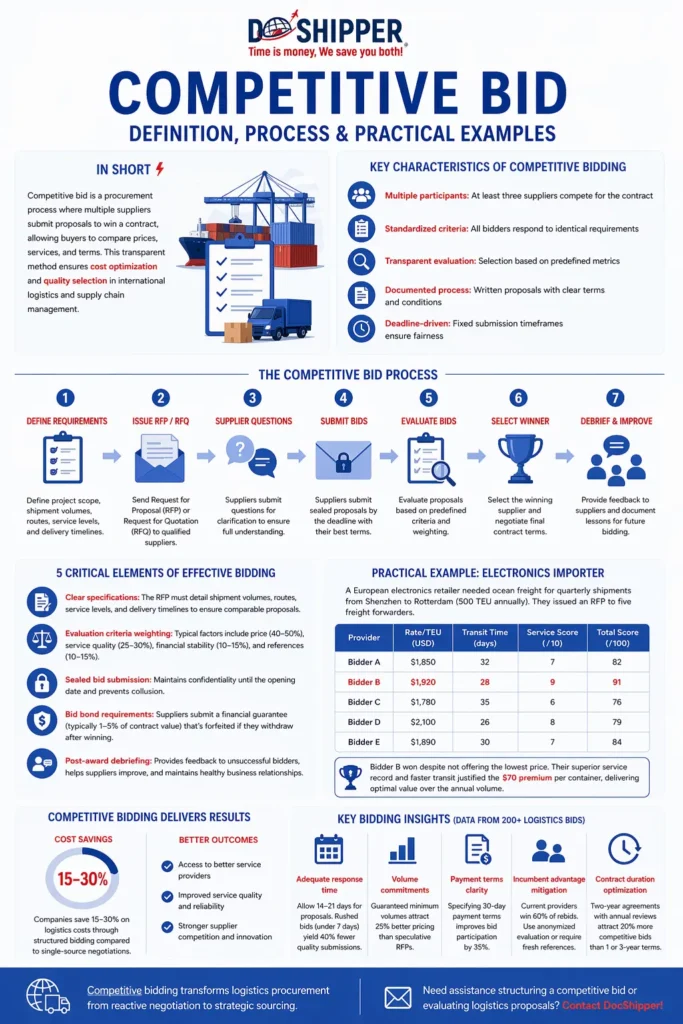
Competitive bid is a procurement process where multiple suppliers submit proposals to win a contract, allowing buyers to compare prices, services, and terms. This transparent method ensures cost optimization and quality selection in international logistics and supply chain management.
Introduction
Many importers and exporters struggle with selecting the right logistics partner while controlling costs. Choosing based on a single quote often leads to overpaying or compromising on service quality. The competitive bid solves this dilemma.
In international trade, where margins are tight and delays costly, competitive bidding has become essential. It creates transparency, drives efficiency, and protects businesses from supplier monopolies.
Key characteristics of competitive bidding include:
- Multiple participants: At least three suppliers compete for the contract
- Standardized criteria: All bidders respond to identical requirements
- Transparent evaluation: Selection based on predefined metrics
- Documented process: Written proposals with clear terms and conditions
- Deadline-driven: Fixed submission timeframes ensure fairness
Understanding Competitive Bidding in Logistics
The competitive bid process follows a structured methodology that protects both buyers and suppliers. It begins with a Request for Proposal (RFP) or Request for Quotation (RFQ), documents that outline project scope, requirements, and evaluation criteria.
Legal frameworks govern competitive bidding, especially in public procurement. The European Union Public Procurement Directives establish thresholds and procedures for transparent tendering. Private companies adopt similar principles to ensure compliance and fairness.
Five critical elements define effective competitive bidding:
Clear specifications eliminate ambiguity. The RFP must detail shipment volumes, routes, service levels, and delivery timelines. Vague requirements lead to incomparable proposals.
Evaluation criteria weighting guides decision-making. Typical factors include price (40-50%), service quality (25-30%), financial stability (10-15%), and references (10-15%). This transparency prevents subjective selections.
Sealed bid submission maintains confidentiality until the opening date. This prevents collusion and ensures each supplier proposes their best terms independently.
Bid bond requirements demonstrate serious intent. Suppliers submit a financial guarantee (typically 1-5% of contract value) that’s forfeited if they withdraw after winning.
Post-award debriefing provides feedback to unsuccessful bidders. This professional courtesy helps suppliers improve future proposals and maintains healthy business relationships.
At DocShipper, we participate in competitive bids regularly and help clients structure their own RFPs to attract quality logistics providers while maintaining cost control.
Practical Examples & Data
Real-world competitive bidding demonstrates measurable value. Industry data shows companies save 15-30% on logistics costs through structured bidding compared to single-source negotiations.
Case Study: Electronics Importer
A European electronics retailer needed ocean freight for quarterly shipments from Shenzhen to Rotterdam (500 TEU annually). They issued an RFP to five freight forwarders.
| Provider | Rate/TEU | Transit Time | Service Score | Total Score |
|---|---|---|---|---|
| Bidder A | $1,850 | 32 days | 7/10 | 82/100 |
| Bidder B | $1,920 | 28 days | 9/10 | 91/100 |
| Bidder C | $1,780 | 35 days | 6/10 | 76/100 |
| Bidder D | $2,100 | 26 days | 8/10 | 79/100 |
| Bidder E | $1,890 | 30 days | 7/10 | 84/100 |
Bidder B won despite not offering the lowest price. Their superior service record and faster transit justified the $70 premium per container. Over the annual volume, this represented optimal value.
Key Bidding Insights
Analysis of 200+ logistics competitive bids reveals five critical success factors:
Adequate response time: Allow 14-21 days for complex international logistics proposals. Rushed bids (under 7 days) yield 40% fewer quality submissions.
Volume commitments: Guaranteed minimum volumes attract 25% better pricing than speculative RFPs. Suppliers price risk into uncertain contracts.
Payment terms clarity: Specifying 30-day payment terms versus ambiguous “standard terms” improves bid participation by 35%.
Incumbent advantage mitigation: Current providers win 60% of rebids. Counter this by anonymizing supplier identities during evaluation or requiring fresh references.
Contract duration optimization: Two-year agreements with annual rate reviews balance commitment and flexibility, attracting 20% more competitive bids than one-year or three-year terms.
Conclusion
Competitive bidding transforms logistics procurement from reactive negotiation to strategic sourcing. It delivers measurable savings while improving service quality through transparent comparison.
Need assistance structuring a competitive bid or evaluating logistics proposals? Contact DocShipper for expert guidance on optimizing your procurement process.
📚 Quiz
Test Your Knowledge: Competitive Bid
Q1 — What best defines a competitive bid in logistics procurement?
Q2 — A common misconception about competitive bidding is that the lowest price should always win. According to best practices, what is the correct approach?
Q3 — A European retailer issues an RFP for ocean freight from Shenzhen to Rotterdam. Bidder B offers $1,920/TEU with a 28-day transit and a 9/10 service score, while Bidder C offers $1,780/TEU with a 35-day transit and a 6/10 service score. Which supplier should be selected based on competitive bid best practices?
🎯 Your Result
📞 Free Quote in 24hFAQ | Competitive Bid: Definition, Process & Practical Examples
An RFQ (Request for Quotation) is the document used to solicit competitive bids. The competitive bid is the broader process including RFQ issuance, proposal evaluation, and supplier selection.
Minimum three suppliers ensure genuine competition. Five to seven is optimal for complex logistics services, balancing evaluation workload against meaningful choice.
Yes, but only with top-ranked bidders (typically top 2-3). Post-bid negotiations should focus on clarifying terms rather than requesting entirely new pricing, which undermines the competitive process.
Essential details include shipment origins/destinations, volumes (annual/monthly), cargo types, required services (customs, warehousing), insurance requirements, and timeline expectations. More detail yields more accurate bids.
Standard timeline: 2-3 weeks for RFP preparation, 14-21 days for supplier responses, 1-2 weeks for evaluation, and 1 week for negotiations. Total: 6-8 weeks for complex international logistics contracts.
No. While price matters (typically 40-50% weighting), service quality, financial stability, and track record prevent costly mistakes. The lowest bid often correlates with service failures or hidden fees.
Frequent errors include vague specifications, unrealistic timelines, ignoring incumbent advantages, evaluating price alone, and failing to verify supplier capabilities through reference checks.
Use sealed submission methods (secure online portals or physical sealed envelopes), restrict access to evaluation committees, sign non-disclosure agreements, and open all bids simultaneously at a predetermined time.
Yes. Many competitive bids include set-asides or preferences for small/medium enterprises. Focus on niche specialization, superior service, and flexibility rather than competing solely on price.
Options include: revising scope to reduce costs, extending contract duration for better rates, negotiating with top bidders, or canceling and reissuing with adjusted expectations. Never award contracts you cannot afford.
Every 2-3 years for established routes maintains competitive pressure without excessive disruption. Annual rebidding suits volatile markets, while stable partnerships may extend 3-5 years with periodic benchmarking.
Yes for contracts exceeding $100,000 or involving complex international terms. Legal review ensures compliance with procurement regulations, protects intellectual property, and clarifies liability terms.
Need Help with
Logistics or Sourcing ?
First, we secure the right products from the right suppliers at the right price by managing the sourcing process from start to finish. Then, we simplify your shipping experience - from pickup to final delivery - ensuring any product, anywhere, is delivered at highly competitive prices.


Fill the Form
Prefer email? Send us your inquiry, and we’ll get back to you as soon as possible.
Contact us




