


In short ⚡
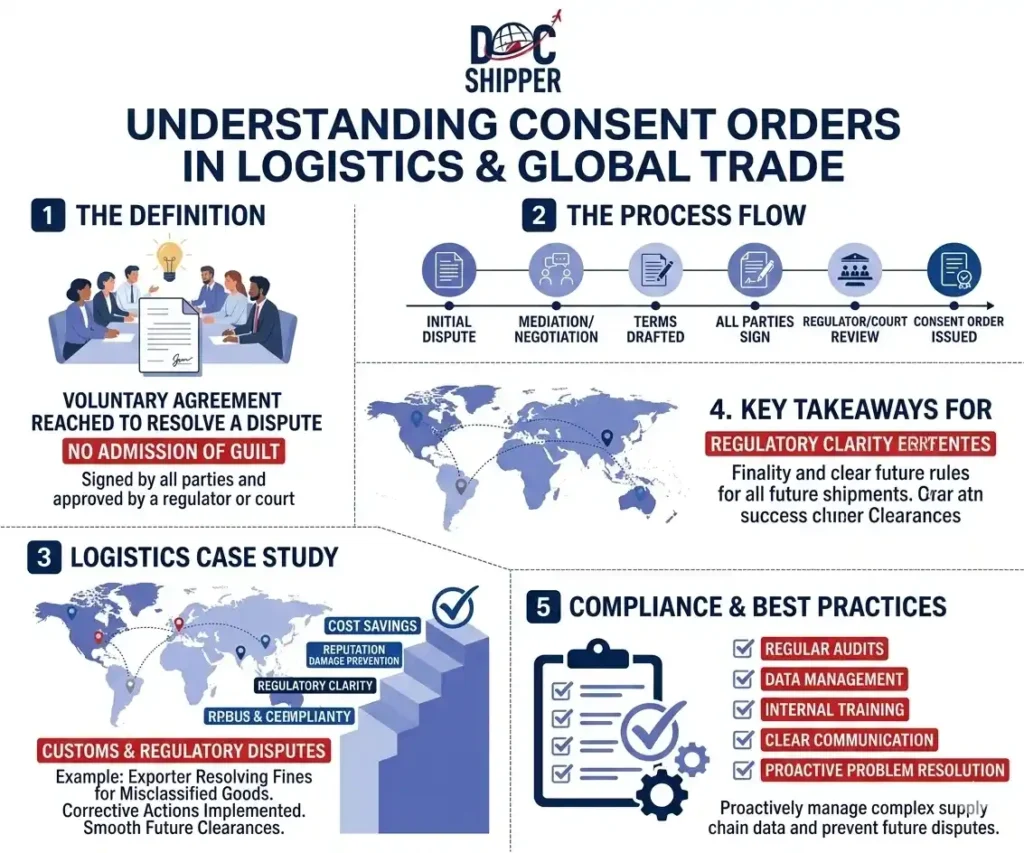
A Consent Order is a legally binding agreement between parties involved in a dispute, approved and enforced by a court or regulatory authority. In international trade and logistics, consent orders typically arise from customs violations, trade compliance issues, or regulatory breaches, allowing parties to resolve matters without prolonged litigation while maintaining legal enforceability.
Introduction
Many importers and exporters face a critical dilemma: how to resolve customs violations or regulatory disputes without incurring the time and expense of full litigation. This question becomes particularly pressing when shipments are detained, penalties are assessed, or compliance issues threaten business continuity.
The consent order mechanism provides a practical solution. It allows parties to negotiate settlement terms while preserving the legal weight of a court decision. This approach has become increasingly common in customs enforcement, trade remedy cases, and regulatory compliance matters.
Key characteristics of consent orders in logistics include:
- Voluntary agreement: Both parties negotiate and accept terms before court approval
- Court enforcement: The order carries the same legal weight as a contested judgment
- Customized remedies: Terms can include payment plans, corrective actions, or compliance programs
- Finality: Once approved, the order typically resolves the dispute conclusively
- Public record: Most consent orders become part of the public judicial record
Legal Framework & Regulatory Context
Consent orders in international trade operate within specific regulatory frameworks. Understanding these mechanisms helps businesses navigate compliance challenges effectively.
Customs enforcement context: When customs authorities detect violations—misclassification, undervaluation, or prohibited goods—they may propose a consent order rather than pursue criminal prosecution. This administrative resolution allows importers to pay penalties, implement corrective measures, and maintain their import privileges.
Antidumping and countervailing duty cases: The U.S. International Trade Commission and Department of Commerce frequently use consent orders to resolve trade remedy investigations. These orders may include price undertakings, volume limitations, or monitoring requirements. According to the U.S. International Trade Commission, consent orders provide flexibility while ensuring trade law compliance.
Regulatory compliance programs: Many consent orders require companies to establish internal compliance systems. At DocShipper, we assist clients in implementing these programs, ensuring they meet the specific requirements outlined in their consent orders while building long-term compliance capacity.
Jurisdictional variations: Different countries apply consent orders differently. In the EU, settlement agreements with customs authorities may not require formal court approval. In the U.S., federal courts must review and approve consent decrees. Understanding these jurisdictional nuances is critical for multinational operations.
Enforcement mechanisms: Violation of a consent order typically results in contempt proceedings, which can lead to enhanced penalties, criminal charges, or import bans. The binding nature of these orders means compliance is not optional—it’s legally mandated.
Practical Applications & Case Studies
Real-world examples demonstrate how consent orders function in international logistics and trade compliance scenarios.
Comparative Analysis: Litigation vs. Consent Order
| Factor | Full Litigation | Consent Order |
|---|---|---|
| Timeline | 18-36 months average | 3-6 months typical |
| Legal costs | $150,000-$500,000+ | $25,000-$75,000 |
| Outcome predictability | Uncertain (judge/jury decision) | Negotiated and agreed |
| Business disruption | Significant (depositions, trials) | Minimal (settlement negotiations) |
| Public exposure | Extensive trial record | Limited to order terms |
Case Study: Customs Misclassification Resolution
Scenario: A European electronics importer incorrectly classified semiconductor components, resulting in $280,000 in unpaid duties over three years.
Consent order terms:
- Payment of $280,000 in back duties plus $85,000 penalty (reduced from potential $420,000)
- Implementation of a customs compliance program within 90 days
- Quarterly compliance audits for two years
- No admission of intentional wrongdoing
- No criminal prosecution
Outcome: The company avoided criminal charges, maintained import privileges, and resolved the matter in four months versus an estimated 24-month litigation process. DocShipper subsequently helped implement the required compliance program, ensuring adherence to the consent order terms.
Key Data Points on Consent Orders
- Resolution rate: Approximately 65-70% of customs enforcement actions result in consent orders rather than litigation
- Average penalty reduction: Negotiated settlements typically reduce penalties by 30-50% compared to maximum statutory amounts
- Compliance cost: Implementing required compliance programs averages $15,000-$50,000 depending on company size
- Violation rate: Only 8-12% of consent orders result in subsequent violations requiring additional enforcement
- Processing time: Court approval of consent orders typically takes 30-60 days after parties reach agreement
Conclusion
Consent orders represent a pragmatic approach to resolving trade compliance disputes, offering predictability and cost efficiency while maintaining legal enforceability. For businesses engaged in international logistics, understanding this mechanism is essential for effective risk management.
Need guidance on navigating customs disputes or implementing compliance programs? Contact DocShipper for expert assistance tailored to your specific situation.
📚 Quiz
Test Your Knowledge: Consent Order
Q1 — What best defines a Consent Order in international trade and logistics?
Q2 — A common misconception about Consent Orders is that companies must admit guilt to enter one. Is this correct?
Q3 — A European electronics importer is found to have misclassified goods, resulting in $280,000 in unpaid duties. Which outcome best illustrates the advantage of resolving this via a Consent Order rather than full litigation?
🎯 Your Result
📞 Free Quote in 24hFAQ | Consent Order: Definition, Application & Practical Examples
A consent order is court-approved and legally enforceable through contempt proceedings, while a settlement agreement is a private contract between parties. Consent orders carry greater enforcement power and become part of the public judicial record.
Yes, but only through formal court proceedings. Both parties must agree to modifications and submit them for judicial approval. Unilateral changes are not permitted and constitute violations of the order.
No. Most consent orders include "no admission" clauses, allowing parties to resolve disputes without acknowledging wrongdoing. This protects companies from collateral civil litigation based on admissions.
Duration varies by case. Customs compliance consent orders typically last 2-5 years, while antidumping consent orders may extend indefinitely until market conditions change or parties petition for termination.
Violations trigger contempt proceedings, potentially resulting in enhanced penalties, criminal charges, suspension of import privileges, or imprisonment for responsible individuals. Courts take consent order violations seriously.
Generally yes. Court-approved consent orders become part of the public record, though some sensitive commercial information may be redacted. Private settlement agreements remain confidential unless disclosed by parties.
Absolutely. Consent orders are available to businesses of all sizes. Smaller importers often benefit more significantly due to proportionally lower legal costs and faster resolution compared to litigation.
Yes. Companies with consent orders typically face increased scrutiny during subsequent audits. However, demonstrating compliance with order terms can actually improve relationships with customs authorities over time.
Customs attorneys or trade lawyers negotiate terms, ensure legal compliance, draft order language, and represent clients during court approval proceedings. Their expertise is critical for favorable outcomes.
Yes. Many consent orders include structured payment schedules, allowing companies to pay penalties over time rather than in lump sums. This flexibility helps maintain business cash flow during resolution.
Procedures vary significantly. U.S. consent decrees require federal court approval, EU member states use administrative settlement procedures, and Asian jurisdictions often employ hybrid approaches. Understanding local requirements is essential.
They are negotiable. While regulatory authorities propose initial terms, experienced counsel can negotiate modifications regarding penalty amounts, compliance timelines, and specific remedial actions required.
Need Help with
Logistics or Sourcing ?
First, we secure the right products from the right suppliers at the right price by managing the sourcing process from start to finish. Then, we simplify your shipping experience - from pickup to final delivery - ensuring any product, anywhere, is delivered at highly competitive prices.


Fill the Form
Prefer email? Send us your inquiry, and we’ll get back to you as soon as possible.
Contact us




