


In short ⚡
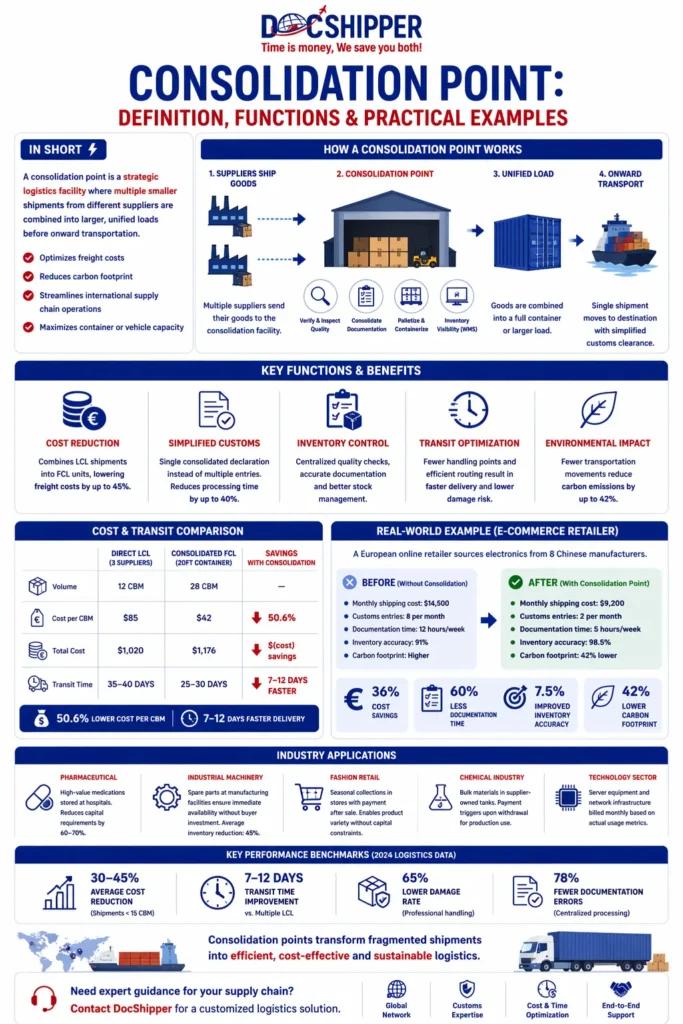
Consolidation is a logistics process that combines multiple smaller shipments from different shippers into a single container or vehicle to optimize costs and reduce environmental impact. This groupage method enables businesses to access international shipping services without filling an entire container, making global trade more accessible and economical.
Introduction
Many small and medium-sized businesses face a common dilemma: their shipment volumes don’t justify booking a full container, yet they need reliable international transportation. Paying for unused space drives costs up dramatically and creates inefficiencies.
Consolidation solves this challenge by pooling cargo from multiple shippers. This approach has become essential in modern supply chains, particularly for e-commerce businesses, startups, and companies with fluctuating inventory needs.
Key characteristics of consolidation include:
- Cost efficiency: Shippers pay only for the space their goods occupy
- Flexibility: No minimum volume requirements for international shipping
- Frequency: Regular departures as consolidators fill containers quickly
- Sustainability: Reduced carbon footprint through optimized container utilization
- Accessibility: Opens international markets to smaller businesses
Consolidation Process & Expertise
The consolidation process involves sophisticated coordination between multiple parties. A consolidation warehouse serves as the central hub where shipments are received, sorted, and combined according to destination.
There are two primary consolidation models. LCL (Less than Container Load) consolidation groups ocean freight shipments into 20-foot or 40-foot containers. Air freight consolidation combines smaller parcels onto pallets or ULDs (Unit Load Devices) for aircraft cargo holds.
The deconsolidation process occurs at the destination port or airport. Here, the consolidated shipment is broken down and individual consignments are separated for final delivery. This requires precise documentation to ensure each shipper receives exactly their goods.
Customs clearance presents unique challenges in consolidation. Each shipment within the consolidated container may have different HS codes, duties, and regulatory requirements. According to World Customs Organization guidelines, consolidated shipments require detailed manifests listing each consignee and their specific goods.
Master Bill of Lading (MBL) and House Bill of Lading (HBL) documentation is critical. The consolidator receives the MBL covering the entire container, while each individual shipper receives an HBL for their portion. At DocShipper, we manage both documentation levels to ensure seamless customs processing and prevent clearance delays.
Practical Examples & Data
Understanding consolidation economics reveals its significant value proposition. Consider these comparative scenarios:
| Shipping Method | Volume | Cost (Shanghai-Rotterdam) | Transit Time |
|---|---|---|---|
| Full Container (FCL) | 5 CBM used / 33 CBM total | $2,800 | 28-32 days |
| LCL Consolidation | 5 CBM | $850 | 32-38 days |
| Air Freight (Standard) | 5 CBM (850 kg) | $4,250 | 5-7 days |
| Air Consolidation | 5 CBM (850 kg) | $3,400 | 7-10 days |
Case Study: A French electronics retailer imports smartphone accessories from Shenzhen. Their monthly volume averages 8 cubic meters—too small for FCL, too large for express courier.
By using weekly LCL consolidation services, they achieve:
- Cost savings: 65% reduction compared to booking partial FCL containers
- Inventory optimization: Weekly shipments instead of waiting to fill containers
- Cash flow improvement: Smaller, frequent orders reduce capital tied up in inventory
- Market responsiveness: Ability to adjust product mix based on sales trends
- Risk mitigation: Distributed shipments reduce impact of single shipment delays
Industry data shows that consolidation utilization rates average 85-92% for established freight forwarders. This efficiency translates directly into competitive pricing for shippers. At DocShipper, we maintain partnerships with major consolidators in Asia, Europe, and North America, ensuring consistent weekly departures and optimal rates for our clients.
Conclusion
Consolidation democratizes international shipping by making it economically viable for businesses of all sizes. This logistics strategy balances cost efficiency with service reliability, creating opportunities for global commerce that were previously accessible only to large-volume shippers.
Need guidance on consolidation strategies for your supply chain? Contact DocShipper for customized logistics solutions tailored to your shipping volumes and timelines.
📚 Quiz
Test Your Knowledge: Consolidation
Q1 — What best defines consolidation in international logistics?
Q2 — In a consolidated LCL shipment, which document does each individual shipper receive to cover their portion of the cargo?
Q3 — A French retailer ships 8 CBM of smartphone accessories monthly from Shenzhen. Which shipping strategy best suits their needs?
🎯 Your Result
📞 Free Quote in 24hFAQ | Consolidation: Definition, Process & Practical Examples
There is no strict minimum volume for LCL consolidation. Most freight forwarders accept shipments starting from 0.5 cubic meters, though pricing becomes more competitive above 2 CBM due to handling fee structures.
Consolidated shipments may experience slightly longer clearance times because customs authorities must process multiple consignees from one container. Proper documentation and pre-clearance preparation minimize delays to typically 1-2 additional days.
Yes, but with strict limitations. Dangerous goods must be properly classified, packaged, and documented according to IMDG or IATA regulations. They're often consolidated separately from general cargo and incur additional handling fees.
These terms are essentially synonymous in logistics. "Groupage" is more commonly used in European markets, while "consolidation" is the preferred term in North American and Asian contexts. Both describe combining multiple shipments.
Charges are based on either volumetric weight (CBM) or actual weight, whichever is greater. The rate per CBM decreases as shipment size increases. Additional fees may include handling charges, documentation fees, and destination deconsolidation charges.
Liability is determined by the House Bill of Lading terms. Cargo insurance is strongly recommended for consolidated shipments. The consolidator's liability is typically limited unless gross negligence is proven.
Yes, modern consolidators provide tracking through the House Bill of Lading number. Visibility includes container departure, arrival, and deconsolidation status, though it may be less granular than FCL tracking.
Consolidation significantly reduces per-unit carbon emissions by maximizing container utilization. Studies show properly consolidated shipments reduce CO2 emissions by 40-60% compared to partially filled dedicated containers.
Essential documents include commercial invoice, packing list, House Bill of Lading, and any required certificates (origin, phytosanitary, etc.). The consolidator handles the Master Bill of Lading and container manifest.
Yes, incompatible goods cannot share containers. Food products cannot be consolidated with chemicals, strong-smelling items are separated, and temperature-sensitive cargo requires dedicated reefer consolidation with compatible products only.
For ocean freight, booking 7-10 days before desired departure is typical. Air consolidation can often accommodate 3-5 day lead times. Peak seasons (Q4, Chinese New Year) require earlier booking to secure space.
Most consolidators accept individual pieces up to 1,000-1,500 kg for LCL ocean freight. Heavier items may require special handling or flat-rack containers. Air consolidation typically limits individual pieces to 150-300 kg depending on aircraft type.
Need Help with
Logistics or Sourcing ?
First, we secure the right products from the right suppliers at the right price by managing the sourcing process from start to finish. Then, we simplify your shipping experience - from pickup to final delivery - ensuring any product, anywhere, is delivered at highly competitive prices.


Fill the Form
Prefer email? Send us your inquiry, and we’ll get back to you as soon as possible.
Contact us




