


In short ⚡
A Distribution Supply Unit (DSU) is a logistics facility or warehouse that serves as an intermediate storage and distribution point between production sites and final consumption markets. It optimizes inventory management by positioning stock closer to customers, reducing delivery times while maintaining centralized control over supply chain operations.
Introduction
Many international businesses struggle with balancing inventory costs against delivery speed. Holding stock too centrally creates long lead times. Distributing too widely inflates warehousing expenses.
The Distribution Supply Unit addresses this challenge by creating strategic intermediate nodes in the supply chain. It bridges manufacturers and end-markets, enabling regional responsiveness without fragmenting inventory control.
Key characteristics of DSUs include:
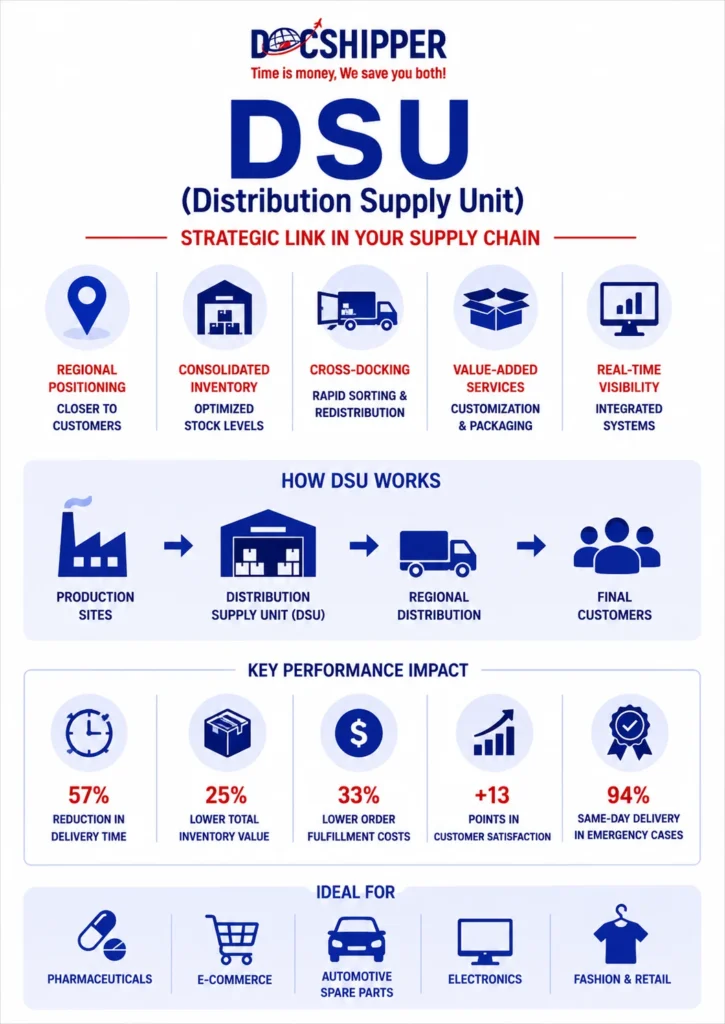
- Regional positioning – Located near demand clusters to minimize last-mile delivery times
- Consolidated inventory – Pools stock from multiple production sources for distribution efficiency
- Cross-docking capabilities – Facilitates rapid sorting and redistribution of incoming shipments
- Value-added services – Often performs light assembly, labeling, or customization before final dispatch
- Real-time inventory visibility – Integrates with central ERP systems for synchronized supply chain management
DSU Strategic Role & Operational Framework
The operational logic of a Distribution Supply Unit rests on inventory stratification. Rather than storing full product ranges at every location, DSUs maintain optimized stock levels based on regional demand patterns. Fast-moving items stay locally available, while slower SKUs ship on-demand from central facilities.
From a regulatory perspective, DSUs often function as bonded warehouses in international trade scenarios. This allows imported goods to remain duty-suspended until released for domestic consumption. The European Union’s customs warehousing procedures provide clear frameworks for DSU operations within member states.
Operationally, DSUs implement zone-based fulfillment strategies. Products arrive in bulk from manufacturing centers, then undergo sortation according to destination postal codes or delivery zones. This consolidation-deconsolidation model reduces transportation costs compared to direct plant-to-customer shipping.
The financial advantage centers on safety stock optimization. Statistical models calculate that holding centralized safety stock requires square-root-of-N less inventory than maintaining equivalent service levels at N dispersed locations. A DSU captures this mathematical efficiency while keeping products regionally accessible.
Technology integration proves critical. Modern DSUs deploy warehouse management systems (WMS) that synchronize with transportation management platforms. This enables dynamic routing decisions based on real-time inventory positions and carrier availability. At DocShipper, we systematically integrate DSU operations with clients’ existing ERP systems to maintain end-to-end supply chain visibility across international movements.
Concrete Applications & Performance Metrics
Consider a practical scenario: A European electronics manufacturer serves markets across Germany, France, and the UK. Previously, they shipped all orders from their Polish production facility, averaging 4-day delivery times. By establishing a DSU in Frankfurt, they reduced delivery windows to 24-48 hours for 73% of their customer base.
The operational impact breaks down as follows:
| Metric | Before DSU | After DSU | Improvement |
|---|---|---|---|
| Average delivery time | 4.2 days | 1.8 days | 57% reduction |
| Total inventory value | €2.8M | €2.1M | 25% decrease |
| Order fulfillment costs | €18.50/order | €12.30/order | 33% savings |
| Customer satisfaction rate | 78% | 91% | +13 points |
In pharmaceutical distribution, DSUs serve a specialized function. Temperature-controlled DSU facilities maintain GDP (Good Distribution Practice) compliance while positioning medications closer to hospital networks. A North American pharmaceutical distributor operates 12 DSUs strategically located within 200 miles of major metropolitan areas, achieving same-day delivery for emergency medication orders in 94% of cases.
E-commerce applications demonstrate another dimension. A fashion retailer implemented a three-tier DSU network across Asia-Pacific: Singapore serves as the primary hub, with secondary DSUs in Bangkok and Manila. This structure enables 2-day delivery across ASEAN markets while maintaining only 18 days of regional inventory compared to the previous 45-day requirement under direct-from-China fulfillment.
Automotive spare parts distribution relies heavily on DSUs due to unpredictable demand patterns. A major manufacturer maintains DSUs co-located with dealer clusters, stocking high-velocity parts locally while accessing central warehouses for rare components. This hybrid model achieves 96% first-time fix rates for service appointments without the capital burden of full-range local inventory.
Peak season scalability represents another critical advantage. During Q4 retail surges, temporary DSU capacity can absorb volume spikes without permanent facility expansion. Third-party logistics providers often offer seasonal DSU space that scales with demand fluctuations, converting fixed costs to variable expenses.
Conclusion
Distribution Supply Units represent the operational bridge between centralized inventory control and localized customer responsiveness. Their strategic positioning optimizes both cost structures and service levels across complex supply chains.
Whether managing international trade flows or domestic distribution networks, DSU implementation requires careful analysis of demand patterns, transportation costs, and inventory carrying expenses. Need expert guidance on optimizing your distribution network? Contact DocShipper for tailored supply chain solutions.
📚 Quiz
Test Your Knowledge: Distribution Supply Unit (DSU)
What is the primary function of a Distribution Supply Unit (DSU)?
What is a common misconception about DSU inventory management?
In which scenario would a DSU provide the greatest operational benefit?
🎯 Your Result
📞 Free Personalized QuoteFAQ | DSU (Distribution Supply Unit): Definition, Role & Practical Examples
A DSU specifically functions as an intermediate node between production and final markets, emphasizing regional positioning and rapid turnover. Traditional distribution centers often serve as endpoint facilities with broader inventory ranges and longer storage durations. DSUs prioritize flow-through efficiency over long-term warehousing.
DSUs reduce last-mile delivery expenses by positioning inventory regionally, which typically represents 25-40% of total logistics costs. However, they add intermediate handling and storage fees. The net impact depends on shipment frequency, order sizes, and distance from central warehouses. Most businesses see 15-30% total cost reduction when DSUs serve high-density demand areas.
Yes, many DSUs function as customs-bonded facilities where imported goods remain duty-suspended until released for domestic consumption. This defers tax obligations and enables value-added processing before customs clearance. Bonded DSU status requires specific licensing and compliance with local customs regulations, but provides significant cash flow advantages for importers.
Successful DSU inventory strategies employ ABC analysis to classify products by velocity. Fast-movers (A-items) stock continuously at the DSU with automatic replenishment triggers. Medium-velocity B-items maintain buffer stock with periodic review cycles. Slow-moving C-items ship on-demand from central facilities. This stratification minimizes working capital while maintaining service levels.
Location analysis balances customer proximity, transportation infrastructure, labor availability, and real estate costs. Network optimization software models demand density, shipping patterns, and service requirements to identify ideal placement. Most analyses reveal that DSUs deliver maximum value when positioned within 200-300 miles of major customer concentrations, balancing delivery speed against facility proliferation costs.
Modern DSUs require warehouse management systems (WMS) for inventory tracking, transportation management systems (TMS) for carrier coordination, and enterprise resource planning (ERP) integration for demand visibility. Real-time data exchange enables dynamic stock allocation and order routing. Advanced implementations incorporate IoT sensors for condition monitoring and predictive analytics for demand forecasting.
SMBs typically leverage third-party logistics (3PL) providers offering shared DSU facilities rather than building dedicated infrastructure. Shared-space DSU models provide regional positioning benefits without capital investment. Break-even analysis generally favors DSU utilization when businesses ship 500+ orders monthly to concentrated geographic regions with 2-day delivery expectations.
Cross-docking at DSUs involves receiving inbound shipments and immediately sorting them for outbound delivery without intermediate storage. Products flow through the facility in hours rather than days. This approach works best for high-velocity items with predictable demand, reducing handling costs and inventory exposure. Effective cross-docking requires precise coordination between inbound and outbound transportation schedules.
Key DSU metrics include inventory turnover ratio (ideally 12-20 turns annually), order fulfillment cycle time, perfect order rate (accuracy and completeness), cost per unit shipped, and space utilization percentage. Leading organizations also monitor forecast accuracy, inbound-to-outbound dwell time, and customer delivery compliance rates. These metrics collectively reveal whether the DSU optimizes the cost-service tradeoff.
Specialized DSUs maintain temperature-controlled environments for pharmaceuticals, fresh food, and other perishable goods. These facilities require GDP or HACCP certification depending on product categories. Cold chain DSUs employ continuous temperature monitoring, backup power systems, and validated qualification protocols. They command premium rates but enable regional distribution of time-sensitive products that couldn't otherwise reach distant markets economically.
DSUs enable retailers to fulfill both e-commerce and store replenishment orders from unified inventory pools. This prevents stock fragmentation across channels while positioning products for rapid deployment. Advanced DSU configurations support ship-from-store capabilities, buy-online-pickup-in-store (BOPIS) fulfillment, and same-day delivery services. The consolidated inventory visibility across channels typically improves overall stock availability by 15-25% compared to siloed channel inventories.
Main risks include demand forecasting errors leading to regional stockouts or excess inventory, facility disruption impacting broader networks, and technology integration failures causing visibility gaps. Natural disasters or geopolitical events can isolate DSU facilities from supply sources. Mitigation strategies involve network redundancy planning, safety stock buffers, diversified supplier bases, and robust business continuity protocols that define alternative fulfillment pathways when primary DSUs become unavailable.
Need Help with
Logistics or Sourcing ?
First, we secure the right products from the right suppliers at the right price by managing the sourcing process from start to finish. Then, we simplify your shipping experience - from pickup to final delivery - ensuring any product, anywhere, is delivered at highly competitive prices.


Fill the Form
Prefer email? Send us your inquiry, and we’ll get back to you as soon as possible.
Contact us




