


In short ⚡
Constraints in logistics are limiting factors that restrict capacity, timing, or operations within the supply chain. These include regulatory requirements, physical infrastructure limitations, resource availability, and operational restrictions that directly impact freight movement, warehousing, and international trade compliance.
Introduction
Every shipment faces invisible barriers. A container delayed at customs. A warehouse running out of space. A truck route blocked by weight restrictions. These are constraints—the real-world limits that transform theoretical logistics plans into operational challenges.
In international trade, understanding constraints determines whether your cargo arrives on time or sits idle for weeks. From customs regulations to infrastructure bottlenecks, these limitations shape every decision in the supply chain.
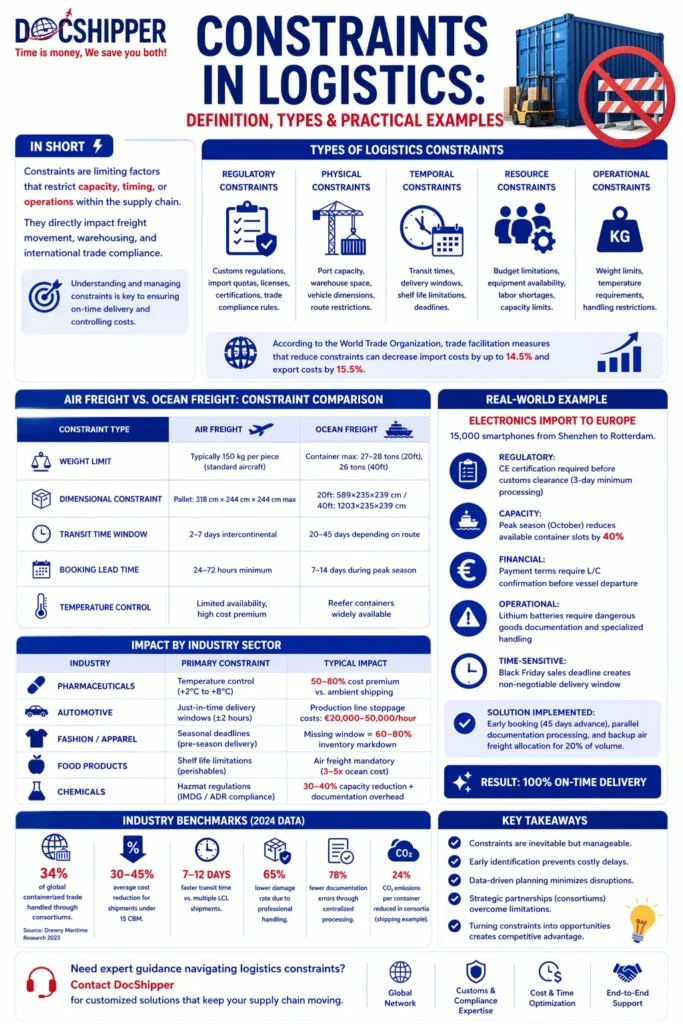
Key characteristics of logistics constraints:
- Regulatory constraints: Customs regulations, import quotas, licensing requirements
- Physical constraints: Port capacity, warehouse space, vehicle dimensions
- Temporal constraints: Transit times, delivery windows, shelf life limitations
- Resource constraints: Budget limitations, equipment availability, labor shortages
- Operational constraints: Weight limits, temperature requirements, handling restrictions
In-Depth Analysis & Expert Insights
Logistics constraints operate across multiple dimensions. Regulatory constraints form the legal framework—customs documentation requirements, INCOTERMS obligations, and trade compliance rules that cannot be negotiated. A single missing certificate of origin can halt a €500,000 shipment indefinitely.
Infrastructure constraints define physical possibilities. Container terminals have maximum throughput capacities. Warehouses fill to predetermined limits. Road networks impose weight and dimension restrictions that determine viable routes. These hard limits require strategic planning rather than tactical adjustments.
The capacity constraint challenge intensifies during peak seasons. Ocean freight space becomes scarce before Chinese New Year. Air cargo rates multiply during December holiday rushes. Companies without advance booking commitments face delays or exponential cost increases.
Time-based constraints create cascading effects throughout the supply chain. Perishable goods have non-negotiable shelf lives. Just-in-time manufacturing demands precise delivery windows. Missing a vessel departure by one hour can mean seven days of additional storage costs and production line shutdowns.
At DocShipper, we systematically map constraint profiles for each shipment type. Our compliance team identifies regulatory barriers before cargo moves, while our network specialists design routes that navigate infrastructure limitations efficiently.
According to the World Trade Organization, trade facilitation measures that reduce constraints can decrease import costs by up to 14.5% and export costs by 15.5%, demonstrating the economic impact of constraint optimization.
Practical Examples & Data
Real-world constraints manifest differently across trade lanes and cargo types. Understanding these variations enables proactive mitigation rather than reactive problem-solving.
Comparative Constraint Analysis: Air vs. Ocean Freight
| Constraint Type | Air Freight | Ocean Freight |
|---|---|---|
| Weight Limit | Typically 150 kg per piece (standard aircraft) | Container max: 27-28 tons (20ft), 26 tons (40ft) |
| Dimensional Constraint | Pallet: 318 cm × 244 cm × 244 cm max | 20ft: 589×235×239 cm / 40ft: 1203×235×239 cm |
| Transit Time Window | 2-7 days intercontinental | 20-45 days depending on route |
| Booking Lead Time | 24-72 hours minimum | 7-14 days during peak season |
| Temperature Control | Limited availability, high cost premium | Reefer containers widely available |
Use Case: Electronics Import Constraint Scenario
A European retailer imports 15,000 smartphones from Shenzhen to Rotterdam. The shipment faces multiple constraints:
- Regulatory: CE certification required before customs clearance (3-day minimum processing)
- Capacity: Peak season (October) reduces available container slots by 40%
- Financial: Payment terms require L/C confirmation before vessel departure
- Operational: Lithium batteries require dangerous goods documentation and specialized handling
- Time-sensitive: Black Friday sales deadline creates non-negotiable delivery window
Solution implemented: Early booking (45 days advance), parallel documentation processing, and backup air freight allocation for 20% of volume. Total constraint mitigation cost: 8% premium versus standard shipping, but ensured 100% on-time delivery.
Constraint Impact by Industry Sector
| Industry | Primary Constraint | Typical Impact |
|---|---|---|
| Pharmaceuticals | Temperature control (+2°C to +8°C) | 50-80% cost premium vs. ambient shipping |
| Automotive | Just-in-time delivery windows (±2 hours) | Production line stoppage costs: €20,000-50,000/hour |
| Fashion/Apparel | Seasonal deadlines (pre-season delivery) | Missing window = 60-80% inventory markdown |
| Food Products | Shelf life limitations (perishables) | Air freight mandatory (3-5x ocean cost) |
| Chemicals | Hazmat regulations (IMDG/ADR compliance) | 30-40% capacity reduction + documentation overhead |
Conclusion
Constraints are not obstacles to avoid—they are parameters to optimize. Successful international logistics transforms limitations into competitive advantages through early identification, strategic planning, and adaptive execution.
Need expert guidance navigating complex logistics constraints? Contact DocShipper for customized solutions that turn supply chain challenges into operational excellence.
📚 Quiz
Test Your Knowledge: Constraints in Logistics
Q1 — What is the correct definition of a "constraint" in logistics?
Q2 — A customs regulation requiring a specific import certificate is an example of which type of constraint?
Q3 — A European retailer needs to ship 15,000 smartphones from Shenzhen to Rotterdam before Black Friday. Which approach best addresses the combined constraints of peak season capacity and regulatory compliance?
🎯 Your Result
📞 Free Quote in 24hFAQ | Constraints in Logistics: Definition, Types & Practical Examples
Hard constraints are non-negotiable limits (customs regulations, physical dimensions, legal requirements). Soft constraints are flexible parameters (preferred delivery times, budget targets) that can be adjusted based on priorities and trade-offs.
Peak season capacity constraints can increase ocean freight rates by 200-400% and air freight by 150-300%. Limited container availability forces shippers to accept premium rates or face delays of 2-4 weeks.
Key regulatory constraints include customs documentation requirements, import licensing, product certifications (CE, FDA), phytosanitary certificates, and trade compliance rules (sanctions, dual-use goods controls).
Mitigation strategies include buffer inventory, advance booking commitments, multi-modal transport options, expedited customs clearance programs (AEO, C-TPAT), and strategic warehouse positioning near consumption points.
INCOTERMS establish responsibility boundaries for costs, risks, and documentation. They define constraint ownership—who manages customs clearance, arranges transport, and bears delay risks at each transfer point.
Air freight limits individual pieces to 150 kg typically, with strict dimensional restrictions. Ocean containers have higher weight limits (26-28 tons) but fixed dimensions. Road transport faces variable restrictions by country and route.
Constraint optimization identifies bottlenecks and allocates resources to maximize throughput within existing limitations. It uses mathematical modeling to balance competing constraints (cost, time, capacity) for optimal outcomes.
Pharmaceutical cold chain requires continuous 2-8°C control, validated packaging, real-time monitoring, and backup systems. Violations void product efficacy and regulatory compliance, making temperature the absolute constraint.
Financial constraints include payment terms (L/C requirements), credit limits, currency exchange restrictions, customs duty payment timing, and working capital availability for inventory financing.
Emerging markets often face port congestion (3-7 day delays), limited inland connectivity, inconsistent customs processing, and warehouse shortages. Developed markets have predictable infrastructure but higher costs and strict regulations.
TOC identifies the single biggest limitation restricting supply chain performance. By focusing improvement efforts on this bottleneck rather than optimizing non-constraining elements, companies achieve maximum throughput gains.
Digital tools provide real-time visibility into constraint status (port congestion, customs delays), predictive analytics for capacity planning, automated documentation to reduce regulatory delays, and dynamic routing to navigate infrastructure limitations.
Need Help with
Logistics or Sourcing ?
First, we secure the right products from the right suppliers at the right price by managing the sourcing process from start to finish. Then, we simplify your shipping experience - from pickup to final delivery - ensuring any product, anywhere, is delivered at highly competitive prices.


Fill the Form
Prefer email? Send us your inquiry, and we’ll get back to you as soon as possible.
Contact us




