


In short ⚡
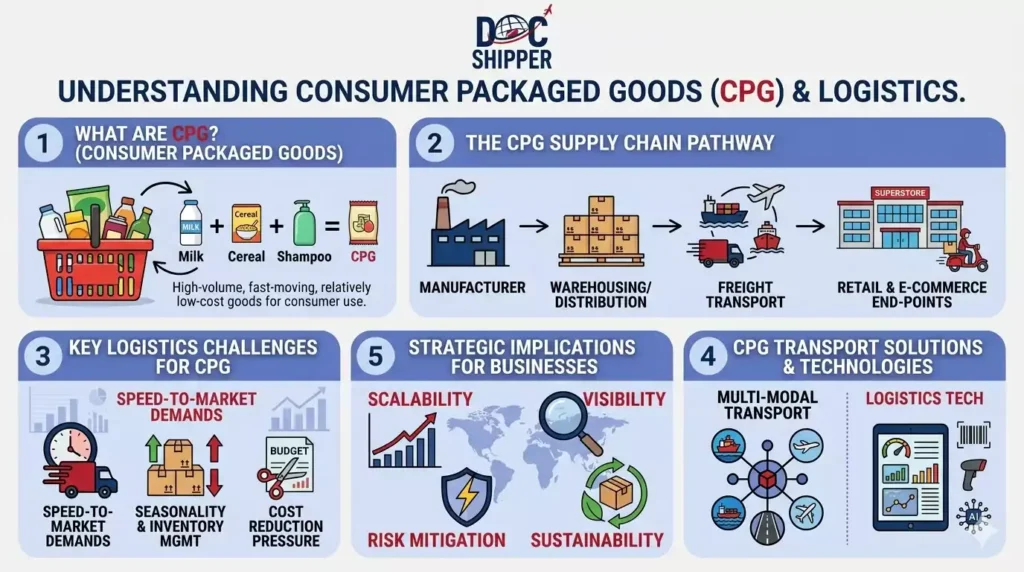
Consumer Packaged Goods (CPG) are fast-moving products sold in standardized packaging, consumed regularly and replaced frequently. These include food, beverages, cosmetics, cleaning supplies, and over-the-counter medications. CPG items represent the backbone of international retail trade, requiring specialized logistics due to shelf-life constraints, regulatory compliance, and high-volume distribution demands.Introduction
Many importers confuse Consumer Packaged Goods with durable goods, leading to critical errors in customs classification, warehousing strategies, and inventory management. Unlike electronics or furniture, CPG products demand rapid turnover, temperature-controlled storage, and strict expiration date tracking.
In global supply chains, CPG represents over 60% of retail imports by volume. Understanding this category is essential for anyone involved in international trade, as these products face unique challenges: perishability, regulatory scrutiny across borders, and intense competition requiring just-in-time delivery.
Key characteristics of CPG in international logistics:
- High consumption frequency requiring continuous replenishment cycles
- Standardized packaging enabling automated handling and distribution
- Regulatory compliance across food safety, labeling, and health standards
- Price sensitivity driving optimization of transportation and warehousing costs
- Short shelf-life for many categories necessitating expedited customs clearance
CPG Categories & Regulatory Framework
Consumer Packaged Goods divide into distinct categories, each with specific import requirements and logistical considerations. The primary classification separates food and beverage CPG from non-food CPG, though both share common distribution challenges.
Food and beverage CPG includes packaged foods, soft drinks, alcoholic beverages, dairy products, and frozen goods. These items require FDA approval in the United States, EFSA certification in the European Union, and equivalent regulatory clearances in other markets. Temperature-controlled shipping and warehousing become mandatory, increasing logistics costs by 15-30% compared to ambient products.
Health and beauty CPG encompasses cosmetics, personal care items, over-the-counter medications, and supplements. These products face stringent labeling requirements, ingredient disclosure mandates, and country-specific formulation restrictions. At DocShipper, we systematically verify compliance with EU Cosmetics Regulation 1223/2009 and FDA CFR Title 21 to prevent costly border rejections.
Household and cleaning CPG includes detergents, disinfectants, paper products, and cleaning supplies. Chemical composition regulations such as REACH in Europe and TSCA in the United States require detailed Safety Data Sheets (SDS) and hazardous materials documentation. Proper classification under the Harmonized System (HS) codes becomes critical for accurate duty calculation.
Pet care CPG represents a rapidly growing segment, subject to animal feed regulations and veterinary product standards. The European Pet Food Industry Federation (FEDIAF) and AAFCO standards in North America govern formulation and labeling requirements.
According to the World Trade Organization, CPG products account for approximately $3.2 trillion in annual global trade, with regulatory harmonization efforts ongoing through the Codex Alimentarius Commission for food products and the International Cooperation on Cosmetics Regulation (ICCR) for beauty items.
Global Trade Dynamics & Market Data
Understanding CPG trade flows requires analyzing specific corridors, tariff structures, and market penetration strategies. Real-world data reveals patterns essential for optimizing international supply chains.
| Trade Route | CPG Category | Average Duty Rate | Transit Time | Key Challenge |
|---|---|---|---|---|
| China → USA | Packaged Foods | 3-8% | 18-25 days (ocean) | FDA prior notice requirements |
| France → UK | Cosmetics | 0% (post-Brexit agreements) | 2-4 days (road) | UKCA marking compliance |
| Thailand → Germany | Beverages | 9.6-17.6% | 28-35 days (ocean) | Sugar content labeling regulations |
| Mexico → Canada | Household Cleaners | 0% (USMCA) | 3-5 days (truck) | Bilingual labeling (French/English) |
| Vietnam → Australia | Instant Noodles | 5% | 14-21 days (ocean) | Biosecurity inspection delays |
Case Study: European Beauty Brand Entering Asian Markets
A French cosmetics manufacturer sought to export premium skincare products to South Korea, Japan, and Singapore. The challenge involved navigating three distinct regulatory frameworks simultaneously while maintaining product integrity during tropical shipping conditions.
Solution implemented: The company utilized consolidated LCL shipments through Hamburg to Busan, with transshipment to Tokyo and Singapore. Refrigerated containers maintained 15-20°C throughout the 32-day ocean transit. Pre-shipment regulatory filings included Korean MFDS registration (4-month process), Japanese PMDA notification (6-week process), and Singapore HSA notification (3-week process).
Results: Total landed cost per unit decreased by 23% compared to air freight alternatives. Customs clearance averaged 2.1 days across all three destinations. Zero product rejections due to temperature excursions or documentation errors. Market entry timeline reduced from 18 months to 11 months through parallel regulatory submissions.
Market Insights:
- E-commerce CPG sales grew 47% globally in 2023, requiring direct-to-consumer fulfillment strategies
- Sustainable packaging mandates in the EU increase CPG import costs by 8-12% for non-compliant suppliers
- Cross-border CPG transactions face average duty rates of 5.3% (food) and 3.7% (non-food) worldwide
- Temperature-controlled logistics capacity shortages add 18-25 days to lead times in peak seasons
- Regulatory compliance documentation errors cause 34% of CPG shipment delays at major ports
Conclusion
Consumer Packaged Goods represent the most complex category in international trade, combining high-volume logistics with stringent regulatory oversight and tight margin pressures. Success requires deep understanding of product-specific requirements, proactive compliance management, and optimized supply chain design.
Whether you’re importing organic foods, launching a beauty brand internationally, or expanding household product distribution, expert guidance ensures smooth customs clearance and cost-effective logistics. Contact DocShipper for comprehensive CPG import solutions tailored to your market entry strategy.
📚 Quiz
Test Your Knowledge: Consumer Packaged Goods (CPG)
Q1 — Which of the following best defines Consumer Packaged Goods (CPG)?
Q2 — A common misconception about CPG logistics is that it follows the same rules as general cargo. What is the key characteristic that actually sets CPG apart?
Q3 — A French cosmetics brand wants to export skincare products to South Korea. Based on CPG trade principles, which approach best ensures a successful market entry?
🎯 Your Result
📞 Free Quote in 24hFAQ | Consumer Packaged Goods (CPG): Definition, Categories & Global Trade Examples
Need Help with
Logistics or Sourcing ?
First, we secure the right products from the right suppliers at the right price by managing the sourcing process from start to finish. Then, we simplify your shipping experience - from pickup to final delivery - ensuring any product, anywhere, is delivered at highly competitive prices.


Fill the Form
Prefer email? Send us your inquiry, and we’ll get back to you as soon as possible.
Contact us




:%20Definition,%20Categories%20&%20Global%20Trade%20Examples)