



In short ⚡
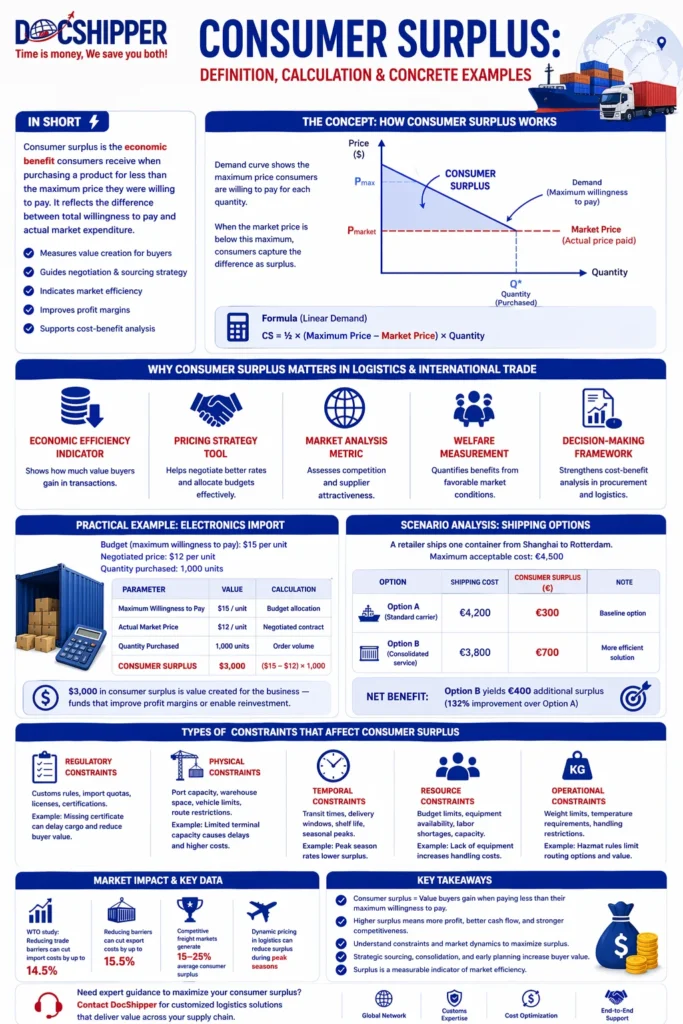
Consumer surplus is the economic benefit consumers receive when purchasing a product for less than the maximum price they were willing to pay. It represents the difference between total willingness to pay and actual market expenditure, serving as a key indicator of market efficiency and consumer welfare in international trade transactions.Introduction
Many importers struggle to quantify the actual value they extract from supplier negotiations. When you secure a shipment at a lower cost than budgeted, you’ve captured consumer surplus—a concept fundamental to strategic sourcing decisions.
In international logistics and procurement, consumer surplus directly impacts profitability margins. Understanding this principle helps businesses optimize purchasing strategies, evaluate supplier competitiveness, and measure transaction efficiency.
- Economic efficiency indicator: Measures value creation in buyer-seller transactions
- Pricing strategy tool: Guides negotiation tactics and budget allocation
- Market analysis metric: Assesses competitive dynamics in supply chains
- Welfare measurement: Quantifies benefits from favorable market conditions
- Decision-making framework: Supports cost-benefit analysis in procurement
Understanding Consumer Surplus in Logistics
Consumer surplus emerges from the downward-sloping demand curve principle. Each buyer has a maximum willingness to pay—the reservation price beyond which they won’t purchase. When market prices fall below this threshold, buyers capture the difference as surplus value.
In freight forwarding and international trade, this manifests when shippers secure container space, warehousing, or customs clearance services below their budgeted maximum. The aggregate consumer surplus across all transactions reflects total market efficiency gains.
Mathematically, consumer surplus equals the area between the demand curve and the price line, calculated as: CS = ½ × (Maximum Price – Market Price) × Quantity for linear demand functions. Non-linear curves require integral calculus for precise measurement.
Regulatory frameworks impact surplus distribution. According to WTO tariff policies, reduced import duties directly increase consumer surplus by lowering effective purchase prices. Trade agreements that eliminate barriers transfer surplus from producers to buyers.
Price discrimination strategies—common in logistics through volume discounts and dynamic pricing—redistribute surplus between buyers and service providers. At DocShipper, we analyze these pricing structures to maximize client surplus through consolidated shipments and negotiated carrier contracts.
The deadweight loss concept inversely relates to consumer surplus. Market inefficiencies like monopolistic pricing or excessive tariffs reduce total surplus, creating economic waste. Competitive markets maximize combined consumer and producer surplus.
Practical Applications & Calculations
Consider a company importing electronics components. Their procurement team budgets $15,000 for 1,000 units, establishing a reservation price of $15 per unit. Through competitive bidding, they secure the order at $12 per unit.
| Parameter | Value | Calculation |
|---|---|---|
| Maximum Willingness to Pay | $15/unit | Budget allocation |
| Actual Market Price | $12/unit | Negotiated contract |
| Quantity Purchased | 1,000 units | Order volume |
| Consumer Surplus | $3,000 | ($15 – $12) × 1,000 |
This $3,000 surplus represents pure value extraction—funds available for reinvestment or margin improvement. DocShipper helps clients identify such opportunities through market intelligence and supplier network optimization.
Scenario Analysis: A retailer evaluates two shipping options for a container from Shanghai to Rotterdam. Their maximum acceptable cost is €4,500 based on product margins.
- Option A: Standard carrier at €4,200 → Consumer surplus = €300
- Option B: Consolidated service at €3,800 → Consumer surplus = €700
- Net benefit: Option B yields €400 additional surplus (132% improvement)
- Strategic implication: Consolidation services maximize buyer welfare
- Scalability factor: Over 50 annual shipments, total surplus gain = €20,000
Industry data shows competitive freight markets generate 15-25% average consumer surplus relative to monopolistic alternatives. Dynamic pricing models in logistics platforms can reduce surplus during peak seasons, while overcapacity periods increase it significantly.
For customs brokerage services, clients often budget $800 per shipment but pay $600 through efficient providers. This $200 per-transaction surplus compounds across hundreds of annual clearances, creating substantial cost advantages.
Conclusion
Consumer surplus quantifies the tangible value businesses extract from efficient procurement and logistics decisions. Maximizing this metric requires market knowledge, competitive sourcing, and strategic negotiation.
Need expert guidance to optimize your supply chain economics? Contact DocShipper for customized logistics solutions that enhance your consumer surplus.
📚 Quiz
Test Your Knowledge: Consumer Surplus
Q1 — What does consumer surplus represent in a purchasing transaction?
Q2 — Can consumer surplus ever be a negative value?
Q3 — A retailer's maximum acceptable shipping cost is €4,500. They choose a consolidated service priced at €3,800 instead of a standard carrier at €4,200. What is the consumer surplus generated by the consolidated option?
🎯 Your Result
📞 Free Quote in 24hFAQ | Consumer Surplus: Definition, Calculation & Concrete Examples
Need Help with
Logistics or Sourcing ?
First, we secure the right products from the right suppliers at the right price by managing the sourcing process from start to finish. Then, we simplify your shipping experience - from pickup to final delivery - ensuring any product, anywhere, is delivered at highly competitive prices.


Fill the Form
Prefer email? Send us your inquiry, and we’ll get back to you as soon as possible.
Contact us




