


In short ⚡
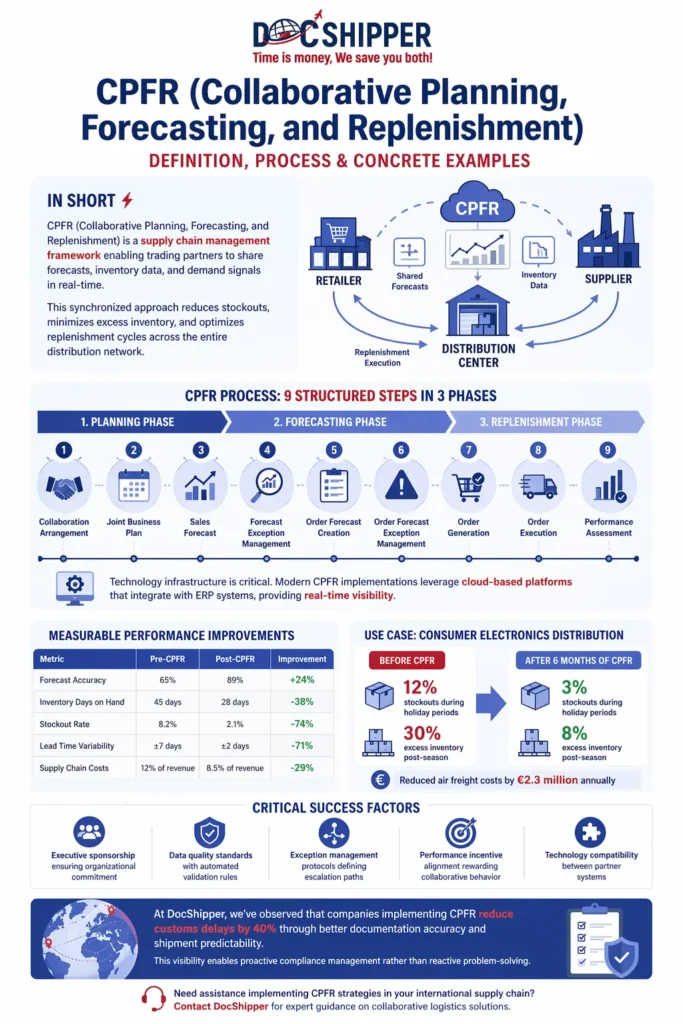
CPFR (Collaborative Planning, Forecasting, and Replenishment) is a supply chain management framework enabling trading partners to share forecasts, inventory data, and demand signals in real-time. This synchronized approach reduces stockouts, minimizes excess inventory, and optimizes replenishment cycles across the entire distribution network.Introduction
Most import-export businesses struggle with the classic dilemma: overstocking ties up capital, while understocking causes revenue loss. Traditional forecasting methods operate in silos, creating misalignment between suppliers, manufacturers, and retailers.
CPFR emerged as a solution to this fragmentation. By synchronizing planning activities across organizational boundaries, companies achieve supply chain visibility that transforms reactive logistics into proactive collaboration.
Key characteristics of CPFR include:
- Shared forecasting models between buyers and suppliers
- Exception-based management focusing on significant variances
- Joint business planning aligning promotional calendars and production schedules
- Automated replenishment triggers based on agreed-upon parameters
- Performance metrics alignment ensuring mutual accountability
CPFR Mechanisms & Strategic Implementation
The CPFR framework operates through nine structured steps grouped into three phases: planning, forecasting, and replenishment. Each phase requires specific data exchanges and decision protocols.
During the planning phase, partners establish collaboration arrangements defining roles, responsibilities, and information-sharing protocols. This includes creating a joint business plan that outlines promotional events, product launches, and seasonal demand patterns. At DocShipper, we help clients structure these agreements to ensure customs compliance and logistics synchronization across borders.
The forecasting phase involves creating and sharing demand forecasts. Partners identify exceptions—significant deviations between forecasts—and resolve them through structured dialogue. Advanced CPFR systems use machine learning algorithms to detect patterns and predict demand fluctuations with greater accuracy than traditional statistical methods.
Replenishment execution translates forecasts into purchase orders and delivery schedules. The system generates order forecasts, which partners review for exceptions before converting them into firm commitments. This process reduces lead times and enables just-in-time inventory management without the traditional risks.
Technology infrastructure is critical. Modern CPFR implementations leverage cloud-based platforms that integrate with ERP systems, providing real-time visibility. According to the GS1 CPFR standards, EDI (Electronic Data Interchange) or API-based integrations ensure data consistency across systems.
Legal considerations include data privacy regulations, particularly when operating across jurisdictions. CPFR agreements must address antitrust concerns, intellectual property protection, and liability for forecast inaccuracies. The framework requires trust but protects it through contractual safeguards.
Concrete Examples & Performance Data
Real-world CPFR implementations demonstrate measurable improvements across supply chain metrics. The following comparative analysis illustrates typical performance gains:
| Metric | Pre-CPFR | Post-CPFR | Improvement |
|---|---|---|---|
| Forecast Accuracy | 65% | 89% | +24% |
| Inventory Days on Hand | 45 days | 28 days | -38% |
| Stockout Rate | 8.2% | 2.1% | -74% |
| Lead Time Variability | ±7 days | ±2 days | -71% |
| Supply Chain Costs | 12% of revenue | 8.5% of revenue | -29% |
Use Case: Consumer Electronics Distribution
A European electronics retailer partnered with Asian manufacturers using CPFR to manage seasonal demand. Before implementation, the retailer faced 12% stockouts during holiday periods and 30% excess inventory post-season. After six months of CPFR collaboration, stockouts dropped to 3%, and excess inventory decreased to 8%. The shared promotional calendar enabled suppliers to pre-position inventory at regional distribution centers, reducing air freight costs by €2.3 million annually.
Critical success factors identified across implementations include:
- Executive sponsorship ensuring organizational commitment
- Data quality standards with automated validation rules
- Exception management protocols defining escalation paths
- Performance incentive alignment rewarding collaborative behavior
- Technology compatibility between partner systems
At DocShipper, we’ve observed that companies implementing CPFR reduce customs delays by 40% through better documentation accuracy and shipment predictability. This visibility enables proactive compliance management rather than reactive problem-solving.
Conclusion
CPFR transforms supply chain management from adversarial negotiations to strategic partnerships. The framework’s structured approach to collaboration delivers measurable improvements in forecast accuracy, inventory efficiency, and customer service levels.
Need assistance implementing CPFR strategies in your international supply chain? Contact DocShipper for expert guidance on collaborative logistics solutions.
📚 Quiz
Test Your Knowledge: CPFR
1. What is the core purpose of CPFR (Collaborative Planning, Forecasting, and Replenishment)?
2. How does CPFR fundamentally differ from Vendor Managed Inventory (VMI)?
3. A European electronics retailer implements CPFR with its Asian suppliers ahead of the holiday season. Which outcome best reflects what CPFR is designed to deliver in this scenario?
🎯 Your Result
📞 Free Quote in 24hFAQ | CPFR (Collaborative Planning, Forecasting, and Replenishment): Definition, Process & Concrete Examples
CPFR involves collaborative forecasting and joint planning, while Vendor Managed Inventory (VMI) typically gives suppliers unilateral control over replenishment decisions. CPFR creates shared accountability through transparent data exchange and exception management.
Most organizations require 6-12 months for full CPFR implementation, including technology integration, process redesign, and partner onboarding. Pilot programs with single partners can demonstrate value within 3-4 months.
Essential components include cloud-based collaboration platforms, EDI or API connectivity, data warehousing capabilities, and analytics tools. Many organizations leverage existing ERP systems with CPFR-specific modules or third-party solutions.
Yes, SMEs can implement scaled CPFR approaches using affordable SaaS platforms. The key is starting with high-volume partners and focusing on critical product categories rather than attempting enterprise-wide deployment immediately.
CPFR uses exception-based management to identify significant forecast variances. Partners collaborate to understand root causes—promotional changes, market shifts, or supply disruptions—and adjust plans accordingly through structured review cycles.
Primary obstacles include organizational resistance to information sharing, incompatible technology systems, lack of executive sponsorship, inadequate data quality, and concerns about competitive intelligence exposure. Successful implementations address these through phased approaches and clear governance.
Standard metrics include Mean Absolute Percentage Error (MAPE), bias measurement, and forecast value-added analysis. Partners typically establish accuracy targets by product category and review performance monthly through joint scorecards.
CPFR is particularly valuable for global operations, reducing lead time uncertainty and customs delays. Cross-border implementations require additional focus on regulatory compliance, currency fluctuations, and time zone coordination for exception resolution.
AI enhances CPFR through predictive analytics, automated exception detection, demand sensing algorithms, and natural language processing for unstructured data analysis. Machine learning models continuously improve forecast accuracy by identifying complex demand patterns.
Protection mechanisms include non-disclosure agreements, data access controls limiting visibility to relevant information only, aggregated data sharing to mask sensitive details, and contractual provisions specifying permitted data usage and retention policies.
Essential metrics include forecast accuracy, in-stock rates, inventory turns, order fill rates, lead time consistency, exception resolution time, and total supply chain costs. Partners should align on measurement methodologies and review cadence.
While CPFR originated in retail replenishment, the collaborative principles apply to project environments. Adaptations focus on milestone-based planning, component-level forecasting, and capacity reservation rather than continuous replenishment cycles.
Need Help with
Logistics or Sourcing ?
First, we secure the right products from the right suppliers at the right price by managing the sourcing process from start to finish. Then, we simplify your shipping experience - from pickup to final delivery - ensuring any product, anywhere, is delivered at highly competitive prices.


Fill the Form
Prefer email? Send us your inquiry, and we’ll get back to you as soon as possible.
Contact us




