


In short ⚡
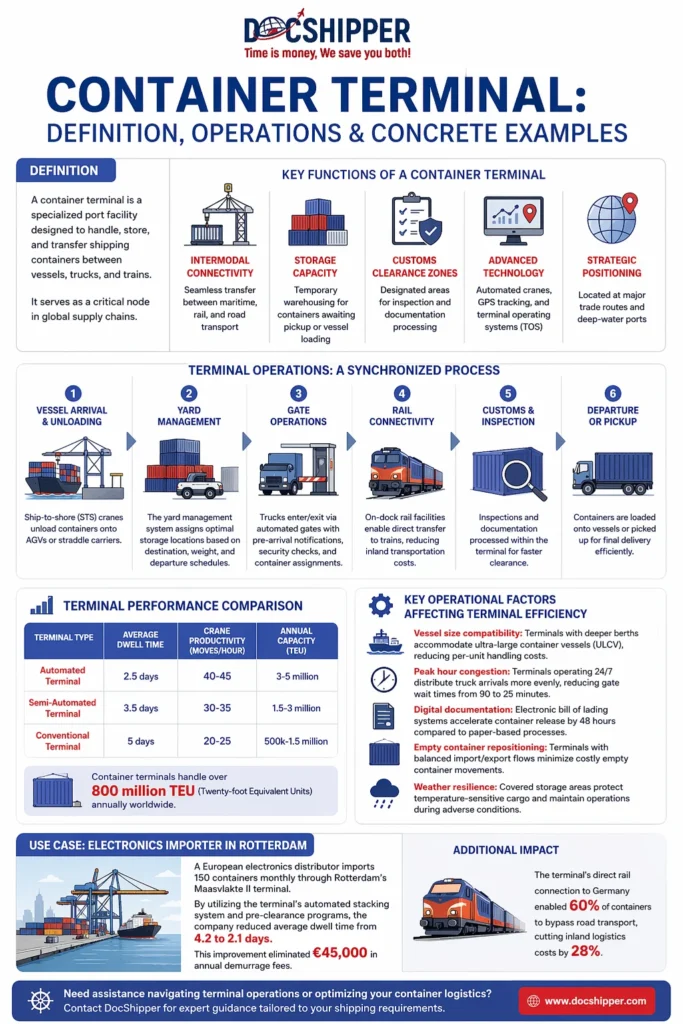
A container terminal is a specialized port facility designed to handle, store, and transfer shipping containers between vessels, trucks, and trains. It serves as a critical node in global supply chains, equipped with cranes, stacking yards, and logistics systems to manage containerized cargo efficiently.
Introduction
Many importers and exporters underestimate the complexity behind container terminals, viewing them simply as “loading docks.” This misconception can lead to costly delays, demurrage charges, and supply chain disruptions.
Container terminals are the backbone of international trade, handling over 800 million TEU (Twenty-foot Equivalent Units) annually worldwide. Understanding their operations is essential for optimizing shipping costs and transit times.
- Intermodal connectivity: Seamless transfer between maritime, rail, and road transport
- Storage capacity: Temporary warehousing for containers awaiting pickup or vessel loading
- Customs clearance zones: Designated areas for inspection and documentation processing
- Advanced technology: Automated cranes, GPS tracking, and terminal operating systems (TOS)
- Strategic positioning: Located at major trade routes and deep-water ports
Terminal Operations & Expertise
Container terminals operate through a synchronized sequence of activities. When a vessel arrives, ship-to-shore (STS) cranes unload containers directly onto automated guided vehicles (AGVs) or straddle carriers. These transport units move containers to designated stacking areas.
The yard management system determines optimal storage locations based on destination, weight, and departure schedules. This prevents unnecessary repositioning and reduces dwell time. Containers destined for immediate pickup are placed near gate exits, while those awaiting vessel loading are positioned for efficient retrieval.
Gate operations manage the flow of trucks entering and exiting the terminal. Pre-arrival notifications and appointment systems minimize congestion. Drivers present documentation, undergo security checks, and receive container assignments through automated kiosks.
For rail connectivity, on-dock rail facilities enable direct container transfer from vessels to trains, eliminating truck drayage. This intermodal capability significantly reduces inland transportation costs, particularly for cargo traveling long distances from ports.
Customs and inspection zones within terminals facilitate regulatory compliance. Containers flagged for examination undergo X-ray scanning or physical inspection without leaving the terminal premises. According to World Customs Organization standards, this integrated approach accelerates clearance processes while maintaining security protocols.
At DocShipper, we coordinate directly with terminal operators to track container movements, anticipate delays, and expedite customs clearance. Our local agents monitor terminal congestion levels and advise clients on optimal pickup windows to avoid demurrage charges.
Concrete Examples & Data
Terminal performance varies significantly based on infrastructure, automation level, and geographic location. The following comparison illustrates key operational metrics:
| Terminal Type | Average Dwell Time | Crane Productivity (moves/hour) | Annual Capacity (TEU) |
|---|---|---|---|
| Automated Terminal | 2.5 days | 40-45 | 3-5 million |
| Semi-Automated Terminal | 3.5 days | 30-35 | 1.5-3 million |
| Conventional Terminal | 5 days | 20-25 | 500k-1.5 million |
Use Case: Electronics Importer in Rotterdam
A European electronics distributor imports 150 containers monthly through Rotterdam’s Maasvlakte II terminal. By utilizing the terminal’s automated stacking system and pre-clearance programs, the company reduced average dwell time from 4.2 to 2.1 days.
This improvement eliminated €45,000 in annual demurrage fees. The terminal’s direct rail connection to Germany enabled 60% of containers to bypass road transport, cutting inland logistics costs by 28%.
Key operational factors affecting terminal efficiency:
- Vessel size compatibility: Terminals with deeper berths accommodate ultra-large container vessels (ULCV), reducing per-unit handling costs
- Peak hour congestion: Terminals operating 24/7 distribute truck arrivals more evenly, reducing gate wait times from 90 to 25 minutes
- Digital documentation: Electronic bill of lading systems accelerate container release by 48 hours compared to paper-based processes
- Empty container repositioning: Terminals with balanced import/export flows minimize costly empty container movements
- Weather resilience: Covered storage areas protect temperature-sensitive cargo and maintain operations during adverse conditions
Conclusion
Container terminals are sophisticated logistics hubs where infrastructure, technology, and coordination determine supply chain efficiency. Selecting the right terminal and understanding its operational characteristics directly impact shipping costs and delivery reliability.
Need assistance navigating terminal operations or optimizing your container logistics? Contact DocShipper for expert guidance tailored to your shipping requirements.
📚 Quiz
Test Your Knowledge: Container Terminal
Q1 — What is the primary purpose of a container terminal?
Q2 — Compared to a conventional terminal, what is a key advantage of a fully automated container terminal?
Q3 — A European importer wants to reduce demurrage fees and inland transport costs for cargo arriving at Rotterdam. Which terminal feature would be MOST beneficial?
🎯 Your Result
📞 Free Quote in 24hFAQ | Container Terminal: Definition, Operations & Concrete Examples
A port is a broader maritime facility that may include multiple terminals handling containers, bulk cargo, and passengers. A container terminal is a specialized section dedicated exclusively to containerized cargo operations.
Free time typically ranges from 3 to 7 days depending on the terminal and shipping line. After this period, daily demurrage charges apply, averaging $75-150 per container per day.
TEU (Twenty-foot Equivalent Unit) is the standard measure for container capacity. A 40-foot container equals 2 TEU. Terminal capacity indicates the maximum annual throughput in TEU the facility can handle efficiently.
Yes, if you have proper documentation (bill of lading, customs clearance, terminal release). You must arrange a truck appointment and pay applicable terminal handling charges before pickup.
Essential documents include original bill of lading, customs clearance certificate, delivery order from the shipping line, terminal gate pass, and valid identification. Requirements vary by country and terminal.
Automated terminals use robotic cranes, AGVs, and AI-powered systems to reduce human error, operate 24/7 without fatigue, and optimize stacking patterns. This increases crane productivity by 30-40% compared to manual operations.
The container yard is the storage area where containers await pickup, loading, or customs inspection. Yards are organized by zones based on container status, destination, and hazardous material classification.
Congestion increases vessel waiting times, extends container dwell periods, and raises demurrage costs. During peak congestion, container retrieval may be delayed by 2-5 days beyond normal processing times.
TOS software manages all terminal activities: vessel planning, yard allocation, gate operations, equipment scheduling, and billing. It optimizes resource utilization and provides real-time visibility of container locations.
Yes, through transshipment operations. Containers are moved between terminals for vessel connections or intermodal transfers. This process adds 1-3 days to transit time and incurs additional handling charges.
Terminals implement ISPS Code standards including perimeter fencing, surveillance cameras, X-ray scanners, radiation detectors, access control systems, and 24/7 security patrols to prevent unauthorized access and cargo tampering.
Consider factors like proximity to final destination, intermodal connectivity, average dwell time, customs efficiency, handling equipment capabilities, and total landed costs including terminal fees and inland transport.
Need Help with
Logistics or Sourcing ?
First, we secure the right products from the right suppliers at the right price by managing the sourcing process from start to finish. Then, we simplify your shipping experience - from pickup to final delivery - ensuring any product, anywhere, is delivered at highly competitive prices.


Fill the Form
Prefer email? Send us your inquiry, and we’ll get back to you as soon as possible.
Contact us




