


In short ⚡
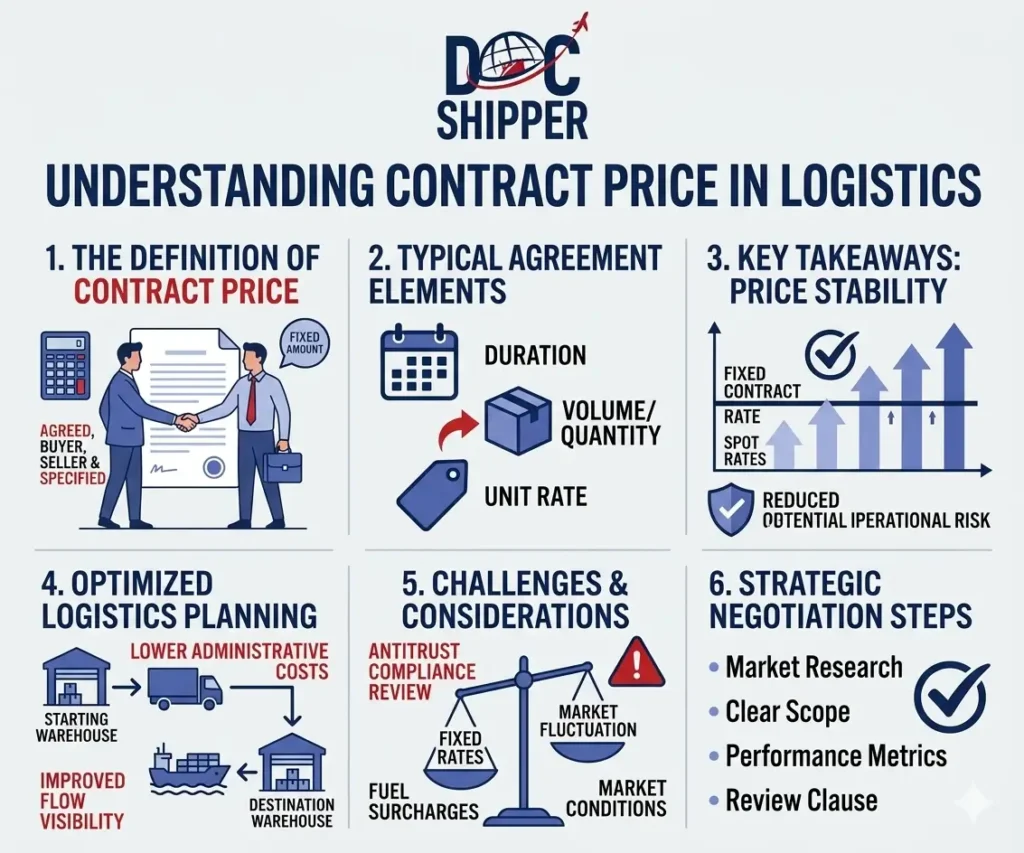
Contract Price is the agreed monetary value specified in a commercial contract between buyer and seller for goods or services. It represents the final transaction amount, including all negotiated terms, conditions, and any applicable adjustments such as discounts, surcharges, or currency fluctuations.
Introduction
One of the most common disputes in international trade stems from misunderstandings about the contract price. What seemed like a straightforward figure on paper can become complicated when currency conversions, payment terms, and Incoterms® enter the equation.
In import/export operations, the contract price serves as the foundation for customs valuation, insurance calculations, and financial planning. A poorly defined contract price can lead to unexpected costs, customs delays, or even legal disputes.
Key characteristics of a properly defined contract price include:
- Currency specification: Clearly stated in a specific currency (USD, EUR, CNY, etc.)
- Payment terms: Linked to Incoterms® that define cost responsibilities
- Adjustment clauses: Provisions for price changes due to market fluctuations or delays
- Customs value alignment: Compatibility with WTO valuation methods
- Documentary evidence: Supported by commercial invoices, purchase orders, and contracts
Contract Price Fundamentals & Legal Framework
The contract price is not merely a number—it’s a legally binding commitment governed by international commercial law. Under the United Nations Convention on Contracts for the International Sale of Goods (CISG), the contract price must be determinable at the time of contract formation or through an agreed mechanism.
Several elements influence how the contract price is established and interpreted:
Incoterms® Integration: The chosen Incoterm directly affects the contract price. An EXW (Ex Works) price excludes all transportation and insurance costs, while a DDP (Delivered Duty Paid) price includes everything up to the buyer’s door. Misalignment between the Incoterm and the stated price is a frequent source of confusion.
Customs Valuation Impact: Customs authorities use the contract price as the primary basis for calculating duties and taxes. According to the WTO Agreement on Customs Valuation, the transaction value (essentially the contract price) must reflect the actual price paid or payable, adjusted for specific elements like royalties, commissions, or assists.
Price Adjustment Mechanisms: Sophisticated contracts include escalation clauses that allow price adjustments based on commodity indices, exchange rate fluctuations, or fuel surcharges. These clauses protect both parties from market volatility but must be clearly documented.
Payment Terms and Financial Instruments: The contract price interacts with payment methods such as Letters of Credit (L/C), Documentary Collections, or Open Account terms. A discrepancy between the L/C amount and the contract price can result in payment rejection by banks.
Currency Risk Management: When the contract price is denominated in a foreign currency, both parties face exchange rate risk. Forward contracts, currency options, or natural hedging strategies can mitigate this exposure.
At DocShipper, we systematically review contract prices against Incoterms®, customs requirements, and payment instruments to ensure complete alignment before shipment. This verification prevents costly delays and disputes at customs clearance.
Calculation Methods & Practical Examples
Understanding how to calculate and adjust the contract price is essential for accurate financial planning and customs compliance. Below are concrete scenarios demonstrating different calculation approaches.
Example 1: Basic Contract Price Calculation (FOB Terms)
| Component | Amount (USD) |
|---|---|
| Product Cost (1,000 units @ $50/unit) | $50,000 |
| Packaging | $2,000 |
| Inland Transport to Port | $1,500 |
| Loading Charges | $500 |
| Contract Price (FOB Shanghai) | $54,000 |
Under FOB terms, the seller’s responsibility ends once goods are loaded on the vessel. The contract price of $54,000 represents the customs value for export declaration in China.
Example 2: Contract Price with Escalation Clause
A manufacturer in Vietnam agrees to supply 5,000 units at a base contract price of $100,000 (CIF Hamburg). The contract includes a fuel surcharge adjustment clause tied to Brent Crude oil prices.
- Base Contract Price: $100,000
- Baseline Oil Price: $80/barrel
- Actual Oil Price at Shipment: $95/barrel
- Surcharge Formula: 0.5% increase per $5 above baseline
- Price Increase: ($95 – $80) / $5 = 3 increments × 0.5% = 1.5%
- Adjusted Contract Price: $100,000 × 1.015 = $101,500
This adjusted figure becomes the declared customs value, and all documentation (commercial invoice, packing list, bill of lading) must reflect this amount.
Example 3: Multi-Currency Contract Price Conversion
A European importer orders machinery from Japan with a contract price of ¥12,000,000 (JPY). The payment is due in 60 days, but customs valuation requires conversion to EUR at the time of importation.
| Scenario | Exchange Rate | EUR Value |
|---|---|---|
| Contract Signing Date | 1 EUR = 155 JPY | €77,419 |
| Customs Declaration Date | 1 EUR = 160 JPY | €75,000 |
| Customs Value Used | €75,000 (rate at import) |
European customs authorities use the exchange rate published by the European Central Bank on the date of acceptance of the customs declaration, not the contract date. This can result in significant variance between the original contract price and the dutiable value.
Key Calculation Principles:
- Transparency: All price components must be itemized in the commercial invoice
- Consistency: The contract price must match across all shipping documents
- Adjustments Documentation: Any price changes require written amendments or supplementary invoices
- Customs Addbacks: Certain costs (royalties, assists, subsequent proceeds) may need to be added to the contract price for customs purposes
- Related Party Transactions: Contracts between affiliated companies face additional scrutiny to ensure arm’s length pricing
DocShipper provides comprehensive contract price analysis as part of our customs brokerage services, ensuring that your declared values withstand customs scrutiny while optimizing duty payments within legal frameworks.
Conclusion
The contract price is far more than a simple transaction figure—it’s the cornerstone of international trade compliance, financial planning, and risk management. Proper definition and documentation of the contract price prevent costly disputes and customs delays.
Need expert guidance on contract pricing, customs valuation, or Incoterms® selection? Contact DocShipper for professional support tailored to your international trade operations.
📚 Quiz
Test Your Knowledge: Contract Price
Q1 — What does the contract price represent in international trade?
Q2 — Under WTO customs valuation rules, must royalties and license fees related to imported goods be added to the contract price?
Q3 — A European importer buys machinery from Japan at ¥12,000,000. The exchange rate at contract signing is 1 EUR = 155 JPY, but at the customs declaration date it is 1 EUR = 160 JPY. Which value do European customs authorities use?
🎯 Your Result
📞 Free Quote in 24hFAQ | Contract Price: Definition, Calculation & Concrete Examples
The contract price is the agreed amount in the sales contract, while the invoice price is the amount billed for a specific shipment. They should match unless adjustments (discounts, surcharges) have been applied and documented.
Yes, but only through a formal amendment or addendum signed by both parties. Verbal agreements are insufficient for customs and legal purposes. Price adjustment clauses must be pre-agreed in the original contract.
Customs duties are calculated as a percentage of the customs value, which is typically based on the contract price (transaction value). A higher contract price results in higher duty payments, making accurate declaration critical.
Customs authorities convert the contract price using official exchange rates published on the date of import declaration. Exchange rate fluctuations can create discrepancies between the contracted amount and the dutiable value.
Yes, the customs value should reflect the actual price paid or payable after all discounts. However, discounts must be legitimate, documented, and applied before importation. Post-importation rebates may require duty refund procedures.
Incoterms® define which party pays for transportation, insurance, and other costs. An EXW price is lower than a DDP price for the same goods because it excludes all logistics costs. The Incoterm must be clearly stated alongside the contract price.
A price escalation clause allows automatic adjustment of the contract price based on predefined indices (fuel costs, commodity prices, exchange rates). It protects both parties from market volatility but must be transparently documented for customs acceptance.
No. Under WTO valuation rules, royalties and license fees related to the imported goods must be added to the contract price for customs valuation, even if paid separately to a third party.
Primary evidence includes the signed commercial contract, pro forma invoice, commercial invoice, purchase order, and payment records. Consistency across all documents is essential to avoid customs challenges.
Transactions between affiliated companies (parent-subsidiary, sister companies) face additional scrutiny. Customs may reject the contract price if it doesn't reflect market value, requiring alternative valuation methods or transfer pricing documentation.
For contracts involving multiple shipments, each shipment's invoice should show the proportional contract price. The total of all invoices must equal the overall contract price, unless amendments have been made.
Yes, under CIF or CIP Incoterms®, the contract price includes cost, insurance, and freight. However, for customs valuation in some countries, these elements may need to be separately identified even when included in a single contract price.
Need Help with
Logistics or Sourcing ?
First, we secure the right products from the right suppliers at the right price by managing the sourcing process from start to finish. Then, we simplify your shipping experience - from pickup to final delivery - ensuring any product, anywhere, is delivered at highly competitive prices.


Fill the Form
Prefer email? Send us your inquiry, and we’ll get back to you as soon as possible.
Contact us




