


In short ⚡
A Control Chart is a statistical tool used to monitor process variation over time, distinguishing between common cause and special cause variations. It displays data points plotted chronologically against calculated control limits to identify when a process becomes unstable, enabling proactive quality management in logistics and manufacturing operations.
Introduction
In international logistics, shipment delays, quality defects, or customs clearance times can appear random. But are they truly unpredictable? Many companies struggle to distinguish normal process fluctuations from genuine problems requiring intervention.
Control charts solve this challenge by providing a visual framework for monitoring operational stability. Originally developed for manufacturing quality control, they’ve become essential tools in freight forwarding, warehouse management, and supply chain optimization.
Key characteristics of control charts include:
- Statistical foundation: Based on probability theory to calculate meaningful thresholds
- Visual clarity: Graphical representation making trends immediately apparent
- Preventive focus: Identifies issues before they escalate into major disruptions
- Continuous monitoring: Tracks performance over time rather than isolated measurements
- Decision support: Provides objective criteria for when to investigate or intervene
Understanding Control Charts: Mechanisms & Applications
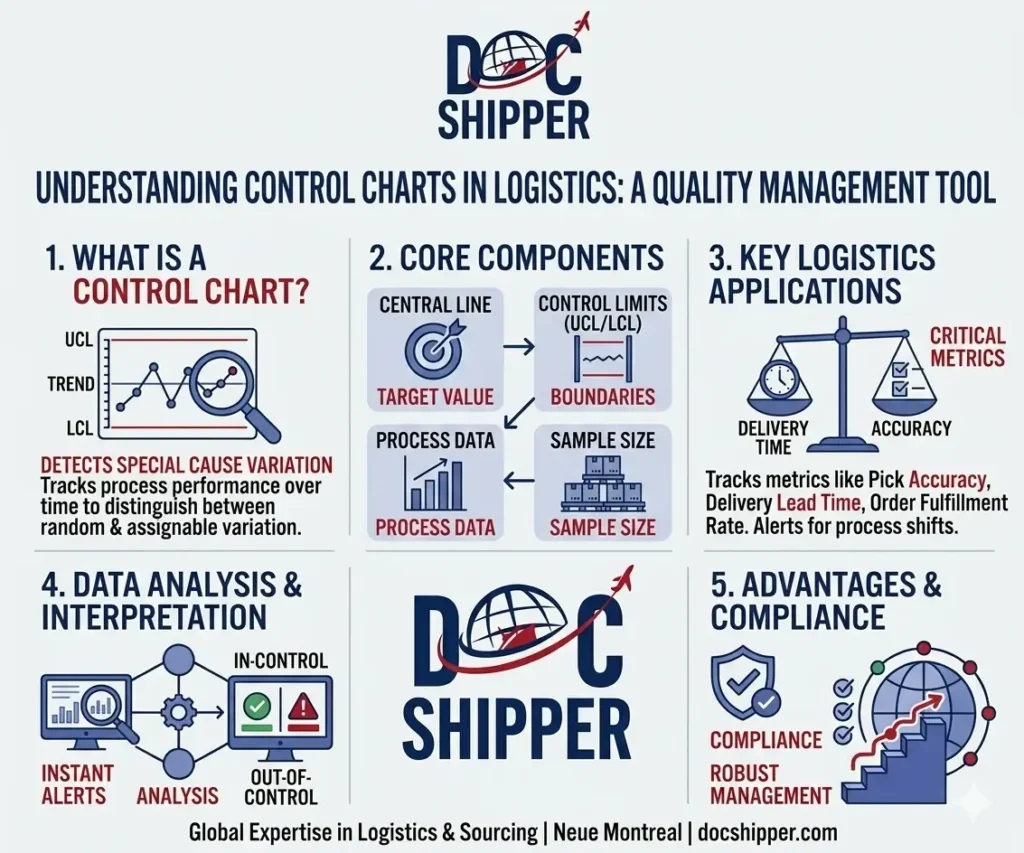
A control chart consists of three fundamental components: a centerline representing the process average, an upper control limit (UCL), and a lower control limit (LCL). These limits are typically set at three standard deviations from the mean, capturing approximately 99.7% of normal variation.
The statistical principle underlying control charts distinguishes between two variation types. Common cause variation represents inherent process fluctuations—predictable randomness within normal parameters. Special cause variation indicates external factors creating abnormal patterns requiring investigation.
Several control chart types serve different data characteristics. Variable charts (X-bar, R-charts) track measurable quantities like delivery times or weights. Attribute charts (p-charts, c-charts) monitor countable defects such as damaged packages or documentation errors. Selection depends on data type and monitoring objectives.
In logistics operations, control charts identify process shifts before customer impact. At DocShipper, we implement control charts to monitor customs clearance durations, ensuring our clients receive consistent service levels across different ports and regulatory environments.
Interpretation follows specific detection rules established by statistical quality control standards. A single point beyond control limits signals immediate investigation. Seven consecutive points on one side of the centerline indicate a process shift. Fourteen alternating points suggest systematic variation. These rules, documented by organizations like the American Society for Quality, provide objective decision criteria.
Implementation requires baseline data collection under stable conditions. Calculate the process mean and standard deviation from historical performance. Establish control limits using appropriate formulas for your chart type. Plot new data points as they occur, applying detection rules systematically. Recalculate limits periodically to reflect process improvements.
Practical Examples & Data Analysis
Consider a freight forwarder monitoring ocean freight transit times from Shanghai to Rotterdam. Historical data shows an average of 32 days with a standard deviation of 2.5 days. The control limits would be:
| Metric | Calculation | Value |
|---|---|---|
| Centerline (CL) | Process Mean | 32 days |
| Upper Control Limit (UCL) | Mean + (3 × SD) | 39.5 days |
| Lower Control Limit (LCL) | Mean – (3 × SD) | 24.5 days |
When three consecutive shipments arrive in 41, 42, and 40 days, the chart signals special cause variation. Investigation reveals port congestion due to labor strikes—actionable intelligence enabling route adjustments or proactive customer communication.
A warehouse operation tracking picking accuracy provides another scenario. Monthly defect rates (incorrect items picked per 1,000 orders) over twelve months yield:
Use Case: Warehouse Quality Monitoring
- Baseline period: 8 months averaging 12 defects per 1,000 picks (standard deviation: 3.2)
- Control limits: UCL = 21.6, LCL = 2.4 defects per 1,000
- Observation: Month 9 shows 7 consecutive points below centerline (5-8 defects range)
- Analysis: New barcode scanning system implemented in month 8 created sustained improvement
- Action: Recalculate control limits with new baseline, document process change
Comparative analysis across service providers demonstrates control chart value. Carrier A shows transit times within control limits but trending upward. Carrier B exhibits random spikes beyond limits. Carrier C maintains tight control with decreasing variation. This data-driven comparison supports strategic vendor selection decisions.
DocShipper applies control charts to customs clearance processing times across multiple jurisdictions. By tracking days from documentation submission to release, we identify regulatory changes, seasonal patterns, and efficiency opportunities. When Singapore clearances show sustained improvement, we analyze procedural differences to replicate success in other markets.
Financial impact quantification strengthens business cases for control chart implementation. A manufacturer reducing delivery time variation from ±5 days to ±2 days decreases safety stock requirements by approximately 30%, directly improving cash flow and warehouse costs. Control charts provide the monitoring framework ensuring sustained performance.
Conclusion
Control charts transform subjective quality assessment into objective process monitoring, enabling logistics professionals to distinguish signal from noise. By implementing these statistical tools, organizations achieve predictable operations, reduced costs, and enhanced customer satisfaction through proactive problem identification.
Need assistance implementing control charts in your logistics operations? Contact DocShipper for expert guidance on supply chain optimization and quality management systems.
📚 Quiz
Test Your Knowledge: Control Chart
Q1 — What is the primary purpose of a Control Chart in logistics operations?
Q2 — A freight forwarder notices that seven consecutive shipment transit times fall on the same side of the centerline, all within the control limits. What does this indicate?
Q3 — A warehouse tracks the percentage of incorrectly picked orders each month. Which control chart type is most appropriate for this data?
🎯 Your Result
📞 Free Quote in 24hFAQ | Control Chart: Definition, Calculation & Practical Examples
Control limits represent statistical process boundaries (what the process actually does), while specification limits define customer requirements (what the process should do). A process can be statistically in control yet fail to meet specifications.
Minimum 20-25 subgroups provide reliable control limit calculations. For logistics applications, collect data over sufficient time to capture normal variation cycles—typically one month minimum for daily operations or one year for seasonal processes.
Absolutely. Logistics, customer service, finance, and administrative processes all benefit from control chart monitoring. Any measurable, repeatable process with variation can be tracked using appropriate chart types.
Investigate immediately to identify the special cause. Document findings, implement corrective action if needed, and determine whether to exclude the outlier from future control limit calculations based on whether the cause is permanent or temporary.
Recalculate when process improvements are implemented, after removing special causes, or when sustained shifts indicate new performance levels. Quarterly reviews work well for stable processes, while rapidly improving operations may require monthly updates.
For on-time delivery percentages, use a p-chart (proportion defective). For actual delivery times in days or hours, use an X-bar and R chart (individual measurements with range). Choice depends on whether you're tracking attributes or variables.
Three standard deviations capture 99.73% of normal variation, balancing sensitivity to real problems against false alarms. This standard minimizes unnecessary investigations while detecting genuine process changes effectively.
Yes, but use individuals charts (I-MR charts) rather than X-bar charts when subgroup sizes are one. These track individual measurements and moving ranges, suitable for infrequent measurements like monthly inventory accuracy audits.
Seasonal patterns create predictable cycles that shouldn't trigger special cause investigations. Either stratify data by season (separate charts for peak/off-peak) or use advanced techniques like seasonally adjusted control limits to account for expected variation.
Excel provides basic functionality for simple charts. Specialized statistical software like Minitab, JMP, or R offers advanced features including automated pattern detection and multiple chart types. Cloud-based quality management platforms integrate control charts with operational data systems.
They provide objective evidence of improvement effectiveness by comparing performance before and after changes. Control charts prevent backsliding by maintaining visibility on process stability and highlight opportunities for further optimization through variation reduction.
Control charts are fundamental Six Sigma tools used in the Measure, Analyze, and Control phases. Six Sigma aims to reduce process variation to 3.4 defects per million opportunities, with control charts providing the ongoing monitoring ensuring sustained capability levels.
Need Help with
Logistics or Sourcing ?
First, we secure the right products from the right suppliers at the right price by managing the sourcing process from start to finish. Then, we simplify your shipping experience - from pickup to final delivery - ensuring any product, anywhere, is delivered at highly competitive prices.


Fill the Form
Prefer email? Send us your inquiry, and we’ll get back to you as soon as possible.
Contact us




