


In short ⚡
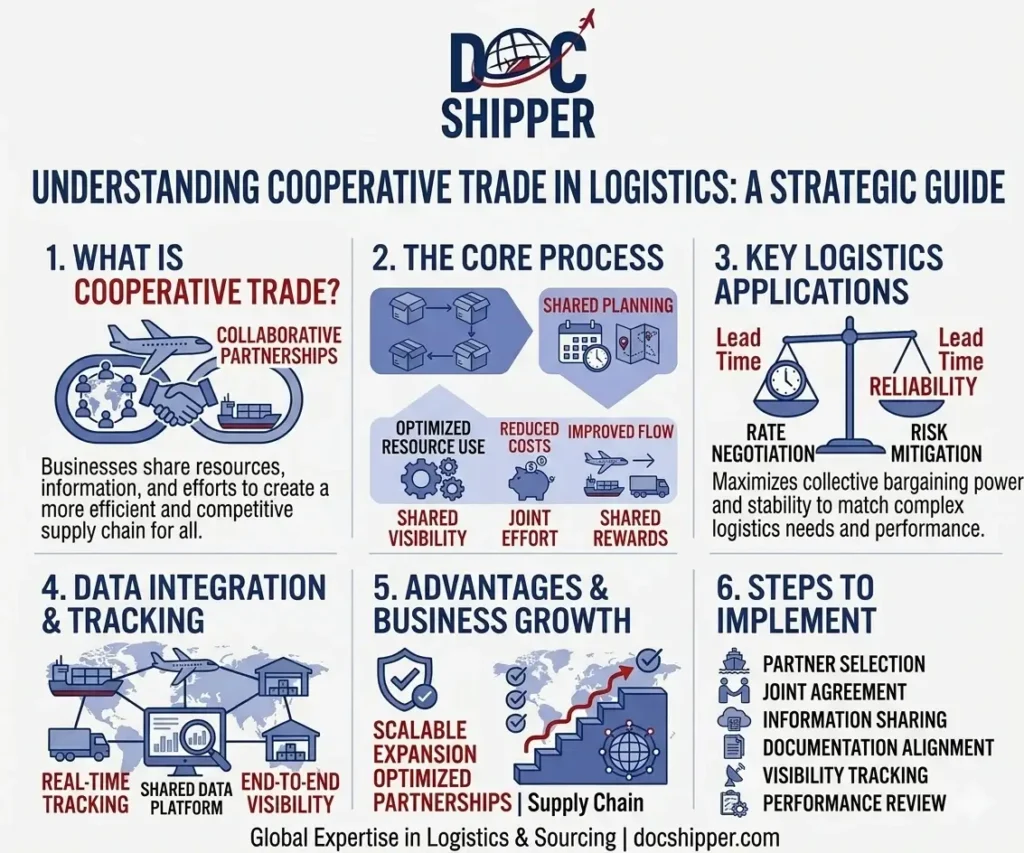
A cooperative is a member-owned business organization where individuals or enterprises pool resources, share risks, and collectively pursue economic benefits. In international logistics, cooperatives facilitate group purchasing, consolidated shipping, and shared warehousing, reducing costs and increasing negotiating power for small and medium-sized importers and exporters.
Introduction
Many small importers struggle with high freight rates and minimum order quantities imposed by carriers and suppliers. Without sufficient volume, negotiating favorable terms becomes nearly impossible.
The cooperative model addresses this challenge by enabling businesses to act collectively in the supply chain. This structure is particularly relevant in international trade, where economies of scale directly impact profitability.
Key characteristics of cooperatives in logistics include:
- Democratic governance: Each member typically has one vote, regardless of capital contribution
- Profit distribution: Surpluses are returned to members based on usage, not investment
- Voluntary membership: Open to all who can use services and accept responsibilities
- Member education: Continuous training on trade compliance and logistics optimization
- Cooperation among cooperatives: Networks that extend purchasing power internationally
Cooperative Mechanisms & Legal Framework
Cooperatives operate under specific legal structures that vary by jurisdiction but share common principles established by the International Cooperative Alliance. Understanding these mechanisms is essential for leveraging cooperative advantages in international logistics.
Purchasing cooperatives aggregate demand from multiple members to negotiate bulk rates with shipping lines, freight forwarders, and customs brokers. This collective bargaining power can reduce freight costs by 15-30% compared to individual negotiations.
Marketing cooperatives consolidate export shipments from multiple producers, enabling access to markets that would be economically unfeasible individually. They handle documentation, quality control, and compliance with destination country regulations.
Service cooperatives provide shared infrastructure such as bonded warehouses, container freight stations, and customs clearance facilities. Members benefit from professional-grade logistics capabilities without capital investment.
Worker cooperatives in freight forwarding and customs brokerage offer specialized services where employees are also owners, often resulting in higher service quality and accountability.
Multi-stakeholder cooperatives bring together importers, exporters, carriers, and service providers to optimize entire trade corridors. These structures are increasingly common in regional trade blocs.
At DocShipper, we regularly work with cooperative structures to streamline documentation and consolidate shipments, ensuring members receive competitive rates while maintaining compliance with international trade regulations.
Practical Examples & Data
Real-world applications demonstrate how cooperatives transform logistics economics for small and medium enterprises in international trade.
Case Study: Agricultural Export Cooperative
A cooperative of 45 organic coffee producers in Colombia consolidates exports to European markets:
- Individual scenario: Each producer would need minimum 10 tons per shipment, requiring $3,200 in freight costs per container
- Cooperative model: Combined volume of 180 tons monthly, negotiated rate of $2,400 per container
- Savings: 25% reduction in per-unit shipping costs, plus shared customs broker fees
- Market access: Ability to fulfill larger orders from European retailers requiring consistent supply
- Quality control: Centralized inspection facility meeting EU organic certification standards
Comparative Analysis: Independent vs. Cooperative Logistics
| Factor | Independent Importer | Cooperative Member |
|---|---|---|
| Ocean Freight Rate | $2,800/TEU | $2,100/TEU |
| Customs Broker Fee | $350/shipment | $180/shipment (shared) |
| Warehousing Cost | $45/pallet/month | $28/pallet/month |
| Insurance Premium | 0.8% of cargo value | 0.5% of cargo value |
| Total Cost Savings | — | 22-28% reduction |
Digital Cooperative Platforms
Technology-enabled cooperatives are emerging in freight forwarding. A European import cooperative uses blockchain-based smart contracts to:
- Automatically allocate container space based on member orders
- Distribute costs transparently according to actual usage
- Track shipments with shared visibility across all members
- Process customs documentation collectively, reducing errors by 40%
- Generate compliance reports for regulatory authorities
According to industry data, cooperatives handling over $50 million in annual trade volume achieve 18-32% lower logistics costs compared to equivalent independent operations, while maintaining comparable or superior service levels.
Conclusion
Cooperatives represent a proven strategy for small and medium enterprises to compete effectively in international trade by leveraging collective resources and shared expertise. The model transforms logistics from a cost burden into a strategic advantage through economies of scale and democratic governance.
Need guidance on joining or establishing a logistics cooperative? Contact DocShipper for expert consultation on collaborative supply chain solutions.
📚 Quizz
Test Your Knowledge: Cooperative
Q1 — What best defines a cooperative in the context of international logistics?
Q2 — A common misconception about cooperatives is that profit is distributed based on how much capital a member invested. What is the correct interpretation?
Q3 — A group of 30 small organic coffee exporters wants to reduce freight costs and access larger European retail buyers. Which approach best fits the cooperative model?
🎯 Your Result
📞 Free Quote in 24hFAQ | Cooperative: Definition, Types & Practical Examples in International Trade
Most jurisdictions require a minimum of 5-7 founding members, though effective logistics cooperatives typically start with 15-20 members to achieve meaningful volume consolidation and risk distribution.
Cooperatives are member-owned with democratic governance and profit-sharing based on usage, while consortiums are typically commercial partnerships between independent companies focused on network expansion rather than collective ownership.
Yes, cooperatives with sufficient volume (typically 500+ TEU annually) can negotiate service contracts directly with carriers, often securing rates 20-35% below published tariffs through volume commitments.
Tax treatment varies by jurisdiction, but many countries offer favorable status for cooperatives. Patronage dividends (profit returns based on usage) may receive different tax treatment than traditional corporate dividends. Consult local tax advisors.
Most cooperatives establish internal arbitration procedures in their bylaws, with escalation to external mediation if needed. Democratic voting structures typically prevent individual member dominance in decision-making.
Many logistics cooperatives employ licensed customs brokers who process clearances on behalf of all members, distributing costs proportionally and ensuring consistent compliance with import regulations.
Cooperatives typically require initial capital contributions and maintain reserve funds to cover defaults. Bylaws specify procedures for member suspension and debt recovery, protecting the collective from individual financial failures.
Yes, multi-stakeholder cooperatives include diverse participants across the supply chain. Clear governance structures ensure balanced representation and prevent conflicts of interest between competing member interests.
Strong cooperatives implement information barriers, sharing only aggregated data necessary for logistics coordination while protecting individual member pricing, supplier relationships, and competitive intelligence through strict confidentiality protocols.
Yes, organizations like the International Cooperative Alliance facilitate connections between national cooperatives, enabling coordinated import-export operations and shared best practices across borders.
Members typically require cargo insurance for their specific goods, while the cooperative maintains general liability coverage for shared facilities and operations. Group insurance policies often provide 15-25% premium savings.
Initial setup takes 6-12 months, but meaningful cost reductions (10-15%) typically emerge within the first year as volume consolidates. Full optimization (20-30% savings) usually requires 18-24 months of operational refinement.
Need Help with
Logistics or Sourcing ?
First, we secure the right products from the right suppliers at the right price by managing the sourcing process from start to finish. Then, we simplify your shipping experience - from pickup to final delivery - ensuring any product, anywhere, is delivered at highly competitive prices.


Fill the Form
Prefer email? Send us your inquiry, and we’ll get back to you as soon as possible.
Contact us




