


In short ⚡
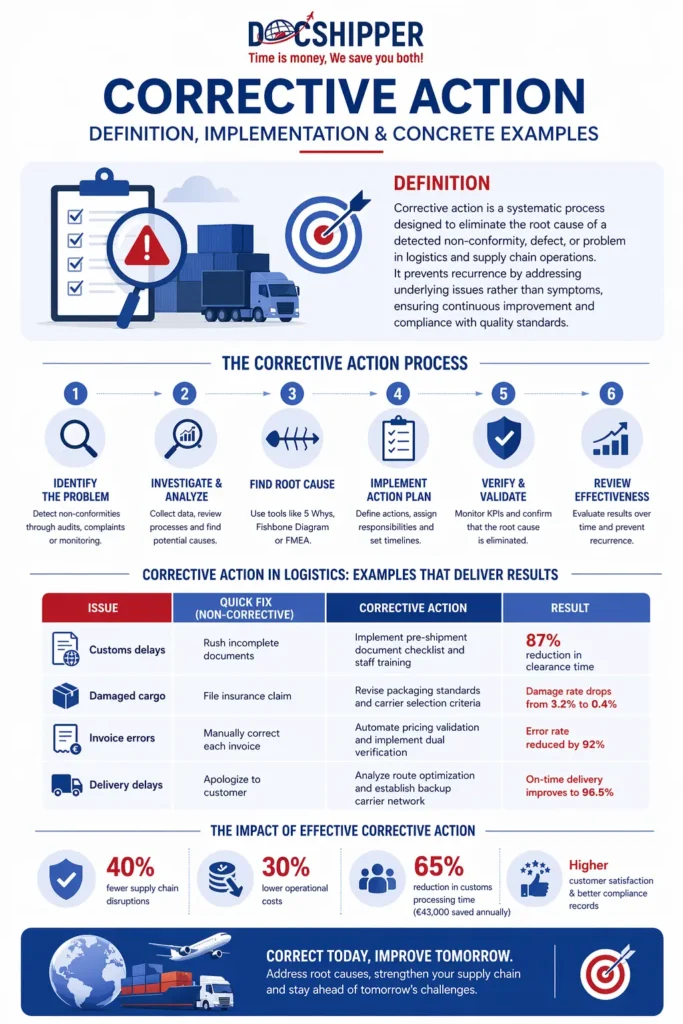
Corrective action is a systematic process designed to eliminate the root cause of a detected non-conformity, defect, or problem in logistics and supply chain operations. It prevents recurrence by addressing underlying issues rather than symptoms, ensuring continuous improvement and compliance with quality standards.
Introduction
In international logistics, a single overlooked defect can cascade into delayed shipments, regulatory penalties, or damaged client relationships. Many companies confuse corrective action with quick fixes, addressing symptoms while ignoring root causes.
Corrective action is essential for maintaining operational excellence in freight forwarding, customs clearance, and supply chain management. It transforms isolated incidents into opportunities for systematic improvement.
- Prevention-focused: Targets root causes, not just immediate problems
- Documentation-driven: Requires thorough investigation and evidence trails
- Compliance-aligned: Meets ISO 9001, ISO 14001, and regulatory requirements
- Continuous improvement: Integrates with CAPA (Corrective and Preventive Action) frameworks
- Cross-functional: Involves multiple departments from operations to quality assurance
In-Depth Analysis & Expert Insights
The corrective action process follows a structured methodology. It begins with problem identification through audits, customer complaints, or internal monitoring. This triggers an investigation phase where teams analyze data, interview personnel, and review documentation.
Root cause analysis employs techniques like the 5 Whys, Fishbone Diagrams, or Failure Mode and Effects Analysis (FMEA). This distinguishes corrective action from superficial fixes. For instance, if a shipment arrives damaged, the root cause might be inadequate packaging specifications rather than carrier mishandling.
Implementation requires action plans with defined responsibilities, timelines, and measurable outcomes. Teams must document every step, creating an audit trail that demonstrates compliance with quality management systems. According to ISO 9001 standards, organizations must retain records proving corrective actions were effective.
Verification and validation confirm that implemented solutions actually eliminate the root cause. This involves monitoring key performance indicators (KPIs) over defined periods. At DocShipper, we integrate corrective action tracking into our quality management system, ensuring clients receive shipments that meet their exact specifications.
The final phase is effectiveness review, conducted weeks or months after implementation. Teams assess whether the problem has recurred and whether additional actions are needed. This closes the loop and feeds data into preventive action strategies.
Concrete Examples & Data
Understanding corrective action becomes clearer through real-world scenarios. Below is a comparative analysis of corrective versus non-corrective responses to common logistics issues:
| Issue | Quick Fix (Non-Corrective) | Corrective Action | Result |
|---|---|---|---|
| Customs delays | Rush incomplete documents | Implement pre-shipment document checklist and staff training | 87% reduction in clearance time |
| Damaged cargo | File insurance claim | Revise packaging standards and carrier selection criteria | Damage rate drops from 3.2% to 0.4% |
| Invoice errors | Manually correct each invoice | Automate pricing validation and implement dual verification | Error rate reduced by 92% |
| Delivery delays | Apologize to customer | Analyze route optimization and establish backup carrier network | On-time delivery improves to 96.5% |
Case Study: A European importer experienced recurring customs holds due to incorrect HS code classification. Instead of simply correcting individual shipments, the corrective action involved:
- Root cause identification: Inadequate product knowledge among classification staff
- Action implemented: Comprehensive training program and automated classification software
- Verification: 90-day monitoring period with zero misclassifications
- Outcome: Customs processing time reduced by 65%, saving €43,000 annually in demurrage fees
- Preventive extension: Created classification database for future product launches
Industry data shows companies with robust corrective action systems experience 40% fewer supply chain disruptions and 30% lower operational costs. These organizations also demonstrate higher customer satisfaction scores and better regulatory compliance records.
Conclusion
Corrective action transforms logistics challenges into systematic improvements, ensuring problems don’t recur. By addressing root causes rather than symptoms, companies build resilient, efficient supply chains that meet evolving quality standards.
Need expert support implementing corrective action processes in your international logistics operations? Contact DocShipper for tailored solutions that enhance your supply chain performance.
📚 Quiz
Test Your Knowledge: Corrective Action
Q1 — What is the primary purpose of a corrective action in logistics and supply chain operations?
Q2 — A shipment repeatedly arrives damaged. A logistics manager files an insurance claim each time. Is this considered a corrective action?
Q3 — A European importer faces recurring customs holds due to incorrect HS code classification. Which response best represents a proper corrective action?
🎯 Your Result
📞 Free Quote in 24hFAQ | Corrective Action: Definition, Implementation & Concrete Examples
Corrective action addresses existing problems and their root causes, while preventive action identifies potential issues before they occur. Both are complementary components of quality management systems.
Timelines vary by complexity. Simple issues may resolve in 1-2 weeks, while systemic problems requiring process redesign can take 3-6 months. Effectiveness reviews typically occur 30-90 days post-implementation.
Responsibility depends on the issue's scope. Quality managers typically coordinate, but implementation involves operations, procurement, and relevant department heads. Clear ownership is essential for success.
Essential documents include non-conformance reports, root cause analysis findings, action plans, implementation evidence, verification results, and effectiveness reviews. ISO standards mandate these records for audit purposes.
Absolutely. Corrective action is critical for addressing classification errors, valuation disputes, or documentation deficiencies. It ensures regulatory compliance and prevents costly penalties or shipment delays.
Common tools include the 5 Whys technique, Ishikawa (Fishbone) diagrams, Pareto analysis, FMEA, and process mapping. The choice depends on problem complexity and available data.
Effectiveness is measured through KPIs like defect recurrence rates, process cycle times, cost savings, customer complaints, and compliance audit results. Metrics should align with the specific problem addressed.
Failed actions trigger re-investigation. Teams reassess the root cause analysis, consider alternative solutions, and may escalate to higher management. The process continues until the issue is resolved permanently.
Yes. ISO 9001 and related standards require documented corrective action processes. Organizations must demonstrate they systematically address non-conformities and continuously improve their management systems.
Corrective action reduces supply chain vulnerabilities by eliminating recurring failure points. It complements risk management by providing structured responses to identified risks and strengthening operational resilience.
Definitely. Corrective action doesn't require extensive resources. Even simple documentation processes and root cause analysis techniques yield significant improvements. Scalability makes it accessible to companies of all sizes.
Quality management software automates tracking, assigns responsibilities, sends reminders, and generates reports. Cloud-based platforms enable real-time collaboration across global teams, improving response times and documentation accuracy.
Need Help with
Logistics or Sourcing ?
First, we secure the right products from the right suppliers at the right price by managing the sourcing process from start to finish. Then, we simplify your shipping experience - from pickup to final delivery - ensuring any product, anywhere, is delivered at highly competitive prices.


Fill the Form
Prefer email? Send us your inquiry, and we’ll get back to you as soon as possible.
Contact us




