


In short ⚡
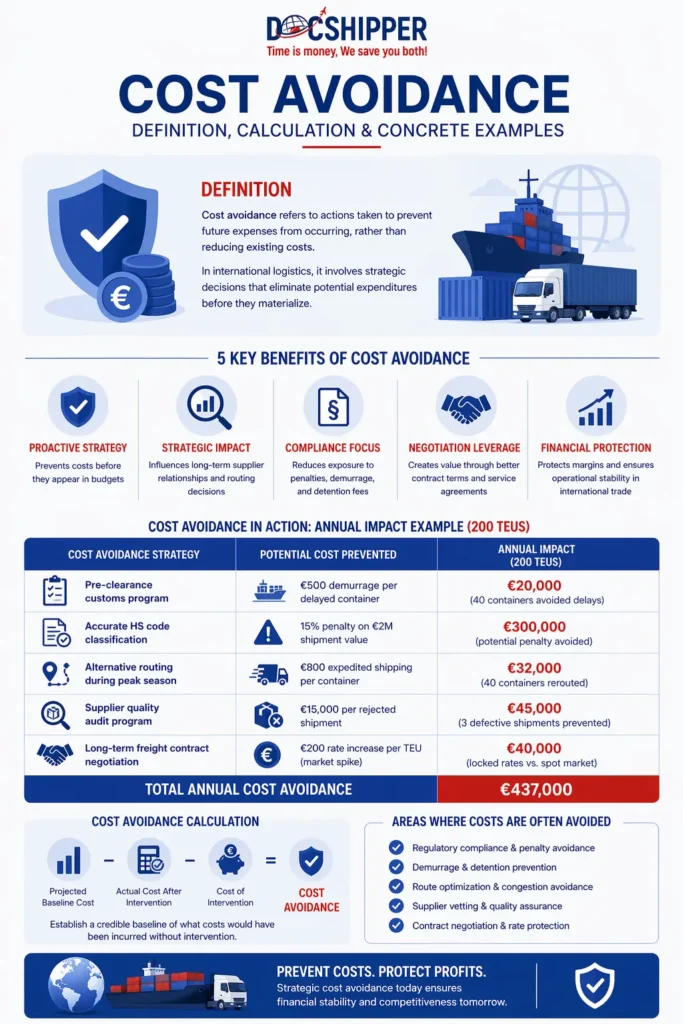
Cost avoidance refers to actions taken to prevent future expenses from occurring, rather than reducing existing costs. In international logistics, it involves strategic decisions that eliminate potential expenditures before they materialize, such as negotiating better freight rates, optimizing routing to avoid demurrage charges, or selecting suppliers that minimize compliance risks.
Introduction
Many logistics managers confuse cost avoidance with cost savings, yet the distinction fundamentally impacts financial reporting and strategic planning. While cost savings reduce current expenditures, cost avoidance prevents expenses that would otherwise occur in the future.
In the complex landscape of international shipping, understanding cost avoidance becomes critical for maintaining competitive margins. Supply chain decisions made today determine whether businesses face unexpected charges, regulatory penalties, or operational inefficiencies tomorrow.
- Proactive strategy: Prevents costs before they appear in budgets
- Difficult to measure: Requires baseline projections of what would have been spent
- Strategic impact: Influences long-term supplier relationships and routing decisions
- Compliance focus: Reduces exposure to penalties, demurrage, and detention fees
- Negotiation leverage: Creates value through better contract terms and service agreements
In-Depth Analysis & Expert Insights
Cost avoidance operates on the principle of opportunity cost prevention. Unlike tangible savings that appear as line-item reductions, avoided costs represent expenses that never materialize due to strategic foresight. This requires establishing a credible baseline of what costs would have been incurred without intervention.
In international trade, regulatory compliance represents a major area for cost avoidance. Misclassified HS codes, incomplete documentation, or failure to meet import requirements can trigger penalties ranging from 5% to 40% of shipment value. Organizations that invest in customs expertise avoid these potential charges entirely. According to EU Customs regulations, proper classification and valuation prevent significant financial exposure.
Demurrage and detention charges constitute another critical avoidance area. When containers remain at ports beyond free time, daily fees accumulate rapidly—often $75-$300 per container per day. Strategic planning around port congestion, pre-clearance procedures, and efficient inland transport prevents these charges from ever appearing.
The concept of route optimization illustrates cost avoidance in action. By analyzing historical data on port delays, customs processing times, and seasonal congestion patterns, logistics managers select routes that avoid predictable bottlenecks. This prevents expedited shipping fees, storage costs, and production delays.
Supplier qualification programs represent a long-term cost avoidance strategy. Vetting suppliers for quality, compliance capabilities, and delivery reliability prevents future costs associated with defective goods, customs holds, or shipment rejections. At DocShipper, we systematically verify supplier credentials and production capabilities to eliminate downstream complications that would otherwise generate unexpected expenses.
Concrete Examples & Data
To illustrate cost avoidance quantitatively, consider a European importer sourcing electronics from Asia with annual container volumes of 200 TEUs.
| Cost Avoidance Strategy | Potential Cost Prevented | Annual Impact (200 TEUs) |
|---|---|---|
| Pre-clearance customs program | €500 demurrage per delayed container | €20,000 (assuming 40 containers avoided delays) |
| Accurate HS code classification | 15% penalty on €2M shipment value | €300,000 (potential penalty avoided) |
| Alternative routing during peak season | €800 expedited shipping per container | €32,000 (40 containers rerouted) |
| Supplier quality audit program | €15,000 per rejected shipment | €45,000 (3 defective shipments prevented) |
| Long-term freight contract negotiation | €200 rate increase per TEU (market spike) | €40,000 (locked rates vs. spot market) |
| Total Annual Cost Avoidance | — | €437,000 |
Use Case: Electronics Importer
A mid-sized electronics distributor importing 50 containers monthly from Shenzhen to Rotterdam implemented a comprehensive cost avoidance program. By investing €25,000 in customs compliance software and pre-clearance procedures, they prevented an average of 8 containers per month from incurring demurrage charges (€500/container/occurrence). Additionally, proper documentation eliminated a projected €120,000 in annual penalty exposure.
The calculation framework for cost avoidance requires establishing a baseline: What would costs have been without the intervention? This involves historical data analysis, industry benchmarks, and scenario modeling. The formula is:
Cost Avoidance = (Projected Baseline Cost) – (Actual Cost After Intervention) – (Cost of Intervention)
Key measurement challenges include proving causality and avoiding double-counting with cost savings initiatives. Organizations must document assumptions clearly and distinguish between one-time avoidances and recurring prevention.
Conclusion
Cost avoidance represents a strategic approach to logistics management that prevents future expenses through proactive planning, compliance diligence, and supplier optimization. While harder to measure than direct cost savings, its impact on long-term profitability and operational stability proves invaluable in international trade.
Need expert guidance on implementing cost avoidance strategies in your supply chain? Contact DocShipper for a customized analysis of your logistics operations.
📚 Quiz
Test Your Knowledge: Cost Avoidance
Q1 — What best defines "cost avoidance" in international logistics?
Q2 — Why is cost avoidance generally harder to justify to stakeholders than cost savings?
Q3 — A European importer invests €25,000 in customs compliance software and prevents 8 containers/month from incurring €500 demurrage charges each. Which formula correctly calculates the annual cost avoidance?
🎯 Your Result
📞 Free Quote in 24hFAQ | Cost Avoidance: Definition, Calculation & Concrete Examples
Cost savings reduce existing expenses, while cost avoidance prevents future costs from occurring. Savings appear as budget reductions; avoidance requires baseline projections to demonstrate value.
Establish a credible baseline of projected costs without intervention, then document actual costs after implementing preventive measures. The difference, minus intervention costs, equals cost avoidance.
Generally, cost avoidance does not appear in standard financial statements as it represents expenses that never occurred. However, it can be tracked internally for performance metrics and strategic decision-making.
Demurrage prevention, customs penalty avoidance, supplier quality programs, route optimization during peak seasons, and long-term freight contract negotiations represent primary opportunities.
Because avoided costs never appear in budgets, proving their value requires hypothetical baseline scenarios. Stakeholders may question assumptions about what would have happened without intervention.
Proper classification, documentation, and regulatory adherence prevent penalties, shipment delays, and seizures. These potential costs are avoided entirely through proactive compliance measures.
Vetting suppliers for quality, compliance capabilities, and reliability prevents future costs from defective goods, production delays, and customs rejections that would otherwise generate unexpected expenses.
Yes. Predictive analytics, customs compliance software, and route optimization tools identify potential cost exposures before they materialize, enabling proactive prevention strategies.
Quarterly reviews align with typical business cycles, though major regulatory changes, market disruptions, or route modifications may warrant immediate reassessment of avoidance strategies.
Historical cost data, industry benchmarks, scenario analyses, intervention records, and clear methodology statements demonstrating the baseline and actual outcomes are essential for credible cost avoidance claims.
Absolutely. Even single shipments benefit from avoiding customs penalties, demurrage charges, or quality issues. The relative impact may be proportionally higher for smaller operations with tighter margins.
Route optimization and efficiency improvements that avoid costs often reduce fuel consumption and emissions. Preventing defective shipments eliminates waste from returns and re-manufacturing, supporting environmental objectives.
Need Help with
Logistics or Sourcing ?
First, we secure the right products from the right suppliers at the right price by managing the sourcing process from start to finish. Then, we simplify your shipping experience - from pickup to final delivery - ensuring any product, anywhere, is delivered at highly competitive prices.


Fill the Form
Prefer email? Send us your inquiry, and we’ll get back to you as soon as possible.
Contact us




