


In short ⚡
Cost of Goods Sold (COGS) represents the direct costs attributable to producing goods sold by a company during a specific period. This includes raw materials, direct labor, and manufacturing overhead directly tied to production. COGS excludes indirect expenses like distribution costs, sales force costs, and marketing expenses, making it a critical metric for calculating gross profit.Introduction
Many businesses struggle to accurately determine their true product costs, leading to pricing errors and profitability miscalculations. Understanding Cost of Goods Sold is fundamental for any company engaged in international trade, manufacturing, or retail operations.
In the context of import/export logistics, COGS becomes even more complex due to customs duties, freight costs, and currency fluctuations. Proper COGS calculation directly impacts your gross margin, tax obligations, and strategic pricing decisions.
- Direct production costs only: COGS includes materials, labor, and overhead directly tied to manufacturing
- Inventory valuation method: FIFO, LIFO, or weighted average significantly affect COGS calculations
- Tax implications: COGS is deductible from revenue, reducing taxable income
- Profitability indicator: Lower COGS relative to sales indicates better operational efficiency
- Supply chain impact: International logistics costs may or may not be included depending on accounting policies
COGS Calculation Methodology & Accounting Standards
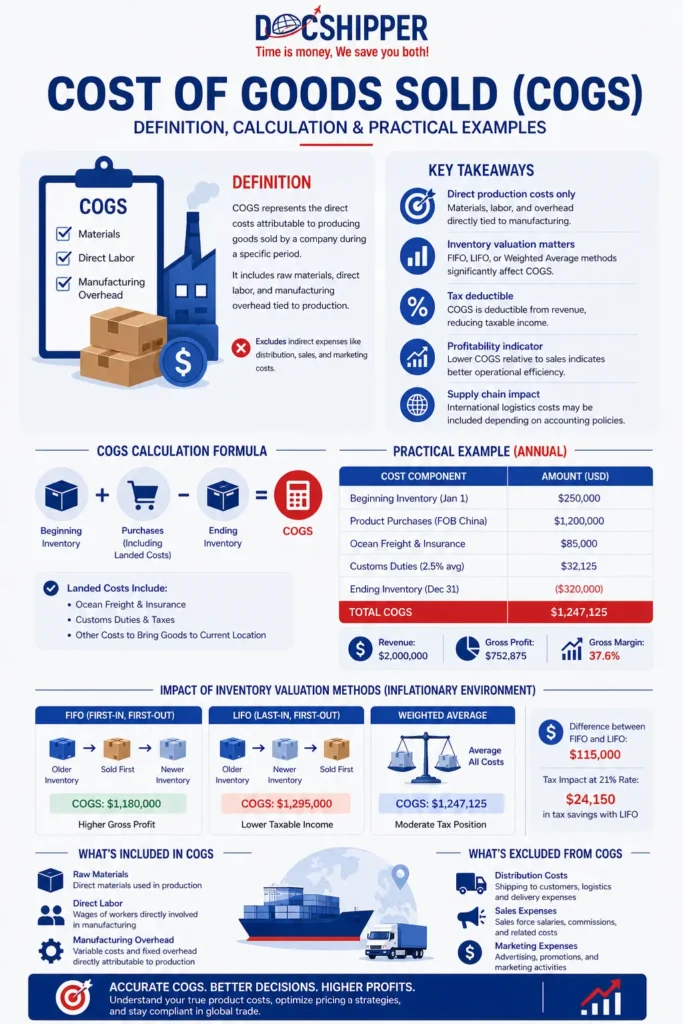
The standard formula for calculating COGS is: Beginning Inventory + Purchases – Ending Inventory = COGS. This seemingly simple equation requires careful consideration of what constitutes “inventory” and “purchases” in international trade contexts.
Under GAAP (Generally Accepted Accounting Principles) and IFRS (International Financial Reporting Standards), COGS must include all costs necessary to bring inventory to its present location and condition. For importers, this typically means including customs duties, freight-in costs, and insurance as part of the landed cost.
The choice of inventory valuation method dramatically affects COGS calculations. FIFO (First-In, First-Out) assumes older inventory sells first, while LIFO (Last-In, First-Out) assumes newer inventory sells first. In inflationary environments, LIFO produces higher COGS and lower profits, while FIFO does the opposite. The weighted average method smooths these fluctuations by averaging all unit costs.
Manufacturing overhead allocation presents another complexity. Only variable manufacturing costs and fixed manufacturing overhead directly attributable to production should be included. Administrative expenses, selling costs, and general overhead remain separate as operating expenses. According to the IRS Publication 538, consistent application of your chosen accounting method is mandatory.
At DocShipper, we help clients properly categorize landed costs to ensure accurate COGS calculation and compliance with international accounting standards, avoiding costly audit issues down the line.
Practical Examples & Industry Data
Let’s examine how COGS works in real-world import scenarios. Consider a U.S. retailer importing electronics from China with the following annual figures:
| Cost Component | Amount (USD) |
|---|---|
| Beginning Inventory (Jan 1) | $250,000 |
| Product Purchases (FOB China) | $1,200,000 |
| Ocean Freight & Insurance | $85,000 |
| Customs Duties (2.5% avg) | $32,125 |
| Ending Inventory (Dec 31) | $320,000 |
| Total COGS | $1,247,125 |
Calculation breakdown: $250,000 (beginning) + $1,200,000 (purchases) + $85,000 (freight) + $32,125 (duties) – $320,000 (ending) = $1,247,125 COGS. If this company generated $2,000,000 in revenue, their gross profit would be $752,875, yielding a 37.6% gross margin.
Industry benchmarks vary significantly. According to CSIMarket data, the retail sector averages a COGS-to-revenue ratio of 65-75%, while manufacturing industries typically see 50-60%. Companies with lower COGS ratios demonstrate better pricing power or operational efficiency.
Consider a comparative scenario using different inventory methods for the same company during an inflationary period where unit costs increased 15% throughout the year:
- FIFO method: COGS = $1,180,000 (selling older, cheaper inventory first) → Higher gross profit
- LIFO method: COGS = $1,295,000 (selling newer, expensive inventory first) → Lower taxable income
- Weighted average: COGS = $1,247,125 (smoothed calculation) → Moderate tax position
The $115,000 difference between FIFO and LIFO directly impacts tax liability. At a 21% corporate tax rate, this represents approximately $24,150 in tax savings with LIFO, though it also shows lower reported profitability to investors.
DocShipper assists clients in structuring their supply chain to optimize COGS reporting while maintaining full compliance with customs regulations and accounting standards across multiple jurisdictions.
Conclusion
Accurate Cost of Goods Sold calculation is essential for profitability analysis, tax compliance, and strategic pricing in international trade. Understanding which costs to include and selecting the appropriate inventory valuation method can significantly impact your financial statements and tax obligations.
Need expert guidance on optimizing your COGS structure for international operations? Contact DocShipper for comprehensive logistics and accounting support tailored to your supply chain.
📚 Quiz
Test Your Knowledge: Cost of Goods Sold (COGS)
Q1 — Which of the following best defines Cost of Goods Sold (COGS)?
Q2 — A U.S. importer switches from FIFO to LIFO during a period of rising prices. What is the most likely impact on their COGS?
Q3 — An electronics retailer imports goods from Asia. Which of the following costs should be included in their COGS calculation?
🎯 Your Result
📞 Free Quote in 24hFAQ | Cost of Goods Sold (COGS): Definition, Calculation & Practical Examples
COGS for imports includes product purchase price, international freight, insurance, customs duties, and any costs necessary to bring inventory to a sellable condition. It excludes domestic distribution, marketing, and sales expenses.
COGS represents direct production or acquisition costs of goods sold, while operating expenses include indirect costs like rent, utilities, administrative salaries, and marketing that aren't directly tied to specific product units.
No. IRS regulations require consistent application of your chosen method (FIFO, LIFO, or weighted average). Changing methods requires formal approval through Form 3115 and may trigger tax adjustments.
Yes. Under both GAAP and IFRS, customs duties are considered part of the landed cost and must be capitalized into inventory value, ultimately flowing through COGS when goods are sold.
Gross profit margin equals (Revenue - COGS) / Revenue. Lower COGS relative to sales produces higher margins, indicating better pricing power, operational efficiency, or favorable sourcing arrangements.
The terms are often used interchangeably, though "cost of sales" sometimes includes service delivery costs for service businesses, while COGS traditionally applies only to tangible goods.
Only warehousing costs directly related to preparing goods for sale (like repackaging or quality inspection) are included. General storage and distribution center operations are typically classified as operating expenses.
Currency movements affect the dollar value of foreign purchases. Companies typically record inventory at the exchange rate on the purchase date, with subsequent fluctuations creating foreign exchange gains or losses separate from COGS.
Industry-dependent, but generally 50-70% is typical. Retail businesses often see 65-75%, while manufacturers may achieve 40-60%. Lower percentages indicate better margin potential and competitive positioning.
Technically no, but inventory write-downs, purchase returns, or accounting corrections can reduce COGS for a period. A sustained negative COGS indicates serious accounting errors requiring immediate correction.
COGS should be calculated at least quarterly for financial reporting, though many businesses track it monthly for better operational visibility. Annual calculation is the minimum for tax purposes.
No. Outbound shipping costs to customers are classified as selling expenses or fulfillment costs, not COGS. Only inbound freight costs that bring inventory to your location are included in COGS.
Need Help with
Logistics or Sourcing ?
First, we secure the right products from the right suppliers at the right price by managing the sourcing process from start to finish. Then, we simplify your shipping experience - from pickup to final delivery - ensuring any product, anywhere, is delivered at highly competitive prices.


Fill the Form
Prefer email? Send us your inquiry, and we’ll get back to you as soon as possible.
Contact us




:%20Definition%20&%20Guide%20for%202026)