



In short ⚡
Crowdsourcing is a business practice where companies outsource specific tasks, ideas, or services to a large external group—typically via online platforms—leveraging collective intelligence, skills, or resources to solve problems, innovate, or reduce operational costs efficiently.Introduction
Many businesses struggle with innovation bottlenecks, limited talent pools, or high R&D costs. Traditional in-house models often cannot match the speed, diversity, or cost-efficiency that external collaboration offers. This is where crowdsourcing becomes strategically essential.
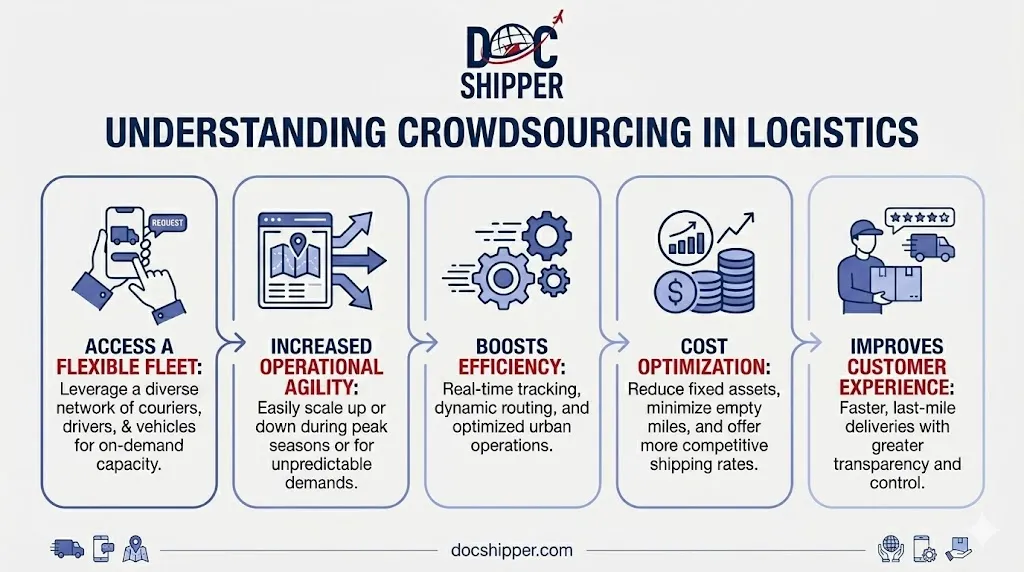
In international logistics and supply chain management, crowdsourcing enables companies to tap into global expertise for route optimization, customs documentation validation, or even real-time shipment tracking through distributed networks. It transforms how organizations access knowledge and execute operations.
Key characteristics of crowdsourcing include:
- Open participation: Tasks are accessible to anyone meeting basic criteria, expanding the talent pool exponentially.
- Digital platforms: Technology facilitates coordination, submission, and evaluation of contributions at scale.
- Flexible compensation: Models range from monetary rewards to recognition, equity, or community benefits.
- Diverse applications: From product design and content creation to data labeling and problem-solving challenges.
- Scalability: Organizations can adjust project scope and contributor volume based on demand and budget.
Crowdsourcing Mechanisms & Strategic Applications
Crowdsourcing operates through several distinct models, each suited to different business objectives. Understanding these frameworks helps companies select the right approach for their logistics or operational challenges.
Crowdwisdom aggregates collective knowledge to make predictions or decisions. Platforms like prediction markets use this to forecast demand fluctuations, shipping delays, or commodity price movements. The European Commission’s Horizon Europe program increasingly supports crowdsourced innovation in sustainable logistics.
Crowdcreation involves contributors generating new content, designs, or solutions. In freight forwarding, companies crowdsource packaging designs that optimize space utilization or reduce damage rates. Contributors submit prototypes, and the best solutions are implemented globally.
Crowdvoting lets the community select preferred options among alternatives. Logistics providers use this to prioritize new service features, route preferences, or sustainability initiatives based on customer and partner input.
Crowdfunding raises capital from many small investors rather than traditional financing. Logistics startups developing innovative tracking technologies or eco-friendly transport solutions often leverage platforms like Kickstarter to validate market interest and secure initial funding.
At DocShipper, we occasionally crowdsource customs documentation reviews through our global partner network, ensuring compliance accuracy across multiple jurisdictions while reducing turnaround time. This distributed validation model catches errors that single-point verification might miss.
Concrete Examples & Industry Data
Real-world applications demonstrate crowdsourcing’s tangible impact across logistics and supply chain operations. The following cases illustrate measurable outcomes and strategic advantages.
| Company | Crowdsourcing Application | Measurable Result |
|---|---|---|
| DHL | Route optimization via driver community input | 12% fuel cost reduction in urban delivery zones |
| Maersk | Container tracking error identification by port workers | 23% improvement in shipment visibility accuracy |
| Amazon | Mechanical Turk for product data validation | Processing 500,000+ SKUs weekly at 40% lower cost |
| UPS | Packaging innovation challenges | 15 patented designs reducing damage claims by 18% |
Case Study: Customs Compliance Validation
A mid-sized electronics importer faced recurring delays due to HS code classification errors. By crowdsourcing verification through a network of 200 certified customs brokers across 15 countries, they achieved:
- Error rate reduction from 8.3% to 1.1% within six months
- Average clearance time decreased from 72 to 38 hours
- Annual savings of €340,000 in demurrage fees and penalties
- Compliance confidence score increased to 97.4%
Industry data shows that 68% of Fortune 500 companies now use some form of crowdsourcing for supply chain innovation, according to recent MIT research. The global crowdsourcing market in logistics is projected to reach $9.2 billion by 2026, growing at 23% annually.
Conclusion
Crowdsourcing represents a fundamental shift in how logistics organizations access expertise, innovate, and optimize operations. By leveraging distributed intelligence and digital platforms, companies achieve cost efficiency, speed, and quality improvements impossible through traditional models alone.
Need guidance on implementing crowdsourcing strategies for your supply chain challenges? Contact DocShipper for expert consultation on optimizing your international logistics operations.
📚 Quiz
Test Your Knowledge: Crowdsourcing
Q1 — Which of the following best defines crowdsourcing?
Q2 — A logistics company wants to forecast shipping demand fluctuations by aggregating insights from drivers, warehouse staff, and managers. Which crowdsourcing model are they using?
Q3 — A mid-sized electronics importer is experiencing recurring customs delays due to HS code classification errors. Which crowdsourcing approach would most effectively reduce their error rate?
🎯 Your Result
📞 Free Quote in 24hFAQ | Crowdsourcing: Definition, Models & Concrete Examples
Outsourcing assigns tasks to specific third-party vendors, while crowdsourcing opens tasks to undefined groups competing or collaborating. Crowdsourcing typically involves more participants, shorter engagements, and performance-based selection rather than contractual obligations.
Quality control mechanisms include peer review systems, expert validation layers, performance scoring, redundant submissions for critical tasks, and AI-assisted verification. Most platforms implement tiered contributor systems where proven performers access higher-value projects.
Yes, especially for specialized tasks like customs documentation review, packaging design, or route optimization. Small businesses pay only for completed work without overhead costs of full-time specialists. Platforms like Upwork or specialized logistics networks offer scalable access.
Key concerns include intellectual property rights, data protection (GDPR compliance for EU operations), contributor classification (employee vs. contractor), and confidentiality agreements. Companies must clearly define ownership terms and ensure contributors sign appropriate NDAs for sensitive information.
Absolutely. Distributed networks of customs experts can validate HS codes, review documentation, and identify regulatory changes across multiple jurisdictions faster than single-source consultants. This reduces error rates and accelerates clearance processes significantly.
Crowdwisdom models excel for freight optimization, aggregating insights from drivers, warehouse staff, and logistics managers to identify inefficiencies. Platforms combining GPS data with contributor feedback generate actionable route improvements and load consolidation opportunities.
Timelines vary by complexity. Simple tasks like data validation can complete within hours. Complex challenges like packaging innovation typically run 4-8 weeks. The key advantage is parallel processing—multiple contributors work simultaneously, compressing total project duration.
Primary risks include confidentiality breaches, inconsistent quality, intellectual property disputes, and dependency on platform availability. Mitigation strategies include robust NDAs, multi-layer verification, clear IP ownership clauses, and maintaining internal capabilities for critical functions.
Yes, platforms like Flexport's network for freight forwarding, Convoy for trucking capacity, and specialized customs broker networks exist. Industry-specific platforms offer pre-vetted contributors with relevant certifications and domain expertise, reducing onboarding time and improving outcome quality.
Modern crowdsourcing platforms offer API integrations with ERP, TMS, and WMS systems. This enables automated task distribution, real-time status tracking, and seamless data flow between crowdsourced activities and core operations without manual intervention.
Hybrid models combining base compensation with performance bonuses yield optimal results. Fixed payments ensure participation, while accuracy bonuses or speed incentives drive quality. Some platforms use reputation systems where top performers access premium projects with higher rates.
Yes, crowdsourcing accelerates sustainable innovation by tapping global expertise on emissions reduction, circular packaging, and green routing algorithms. Community voting on sustainability initiatives also increases stakeholder buy-in and identifies practical implementation strategies faster than traditional consulting approaches.
Need Help with
Logistics or Sourcing ?
First, we secure the right products from the right suppliers at the right price by managing the sourcing process from start to finish. Then, we simplify your shipping experience - from pickup to final delivery - ensuring any product, anywhere, is delivered at highly competitive prices.


Fill the Form
Prefer email? Send us your inquiry, and we’ll get back to you as soon as possible.
Contact us




