


In short ⚡
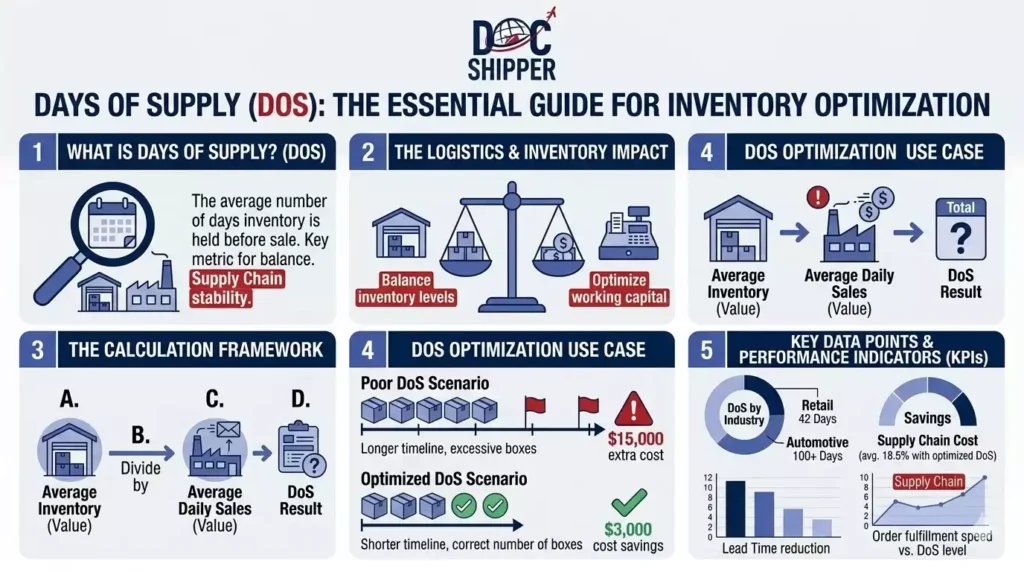
Days of Supply (DOS) is a key inventory metric measuring how many days current stock can sustain demand before depletion. Calculated by dividing on-hand inventory by average daily usage, this KPI helps businesses optimize stock levels, prevent shortages, and reduce holding costs in international supply chains.
Introduction
Many importers struggle with a critical question: “How long will my inventory last?” Overstocking ties up capital and warehouse space, while understocking causes stockouts and lost sales. Days of Supply provides the answer.
In international logistics, where lead times span weeks or months, DOS becomes essential for forecasting reorder points. It bridges inventory planning with demand forecasting, ensuring smooth operations across borders.
Key characteristics of Days of Supply:
- Forward-looking metric – Predicts inventory runway based on current consumption rates
- Universal applicability – Works across industries, from electronics to perishables
- Dynamic calculation – Adjusts automatically as demand patterns shift
- Risk indicator – Flags potential shortages before they impact operations
- Cost optimization tool – Balances holding costs against service levels
Understanding DOS Mechanics & Strategic Importance
Days of Supply operates on a simple premise: divide total available inventory by the rate at which it’s consumed. The result tells you exactly how many days you can operate before needing replenishment.
The calculation foundation requires two inputs: current inventory quantity and average daily demand. Daily demand typically derives from historical sales data, adjusted for seasonality and trends. This metric becomes particularly critical when managing international supply chains where ocean freight may require 30-45 days transit time.
From a compliance perspective, maintaining adequate DOS helps meet contractual obligations with retailers. Many major distributors mandate minimum DOS levels (often 30-60 days) to ensure continuous product availability. According to U.S. International Trade Administration guidelines, proper inventory metrics reduce supply chain disruptions by 40%.
The working capital implications are substantial. Excessive DOS locks cash in inventory, while insufficient levels trigger expedited shipping costs. At DocShipper, we help clients optimize their DOS targets based on product velocity, lead times, and demand variability to strike the right balance.
Advanced applications include safety stock integration. Smart businesses add buffer inventory to their DOS calculation, accounting for demand spikes or supplier delays. This creates a more resilient supply chain capable of absorbing unexpected disruptions without customer impact.
Calculation Methods & Concrete Examples
The standard Days of Supply formula is straightforward:
DOS = (Current Inventory Units) ÷ (Average Daily Sales Units)
Let’s examine three real-world scenarios:
| Scenario | Inventory Units | Daily Sales | DOS Result | Interpretation |
|---|---|---|---|---|
| Electronics Importer | 5,000 | 150 | 33 days | Adequate for 30-day ocean transit |
| Fashion Retailer | 1,200 | 80 | 15 days | Critical – reorder immediately |
| Industrial Parts Distributor | 8,500 | 95 | 89 days | Overstocked – excess holding costs |
Use Case: Seasonal Adjustment
A toy importer holds 10,000 units in September with average daily sales of 200 units (DOS = 50 days). However, November-December sales triple to 600 units daily. Adjusted DOS drops to 16.7 days – insufficient for holiday demand. The solution? Calculate forward-looking DOS using projected seasonal demand rather than historical averages.
Multi-location DOS calculation adds complexity. Consider inventory across three warehouses: 2,000 units (East), 1,500 units (Central), 1,000 units (West). Combined inventory is 4,500 units. If total daily sales equal 300 units, consolidated DOS = 15 days. However, individual warehouse DOS may vary significantly based on regional demand patterns.
At DocShipper, we implement automated DOS monitoring systems that alert clients when inventory drops below predetermined thresholds. This proactive approach prevents stockouts while optimizing cash flow across international operations.
Key optimization strategies:
- Dynamic reorder points – Trigger new orders when DOS reaches lead time + safety buffer
- SKU-level tracking – High-velocity items need lower DOS than slow-movers
- Supplier reliability factor – Increase DOS for unreliable suppliers by 20-30%
- Seasonal multipliers – Adjust baseline DOS before peak demand periods
- Cost-benefit analysis – Balance holding costs against stockout penalties
Conclusion
Days of Supply transforms raw inventory numbers into actionable intelligence, enabling precise forecasting and cost control. Mastering this metric is non-negotiable for competitive international trade operations.
Need expert guidance optimizing your inventory metrics across global supply chains? Contact DocShipper for customized logistics solutions.
📚 Quiz
Test Your Knowledge: Days of Supply
Q1 – What does the Days of Supply (DOS) metric measure?
Q2 – A fashion retailer has 1,200 units in stock and sells 80 units per day. Their DOS is 15 days, but their supplier lead time is 30 days. What should they do?
Q3 – A toy importer calculates a DOS of 50 days in September using average daily sales of 200 units. However, November–December sales are projected to triple. Which approach gives the most accurate DOS for holiday planning?
🎯 Your Result
📞 Free Quote in 24hFAQ | Days of Supply: Definition, Calculation & Practical Examples
Optimal DOS varies by industry and lead times. Most importers target 30-60 days to cover ocean freight transit plus safety buffer. Fast-moving consumer goods may operate at 20-30 days, while industrial parts often maintain 60-90 days.
DOS measures forward-looking inventory duration in days, while turnover calculates backward-looking sales cycles per year. DOS = 365 ÷ Inventory Turnover Ratio. A turnover of 6x annually equals approximately 60 days of supply.
Yes. Comprehensive DOS includes safety stock to account for demand variability and supplier delays. Calculate base DOS separately, then add safety stock days to determine total available supply runway.
Weekly recalculation is standard for most businesses. High-velocity or seasonal products may require daily monitoring. Automated inventory systems can provide real-time DOS updates as sales occur.
Sudden demand spikes, promotional campaigns, supplier delays, or inventory count discrepancies all impact DOS. Implementing demand forecasting tools and regular cycle counts minimizes unexpected fluctuations.
No. Zero inventory means zero DOS. However, negative "days until stockout" can indicate backorder situations where demand exceeds available inventory. This requires immediate replenishment action.
Minimum DOS should equal total lead time (production + transit + customs clearance) plus safety margin. For Asia-US shipments averaging 45 days, maintain at least 60-75 days of supply to prevent stockouts.
Higher DOS increases working capital requirements by tying more cash in inventory. Reducing DOS from 90 to 60 days can free up 33% of inventory investment for other business needs.
Use seasonal demand forecasts rather than annual averages. Calculate separate DOS targets for peak and off-peak periods. Build inventory 2-3 months before seasonal spikes to ensure adequate supply.
Absolutely. High-margin, fast-moving items warrant lower DOS (20-30 days) to maximize turnover. Slow-moving or long-lead-time products may justify 90+ days to avoid expensive air freight emergencies.
Include average customs clearance time in your lead time calculation. For regulated products requiring FDA/EPA approvals, add 5-10 days to standard DOS targets. DocShipper's customs brokerage services minimize these delays.
Modern WMS and ERP systems calculate DOS automatically using real-time inventory and sales data. Cloud-based solutions like NetSuite, SAP, or specialized tools like Cin7 provide dashboard visibility and automated alerts.
Need Help with
Logistics or Sourcing ?
First, we secure the right products from the right suppliers at the right price by managing the sourcing process from start to finish. Then, we simplify your shipping experience - from pickup to final delivery - ensuring any product, anywhere, is delivered at highly competitive prices.


Fill the Form
Prefer email? Send us your inquiry, and we’ll get back to you as soon as possible.
Contact us




