


In short ⚡
Defective Goods Inventory (DGI) refers to the stock of damaged, non-conforming, or faulty products segregated from saleable inventory. This category includes items rejected during quality control, returned by customers, or damaged during transit. Proper DGI management prevents revenue loss, ensures compliance, and optimizes warehouse operations in international trade.Introduction
Every importer faces a critical dilemma: what happens when shipments arrive damaged or fail quality inspections? Mishandling defective goods creates hidden costs through storage fees, compliance violations, and lost customer trust. In global supply chains, where margins are tight and regulations strict, defective goods inventory becomes a strategic concern rather than a simple write-off.
Understanding DGI is essential for maintaining operational efficiency and financial health. Unlike regular inventory, defective goods require specialized handling protocols, segregated storage, and clear documentation trails for customs, insurance claims, and supplier negotiations.
- Segregation requirement: Defective items must be physically separated to prevent accidental shipment
- Financial impact: DGI affects inventory valuation, tax deductions, and insurance claims
- Regulatory compliance: Customs authorities require proper documentation for damaged goods disposal or re-export
- Quality control integration: DGI tracking reveals supplier quality trends and production issues
- Disposition pathways: Options include repair, rework, liquidation, donation, or destruction
DGI Management & Expertise
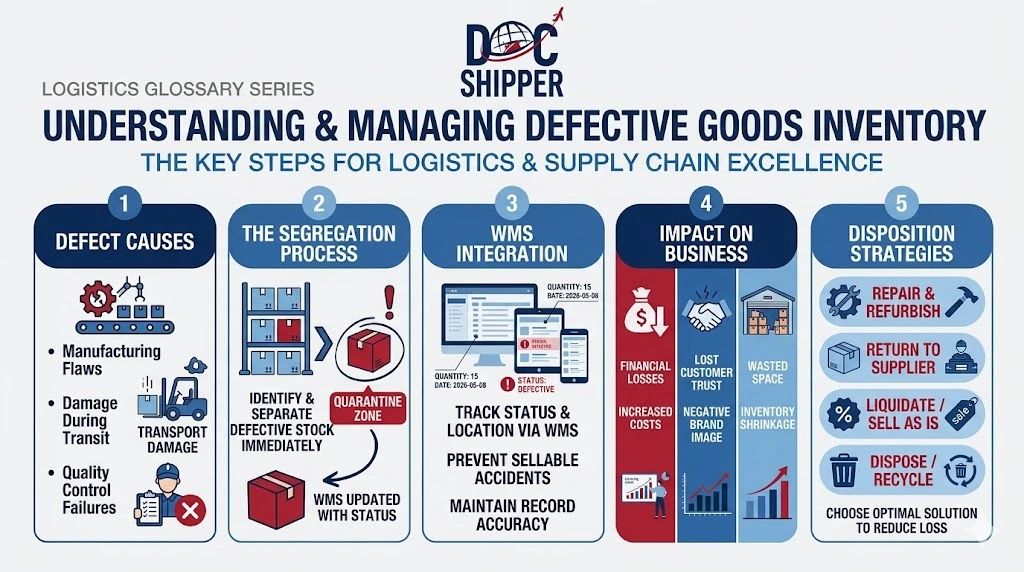
Effective defective goods inventory management begins with immediate identification and documentation. Upon discovery, each item receives a unique defect code linked to its origin—whether from supplier shipment, warehouse damage, or customer return. This traceability enables accurate supplier chargebacks and insurance claims.
The segregation process requires dedicated warehouse zones with restricted access. Mixing defective goods with active inventory creates catastrophic errors: shipping faulty products damages brand reputation, while disposing of saleable items destroys profit. Physical barriers, distinct labeling systems, and WMS (Warehouse Management System) flags prevent cross-contamination.
From a financial accounting perspective, DGI valuation follows specific rules. Generally Accepted Accounting Principles (GAAP) require inventory write-downs to net realizable value. Companies must establish clear policies for when defective goods transition from assets to losses on financial statements. This timing affects quarterly earnings and tax obligations.
Customs and regulatory compliance adds complexity to international DGI scenarios. According to World Customs Organization guidelines, defective imported goods may qualify for duty drawbacks if re-exported or destroyed under customs supervision. Documentation requirements include original commercial invoices, inspection reports, and destruction certificates. At DocShipper, we systematically assist clients in preparing these documents to ensure smooth customs processing and maximum duty recovery.
The disposition decision matrix evaluates five pathways based on defect severity and economic viability. Minor defects may justify repair or rework if costs remain below 40% of product value. Moderate damage suits secondary markets or liquidation channels. Severe defects require destruction, with environmental regulations dictating proper disposal methods. This matrix balances recovery value against handling costs and brand protection.
Practical Examples & Data
Consider a real-world scenario: An electronics importer receives 10,000 units valued at $500,000. Quality inspection reveals 3% defect rate—300 units with various issues. The financial impact cascades through multiple dimensions.
| Defect Category | Quantity | Disposition | Recovery Rate | Net Loss |
|---|---|---|---|---|
| Minor cosmetic damage | 150 units | Liquidation channel | 60% | $3,000 |
| Functional defects (repairable) | 100 units | Repair & resell | 75% | $1,250 |
| Severe damage (non-repairable) | 50 units | Destruction | 0% | $2,500 |
| Total | 300 units | — | — | $6,750 |
This scenario demonstrates how strategic disposition planning minimizes losses. Without proper DGI management, companies often default to full write-offs, losing potential recovery value. Industry data shows that optimized defective goods handling recovers 40-65% of original value compared to 10-20% for ad-hoc approaches.
Case Study: Apparel Importer DGI Optimization
A fashion retailer importing from Southeast Asia reduced DGI losses by 58% through systematic changes. Previously, all defective items went to landfill. The new protocol included:
- Tier-1 defects (5% of DGI): Minor stitching issues resolved through in-house repair team—95% returned to inventory
- Tier-2 defects (60% of DGI): Color variations sold through outlet stores at 70% original price
- Tier-3 defects (35% of DGI): Fabric recycling partnership recovered 15% value through material reclamation
Annual DGI volume: 12,000 units. Previous loss: $180,000. New loss: $75,600. Savings: $104,400 annually. Implementation cost: $28,000 (first year). ROI: 273%.
Key performance indicators for DGI management include defect rate trending (target: <2% for established suppliers), average recovery percentage (benchmark: 50-60%), and disposition cycle time (goal: <30 days from identification to final disposition). These metrics enable continuous improvement and supplier accountability.
Conclusion
Defective goods inventory represents both a challenge and an opportunity in international trade. Strategic management transforms potential losses into recoverable value while maintaining compliance and operational integrity. The difference between reactive disposal and proactive DGI optimization directly impacts your bottom line.
Need expert guidance on managing defective goods in your supply chain? Contact DocShipper for customized solutions that protect your margins and streamline your operations.
📚 Quiz
Test Your Knowledge: Defective Goods Inventory (DGI)
Q1 — Which of the following best defines Defective Goods Inventory (DGI)?
Q2 — A common misconception about DGI is that all defective goods must be fully written off with zero recovery. What does optimized DGI management actually achieve?
Q3 — An electronics importer receives 500 units from overseas. 15 units show minor cosmetic scratches, while 5 units have severe internal damage. Which DGI disposition strategy is most appropriate?
🎯 Your Result
📞 Free Quote in 24hFAQ | Defective Goods Inventory (DGI): Definition, Management & Practical Examples
DGI includes products that fail quality standards, arrive damaged, contain manufacturing defects, or are returned by customers due to non-conformance. It excludes obsolete or slow-moving inventory that meets quality specifications.
Under GAAP and IFRS, defective inventory must be written down to net realizable value—the estimated selling price minus disposal costs. This typically results in significant reductions from original cost basis.
Yes, if defective imported goods are re-exported or destroyed under customs supervision within specific timeframes. Documentation requirements include proof of defect, destruction certificates, and original entry documents.
Industry averages range from 1-3% for established suppliers with robust quality controls. Rates above 5% indicate serious supplier quality issues requiring immediate intervention.
Best practice suggests 30-45 days maximum to minimize storage costs and prevent inventory obsolescence. Longer retention only makes sense when awaiting supplier negotiations or insurance claim resolution.
In many jurisdictions, charitable donations of inventory qualify for tax deductions based on fair market value or cost basis. Requirements include recipient qualification as tax-exempt organization and proper documentation.
Essential WMS capabilities include defect reason coding, segregated location management, automated hold status, disposition workflow tracking, and integration with accounting systems for real-time valuation updates.
Multi-layer controls include physical segregation with restricted access, distinct labeling systems, WMS blocking rules that prevent order allocation, and mandatory scanning verification during picking processes.
Typical requirements include commercial invoice, packing list, bill of lading, inspection report with photos, defect quantification, estimated loss calculation, and proof of mitigation efforts.
Yes, but cost-benefit analysis is critical. Return shipping, customs clearance, and supplier credit terms often make returns economically unviable for low-value items. Negotiate credits or replacement shipments instead.
Regulations vary by product category and jurisdiction. Electronics require e-waste compliance, hazardous materials need certified disposal, and general goods must follow local landfill regulations. Non-compliance carries significant penalties.
B2C operations face higher return rates (8-15% vs. 2-5% B2B) but lower per-unit values. B2B defects often involve larger quantities requiring supplier negotiations, while B2C emphasizes rapid processing to maintain customer satisfaction.
Need Help with
Logistics or Sourcing ?
First, we secure the right products from the right suppliers at the right price by managing the sourcing process from start to finish. Then, we simplify your shipping experience - from pickup to final delivery - ensuring any product, anywhere, is delivered at highly competitive prices.


Fill the Form
Prefer email? Send us your inquiry, and we’ll get back to you as soon as possible.
Contact us




:%20Definition,%20Management%20&%20Practical%20Examples)