


In short ⚡
A Delivery Order (DO) is a legal document issued by a carrier or freight forwarder authorizing the release of cargo to the consignee or their designated agent. This critical shipping document serves as proof of entitlement to collect goods from warehouses, ports, or container terminals, effectively transferring custody from the shipping line to the importer.
Introduction
Importers frequently encounter delays at ports due to confusion between different shipping documents. The Delivery Order is often mistaken for a Bill of Lading, yet it serves an entirely distinct function in the cargo release process.
In international trade, the DO represents the final authorization stage before physical cargo collection. Without this document, terminal operators will refuse to release containers, regardless of payment status or customs clearance completion.
Key characteristics of a Delivery Order include:
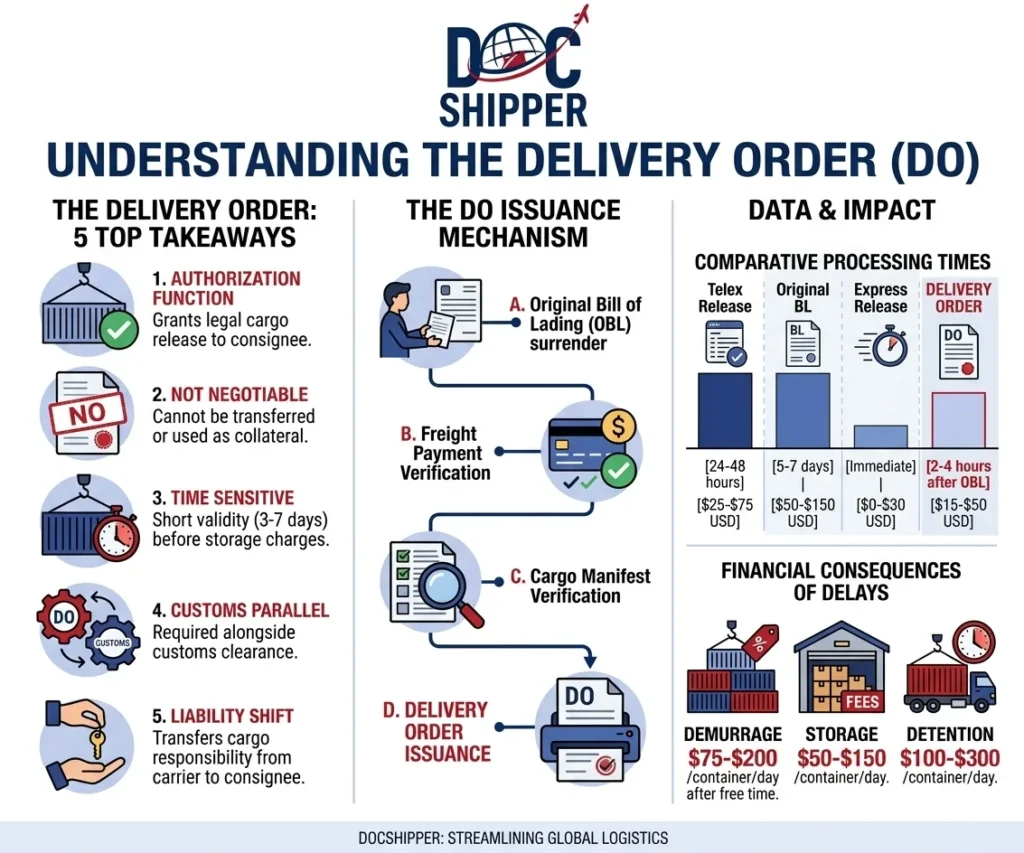
- Authorization function: Grants legal permission to collect cargo from the carrier’s custody
- Surrender requirement: Issued only after the original Bill of Lading is surrendered or telex released
- Time sensitivity: Typically valid for a limited period (3-7 days) before demurrage charges apply
- Non-negotiable nature: Unlike a Bill of Lading, cannot be transferred or used as collateral
- Terminal-specific validity: Only applicable at the designated port or warehouse facility
Understanding the Delivery Order Mechanism
The issuance of a Delivery Order follows a precise procedural chain within maritime logistics. The process begins when the consignee or notify party presents the original Bill of Lading to the shipping line’s local agent or freight forwarder. This surrender confirms that freight charges have been settled and that the rightful cargo owner is claiming the goods.
The carrier’s release protocol involves verification of several critical elements. The shipping line validates that all ocean freight, terminal handling charges, and documentation fees have been paid. They cross-reference the Bill of Lading details against their cargo manifest to confirm the container numbers, seal integrity, and discharge status at the destination port.
Once verification is complete, the carrier issues the DO, which contains essential release information including the container numbers, cargo description, weight specifications, and the authorized consignee details. This document explicitly states the terminal location where cargo can be collected and any special handling instructions.
The legal framework governing Delivery Orders varies by jurisdiction but generally follows principles established in the Hague-Visby Rules and national maritime codes. According to the International Chamber of Commerce (ICC) guidelines, the DO transfers responsibility for cargo from the carrier to the consignee, making it a critical liability transition point. More information can be found in the ICC Incoterms documentation.
The customs clearance relationship is frequently misunderstood. While customs authorities require proof of cargo ownership, the DO itself does not clear goods through customs. It operates in parallel with customs documentation, with both processes necessary before physical cargo release. At DocShipper, we coordinate DO collection simultaneously with customs clearance to minimize port dwell time and avoid unnecessary storage charges.
Terminal operators enforce strict presentation requirements for Delivery Orders. The document must be original (or electronically authenticated), presented by the named consignee or their authorized agent with proper power of attorney, and accompanied by valid identification. Any discrepancies between the DO details and the actual cargo can result in release refusal and additional investigation delays.
Practical Examples & Data
Understanding the Delivery Order process becomes clearer through real-world scenarios and comparative data. The following examples illustrate common situations importers encounter.
Comparative Processing Times by Document Type
| Document Type | Average Processing Time | Cost Range (USD) | Validity Period |
|---|---|---|---|
| Original Bill of Lading | 5-7 days (courier dependent) | $50-$150 | Until surrender |
| Telex Release | 24-48 hours | $25-$75 | Immediate upon issuance |
| Delivery Order | 2-4 hours (after BL surrender) | $15-$50 | 3-7 days |
| Express Release | Immediate (no original BL issued) | $0-$30 | N/A |
Use Case: Electronics Import to Los Angeles
A European electronics manufacturer ships 2 x 40ft containers to Los Angeles containing computer components valued at $280,000. The timeline illustrates the DO’s critical role:
- Day 1: Vessel arrives at Port of Los Angeles; containers discharged to terminal
- Day 2: Importer receives arrival notice from shipping line; customs entry filed
- Day 3: Original Bill of Lading surrendered to carrier’s local office; all freight charges paid ($3,200)
- Day 3 (afternoon): Delivery Order issued electronically; forwarded to customs broker
- Day 4: Customs clearance obtained; DO presented to terminal with equipment interchange receipt
- Day 4 (evening): Containers released and delivered to final warehouse destination
In this scenario, the DO facilitated cargo release within 4 days of vessel arrival, avoiding the $150/day per container demurrage charges that would have applied from Day 5 onwards.
Cost Impact Analysis
Delays in obtaining a Delivery Order create measurable financial consequences:
- Demurrage charges: $75-$200 per container per day after free time expires (typically 3-5 days)
- Storage fees: $50-$150 per container per day at container yards
- Detention charges: $100-$300 per container per day if equipment is held beyond allowed period
- Expedite fees: $200-$500 for rush processing when standard timelines cannot be met
- Opportunity cost: Production delays, missed sales windows, customer penalties
For a single 40ft container delayed 7 days due to DO processing issues, total additional costs can exceed $2,000, not including business disruption impacts. At DocShipper, we maintain direct relationships with major carriers to expedite DO issuance and minimize these avoidable expenses.
Conclusion
The Delivery Order serves as the essential final authorization in the cargo release process, bridging the gap between maritime transport and physical delivery. Understanding its function, requirements, and timing prevents costly delays and ensures smooth import operations.
Need assistance managing your shipping documentation and cargo release procedures? Contact DocShipper for expert support throughout your international logistics operations.
📚 Quiz
Test Your Knowledge: Delivery Order
1. What is the primary function of a Delivery Order (DO) in international shipping?
2. A consignee has completed customs clearance and paid all freight charges. Can the terminal release the cargo without a Delivery Order?
3. An importer receives a telex release from the shipping line. Which statement correctly describes the next step regarding the Delivery Order?
🎯 Your Result
📞 Free Quote in 24hFAQ | Delivery Order: Definition, Process & Practical Examples
A Bill of Lading is a contract of carriage and receipt issued by the carrier at origin, while a Delivery Order is an authorization document issued at destination after the BL is surrendered, permitting cargo collection from the terminal.
No. Terminal operators require a valid Delivery Order as proof of authorization before releasing containers. Without this document, cargo will remain at the terminal regardless of customs clearance status.
Once the original Bill of Lading is surrendered and all charges paid, carriers typically issue a DO within 2-4 hours. Electronic systems can reduce this to minutes, while manual processes may take up to 24 hours.
Expired DOs require reissuance by the carrier, which may involve additional documentation fees ($25-$75). Meanwhile, demurrage and storage charges continue to accumulate, potentially adding hundreds of dollars per day in costs.
Only the named consignee or their authorized agent with proper power of attorney can use a DO to collect cargo. The terminal will verify identification and authorization documents before releasing containers.
Air freight typically uses an Air Waybill and delivery receipt system rather than a separate DO. However, some air cargo terminals may issue similar release authorizations depending on local procedures and carrier policies.
A valid DO must contain the carrier name, vessel and voyage details, container numbers, consignee information, cargo description, terminal location, authorized signatures, and issuance date with validity period.
No. Unlike a negotiable Bill of Lading, a Delivery Order is non-transferable and issued specifically to the named consignee. Any change in receiving party requires carrier approval and reissuance of the document.
Lost DOs require formal notification to the carrier and issuance of a replacement document. This process involves indemnity letters, potential bonds, and reissuance fees ranging from $50-$200, plus delays in cargo collection.
Yes. A telex release eliminates the need for the original Bill of Lading but does not replace the Delivery Order. The carrier still issues a DO (often electronically) as the terminal authorization document after telex release confirmation.
Electronic DOs (eDOs) use digital platforms where carriers issue release authorizations via secure portals or EDI systems. Terminals access these systems directly, eliminating paper handling and reducing processing time to minutes rather than hours.
Carriers require payment of ocean freight, terminal handling charges, documentation fees, Bill of Lading surrender charges, and any applicable demurrage or detention fees before releasing the DO to the consignee or their agent.
Need Help with
Logistics or Sourcing ?
First, we secure the right products from the right suppliers at the right price by managing the sourcing process from start to finish. Then, we simplify your shipping experience - from pickup to final delivery - ensuring any product, anywhere, is delivered at highly competitive prices.


Fill the Form
Prefer email? Send us your inquiry, and we’ll get back to you as soon as possible.
Contact us




